
What are Conversational Insights?
Conversational Insights refers to the systematic, qualitative analysis of human-machine interactions in AI-based systems, such as chatbots and voice assistants. The focus is on understanding user intentions, the depth of users’ questions and the quality of the generated answers. The aim is not only to capture how much communication takes place, but also what is being discussed, where information gaps exist, and how actionable insights for editorial teams, product development and content strategy can be derived from this.
Conversational Insights provide:
- Insights into user questions and answers
- Identification of topic interests and information needs
- Detection of comprehension problems and content gaps
Classification Within Conversational Analytics
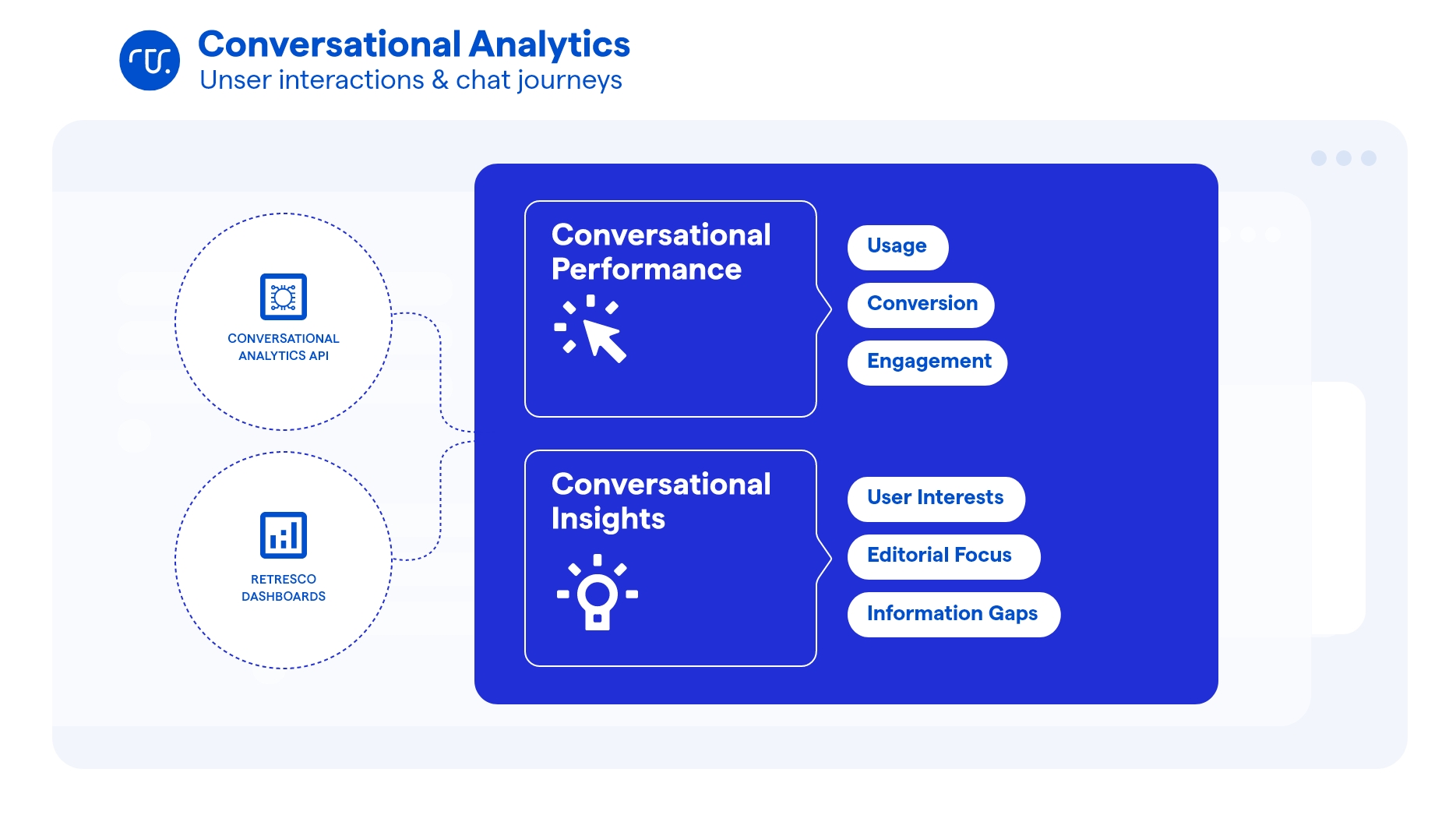
Conversational Analytics refers to the holistic analysis of dialogue systems and combines two complementary perspectives:
- Conversational Performance, quantitative: captures system performance using KPIs such as response time, session duration, bounce rates and goal achievement
- Conversational Insights, qualitative: analyses the content and meaning of dialogues – in other words, what users ask, why they do so and which needs lie behind their questions
While the performance layer measures efficiency and functionality – “How well does the system work?” – insights provide an understanding of the content – “What happens in the dialogue, and why?”
The Importance of Conversational Insights
In an AI-driven media landscape, Conversational Insights act as a direct ear to the market. They make the “voice of the user base” continuously and scalably usable, creating a sound basis for strategic and editorial decisions.
They enable:
- A detailed understanding of user needs and interests
- The identification of trends and shifts in topics
- Data-based prioritisation and management of editorial content
- The identification of information gaps, or “blind spots”
- The optimisation of content offerings based on real user questions
- The improvement of answer quality in AI-based interactive offerings
- The strengthening of trust through transparent, GDPR-compliant content provision
This creates a closed feedback loop between users, editorial teams and AI – precise, adaptive and user-centred.
Core Aspects of Conversational Insights
Conversational Insights provide editorial teams and product managers with data-based insights into user requirements, topic developments and content gaps. The focus is on the following core areas:
1) Automated topic clusters
User questions are algorithmically grouped into dynamic topic clusters that are updated daily. These can be flexibly filtered by publication, desk or specific topics.
Key questions include:
- Which topics are currently relevant?
- What are the latest trends?
- How are interests changing over time?
2) Cluster analyses
Quantitative and temporal analysis of topic clusters:
- Number of questions, total, daily and weekly
- Dynamic relevance assessment
- Development and trends over time
3) Cluster details
Transparent in-depth analyses at cluster level:
- User questions asked and generated answers
- Sources used
- Keyword and topic analyses
- Number of users and interaction density
4) Blind spots, or content gaps
Systematic identification of unanswered or insufficiently covered topics:
- Ratio of answered to unanswered questions
- Topics with a high information deficit in the content offering
- Prioritisation of content needs
5) User intent and contextual understanding
Analysis of the actual goal behind user questions:
- Differentiation between informational and transactional intent
- Assessment of the relevance, depth and comprehensibility of answers
- Contextual classification of user needs
Key Metrics for Conversational Insights
Compared with performance KPIs, which primarily measure efficiency and output, Conversational Insights focus on the added value of content, the quality of answers and the actual information needs of users.
The following metrics are particularly important:
- Knowledge gap rate, or blind spot rate: the proportion of unanswered or insufficiently answered questions within a topic cluster – a direct indicator of knowledge gaps.
- Topic shift: changes in user interests over time, showing which topics are gaining or losing importance.
- Cluster relevance: prioritisation of topic clusters based on question volume, timeliness and strategic relevance.
- Source attribution: frequency and distribution with which specific publisher-owned sources are used to generate answers.
Additional metrics provide an even more granular understanding:
- Question volume per topic cluster: number of questions per topic area as a basis for prioritisation.
- Topic growth, or trend dynamics: development of demand for specific topics over time.
- Diversity of user questions: breadth and variance of questions within a topic cluster.
- Answer coverage: proportion of questions answered fully and satisfactorily.
- Relevance score per cluster: combined score based on demand, timeliness and strategic importance.
- Interaction depth: number and quality of follow-up questions as an indicator of engagement and clarification needs.
These metrics make it possible not only to assess the performance of a chatbot or interactive offering, but also to continuously improve content, the knowledge base and the user experience.
Data Provision and Monitoring
Conversational Insights should be provided through an intuitive, regularly updated dashboard tailored to the needs of editorial and leadership teams. Continuous monitoring makes it possible to respond dynamically to new developments by adapting content and optimising AI-supported prompts in a targeted way.
Current interaction systems offer powerful functions for this purpose, such as overarching dashboards, daily updated topic clusters and API-supported exports for seamless integration into editorial planning and reporting. For more advanced analyses, the insights gained are transferred via API to external editorial dashboards or comparable analytics environments.
Data processing should be designed to comply with GDPR: exclusively aggregated, without personal reference, with anonymised user data and secure storage within the EU.
Retresco and Conversational Insights
Retresco is a specialist in AI-supported content provision and closes the gap between generative AI and editorial control. By integrating Conversational Insights into its chatbot platform, Retresco enables interactive, data-driven content delivery as a robust foundation for modern media work.
User interactions can be systematically analysed in order to derive specific content needs. Based on this, content is provided automatically and precisely along identified topic clusters. At the same time, Retresco supports editorial teams in strategic planning through data-based decision-making foundations.
The platform offers, among other things:
- Automated capture and daily updating of topic clusters
- Blind spot analyses to identify untapped content potential
- Insights into user questions and answer quality
This is complemented by scalable, GDPR-compliant data processing that meets the requirements of European media organisations.
The Strategic Role of Conversational Insights in Retresco’s Rag Systems
In combination with retrieval-augmented generation (RAG) and question-answering systems, Conversational Insights take on a strategic role as a bridge between user needs and knowledge optimisation. They show which content is well covered and where retrieval, sources or answers need to be improved. User questions serve as direct signals for content, product and information needs. This allows offerings in digital commerce, media and journalism to be optimised in a targeted way, while RAG systems can be continuously improved.
Sources and Further Reading
Hiver: Chatbot Analytics 2025 Guide
Reuters Institute: Digital News Report 2025
UK Government: International AI Safety Report 2026 [PDF]