
What is the Model Context Protocol (MCP)?
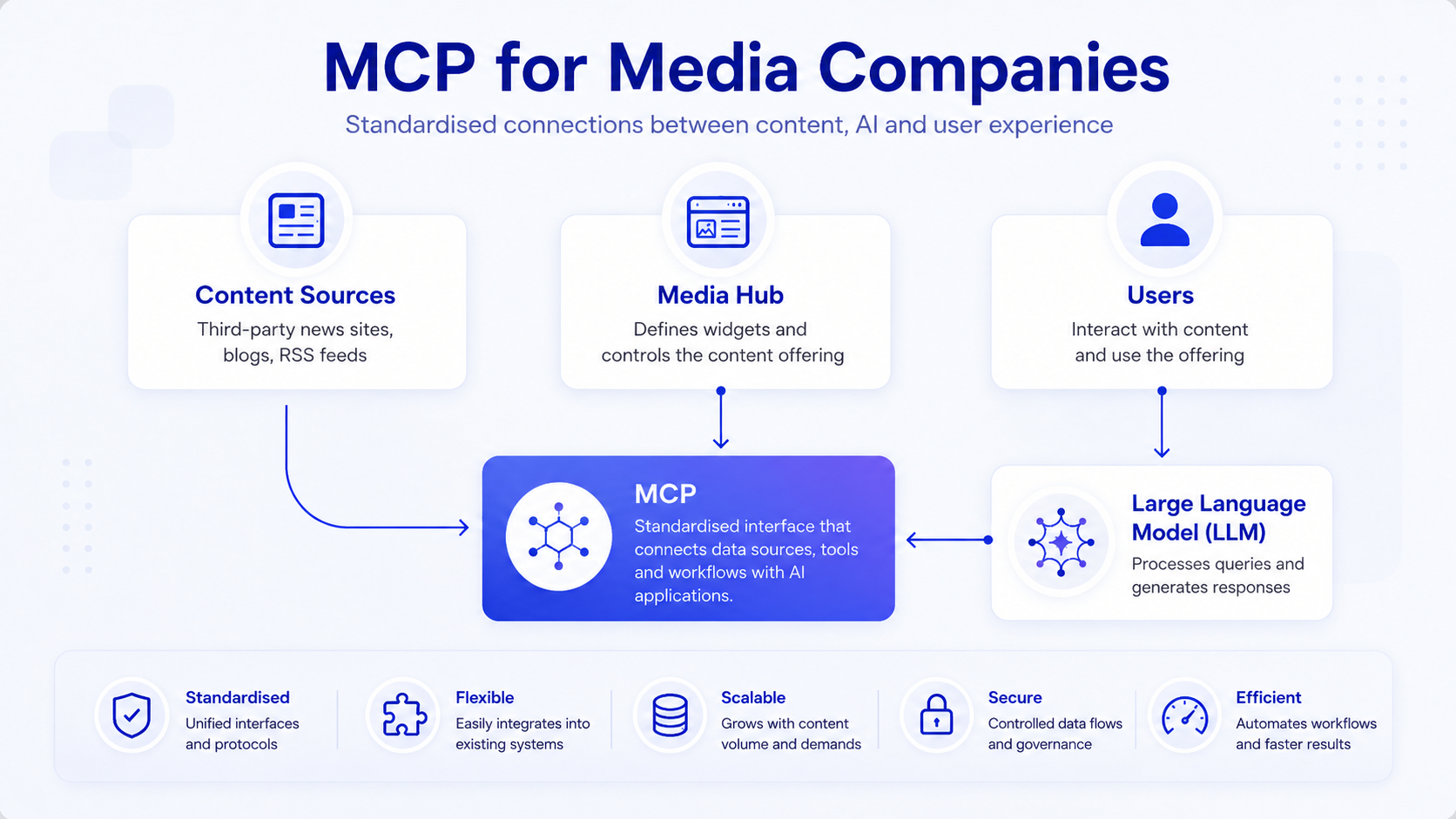
The Model Context Protocol (MCP) is an open standard that enables AI applications to access external data sources, tools and functions in a controlled way. It creates a consistent interface between AI applications and systems such as databases, editorial systems, content archives, search services, analytics tools and internal workflows.
MCP is often described as “USB-C for AI applications”. Just as USB-C standardises the way devices connect to one another, MCP standardises the way AI systems connect to external resources. This means that data sources and tools no longer have to be integrated individually for every AI application. Instead, approved content, functions and interfaces can be made available via MCP.
Importantly, MCP does not simply provide an AI application with additional context. It enables AI tools to interact with external systems in a targeted and traceable way – for example, to retrieve information, check sources, compare data, trigger workflows or return structured results. The MCP specification describes the protocol accordingly as an open standard for integrating AI applications with external systems and tools.
For media organisations and publishers, MCP is particularly relevant because AI chatbots, research assistants and agentic applications need to do more than generate text. They need to access verified content, make sources transparent, respect access rights, check content freshness and follow editorial rules. MCP can provide the technical access layer required for controllable, transparent and editorially robust AI applications.
Why MCP Matters for Media Organisations and Publishers
Many media organisations and publishers are already working with RAG systems, AI chatbots, semantic search and internal assistance systems. RAG, or Retrieval-Augmented Generation, primarily answers the question: which content is relevant to a specific user query? MCP adds another important dimension: which systems, data sources and tools may an AI application use in a controlled way?
This is particularly important in a media environment. AI chatbots and interactive information services are increasingly becoming new interfaces for news, research, service content and information access. Users ask follow-up questions, request explanations of multi-layered topics, summarise content or ask for sources to be assessed. For publishers, this is not only about efficiency gains. It is also about source sovereignty, brand trust, direct user relationships and controlled AI experiences.
MCP addresses one of the main challenges of AI transformation: the fragmentation of proprietary interfaces. Instead of developing individual, high-maintenance API integrations for every editorial system, content archive, image database or news feed, MCP creates a standardised connection layer. This allows content, data sources and tools to be integrated into AI workflows in a structured, secure and traceable way.
In a publishing context, MCP can therefore become a technical foundation for AI-assisted research, editorial assistance systems, chatbots, topic dossiers, source verification, personalisation and agentic workflows. The key point is this: MCP does not replace editorial control. Rather, it provides the technical basis for implementing rights, roles, source logic, freshness checks and quality assurance in a controlled way.
The Three Core Components of MCP
- MCP Host: The overarching AI application, such as an internal research chatbot, an editorial assistant, an AI-supported editorial module or a user-facing chatbot.
- MCP Client: The software component within the host that establishes connections to MCP servers, recognises their capabilities and manages controlled access to data sources and tools.
- MCP Server: A programme that makes selected publisher-owned systems and functions available to AI applications – for example content archives, image databases, paywall metadata, topic dossiers, search services, rights information or external sources such as news feeds.
How MCP, RAG and Agentic AI Differ
The terms MCP, RAG and agentic AI are often used together, but they describe different layers of modern AI architectures.
- MCP is the standardised interface that enables AI applications to access data sources, tools and functions in a controlled way.
- RAG connects AI applications with relevant content from predefined sources. It helps ensure that answers are based on editorial content, article archives, topic dossiers or specialist databases.
- Agentic AI describes AI applications that can carry out tasks across multiple steps: searching, comparing, checking, prioritising, summarising or preparing follow-up actions.
In short: RAG provides the content context, agentic AI organises multi-step processes, and MCP standardises access to systems and tools.
Benefits of MCP for Media Organisations and Publishers
MCP can help media organisations develop AI applications that are scalable, controllable and secure. Instead of connecting every data source and every tool individually to every chatbot or AI assistant, defined capabilities can be made available via MCP. This reduces integration effort and creates a solid technical governance framework.
Key benefits for media organisations and publishers include:
- Controlled access: Only approved content, tools and data sources can be used through the Model Context Protocol.
- Strong traceability: Sources, tool calls and answer logic can be systematically documented through MCP.
- Editorial control: Prioritisation, content freshness, access rights, paywalls and source logic can be mapped more precisely.
- Scalability: A single MCP server can provide capabilities to several different AI applications.
- Distribution logic: Publishers can make their own content and verified external data accessible to AI agents without giving up control.
Added Value for Editorial and Product Teams
The value of the Model Context Protocol lies in connecting AI applications with existing systems, data sources and tools in a controllable way.
- Real-time context for editorial chatbots: Editorial assistants can access live tickers, verified external databases or internal article archives directly via MCP servers to provide up-to-date information.
- Monetisation and rights governance: Publishers can make premium content available to AI agents and users through secure MCP servers. Permissions and rate limiting can be embedded at protocol level.
- Streamlined IT operations: Media organisations can significantly reduce the development effort required for internal AI applications, as existing MCP servers can be reused across different language models and AI systems.
Typical MCP Use Cases for Media and Publishing
In the media and publishing area, the Model Context Protocol is particularly relevant wherever interactive AI applications are involved.
AI Chatbots and Q&A Services
A chatbot can use MCP to access approved article archives, topic pages, dossiers, specialist databases or external data. This makes it possible to generate and present answers with sources, freshness checks and clearly defined editorial boundaries.
Editorial Research Assistants
Journalists can use an AI assistant to search archives, compare sources, check facts, assess previous coverage or generate structured briefings in an interactive way.
Agentic Workflows
An AI agent can perform several steps: search internal content, check external data, weight results, document sources and generate answers and recommendations. MCP standardises the necessary tool and data connections.
Rights, licences and access control
MCP is also relevant for publishers if content is made available not only through websites, apps, search engines or AI search interfaces, but also through AI agents, chatbots and AI interfaces. In such scenarios, MCP can act as a controllable interface between agentic AI and publisher systems, helping to connect licensing models, identity and rights management, access control, audit trails and usage-based remuneration.
Internal Product and Editorial Systems
MCP can help make editorial systems, search, topic management, knowledge graphs, analytics, personalisation and content automation available as controlled capabilities for AI applications.
Challenges for Media Organisations and Publishers
The flexibility of MCP also creates new requirements for IT security, governance and editorial control. This is especially true wherever AI applications can access sensitive publisher data, user accounts, internal systems or protected content.
MCP does not automatically solve these issues. The more applications are allowed to access tools, data sources and systems through standardised interfaces, the more important clear security architectures, rights management, monitoring and binding editorial rules become. The MCP specification itself also points to questions of security and trust, as the protocol opens up far-reaching possibilities for data access and tool usage.
For media organisations, this means that MCP should not be understood as a purely technical integration. It should be treated as a controllable framework for the use of AI applications. Clear rules are needed for sources, roles, rights, content freshness, domain expertise, tone of voice, transparency and quality assurance.
MCP and Retresco
For media organisations and publishers, MCP is particularly interesting as a building block for the next generation of AI chatbots, RAG applications and agentic editorial workflows. The real value does not come from the protocol alone, but from the combination of verified content, semantic search, editorial control, source logic, rights concepts and analytics.
A meaningful starting point is therefore a clearly defined use case: for example, a chatbot that serves as a local information hub, a research assistant, access to a specialist database, a topic dossier or a tool for updating existing content. Only after this should data sources, rights and answer logic be defined through MCP.
Sources and Further Reading
Anthropic Blog: Introducing the Model Context Protocol
Model Context Protocol Specification – Anthropic, Version 2025-11-25
Digiday: WTF is Model Context Protocol, and why should publishers care?
Enonic: MCPs allow AI to Perform Editorial Actions Directly in the CMS
Model Context Protocol (MCP): Landscape, Security Threats, and Future Research Direction [PDF]
ACE-Router: Generalizing History-Aware Routing from MCP Tools to the Agent Web [PDF]