Blog
AI as Information Infrastructure and What the Reuters Report Means for Publishers

Nadine Jakob
Marketing Manager, Retresco
Reading a news story, understanding its background and asking what it means for everyday life: generative AI is bringing these activities closer together.
For news organisations and publishers, this creates new ways to make their journalism accessible. An article can become the starting point for a conversation, an archive becomes a research assistant, and local expertise an interactive service.

The new Generative AI and News Report 2026: From standalone tools to information infrastructure, published by the Reuters Institute for the Study of Journalism at the University of Oxford, examines how AI is becoming part of everyday information use. For publishers, it raises a strategic question: how can they make their journalism available in this changing environment while keeping its quality visible and delivering practical value to audiences?
The findings offer starting points for audience products and for generative AI in newsrooms. They also show why growing AI adoption alone does not establish a viable business case.
AI as Information Infrastructure Is Becoming an Everyday Reality
Across the six countries surveyed consistently since 2024, weekly use of generative AI rose from 18% to 51%. Daily use increased from 7% to 28% over the same period. The shift is even clearer when looking at information seeking: 11% used generative AI for this purpose each week in 2024, compared with 38% in 2026.
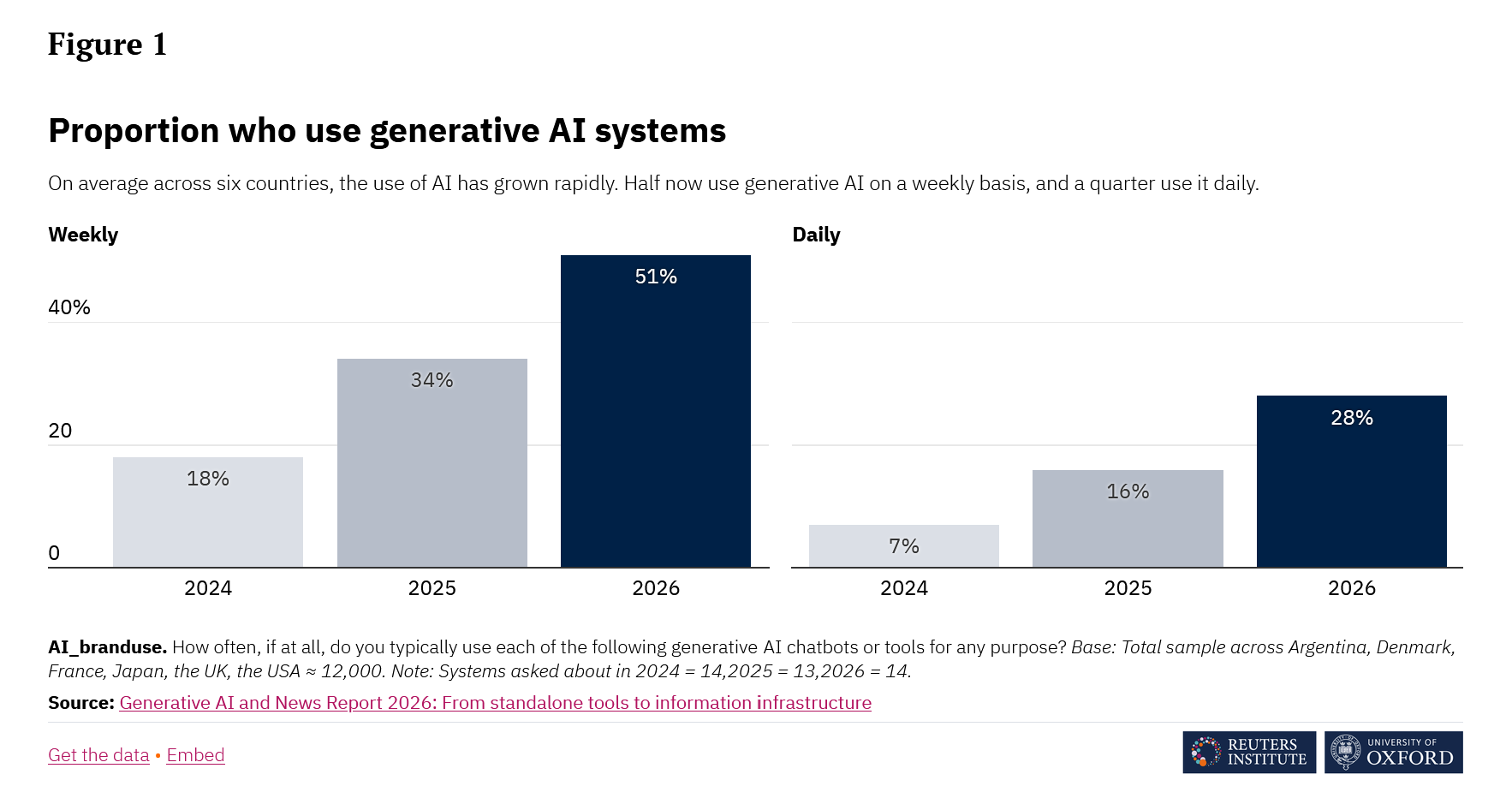
Generative AI is becoming part of everyday life, with more people using it regularly and increasingly daily (Reuters Institute)
AI as information infrastructure introduces another layer between a question and the content that can answer it. This layer retrieves information, brings it together, generates answers and supports follow-up questions. For audiences, it changes how they access knowledge. For publishers, the strategic issue is the role their content, brands and own services will play within it.
However, AI as a news source remains a relatively small, albeit growing, use case. In the six countries with comparable data, 9% use generative AI for news each week; across all nine countries surveyed, the figure is 8%. Widespread AI adoption should therefore not be equated with equally widespread demand for AI news products.
From Retresco’s perspective, the opportunity lies in meeting specific information needs more effectively: making a complex topic understandable, answering a local question or helping users find relevant specialist information within a large collection.
AI News Chatbots Turn Follow-up Questions Into a Product Opportunity
What people do with AI in a news context is particularly revealing. Among AI news users in the six comparison countries, 49% ask follow-up questions about a story. This is the most common use case surveyed, ahead of getting the latest news at 46%. A further 38% use AI to summarise news and 35% to explain it more simply.
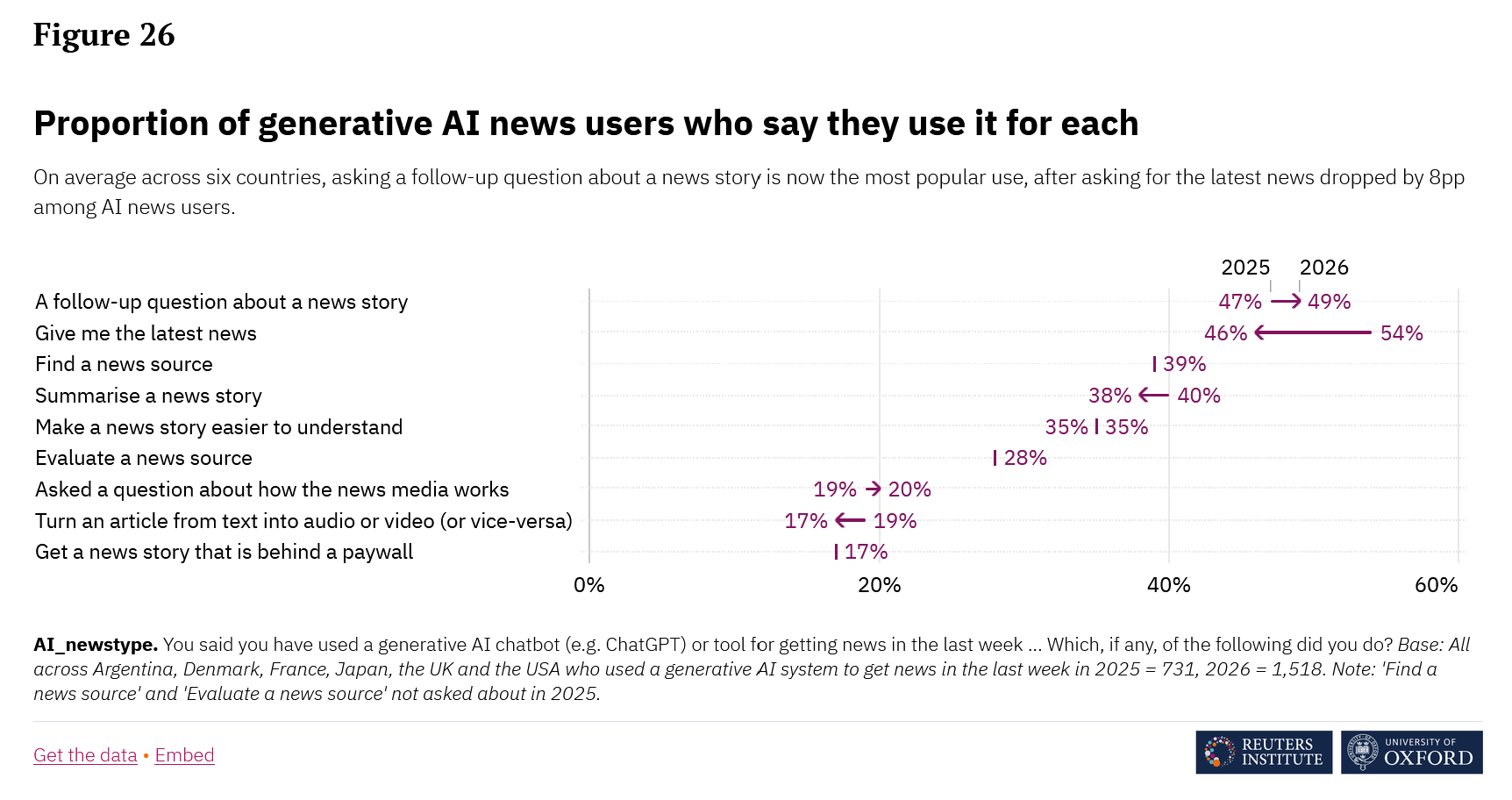
Generative AI makes news interactive, enabling users to ask follow-up questions and deepen their understanding (Reuters Institute)
For news organisations, this points to a clear product opportunity. Readers’ information needs often extend beyond the final paragraph of an article. They want to understand how a decision was reached, which arguments support or challenge it, and what it means for their community.
AI news chatbots can address these follow-up questions alongside the journalism itself. An article about transport reform could invite readers to ask, ‘Which changes affect my neighbourhood?’ A collection of reporting on energy supply could answer questions about costs, responsibilities or developments over time.
To do this well, a service needs to understand the article’s context and retrieve relevant additional sources. Sample questions tailored to the content can help readers get started. As the conversation develops, the assistant should take earlier questions into account and ask for clarification when needed. A single article can then provide a route into a publisher’s wider editorial knowledge.
Convenience Attracts Users and Quality Gives Them a Reason to Return
Why do people turn to AI for information? The report identifies two leading motivations: 64% cite faster and easier answers, while 56% value the ability to interact. By contrast, 21% say they use AI because it provides more reliable information than other sources.
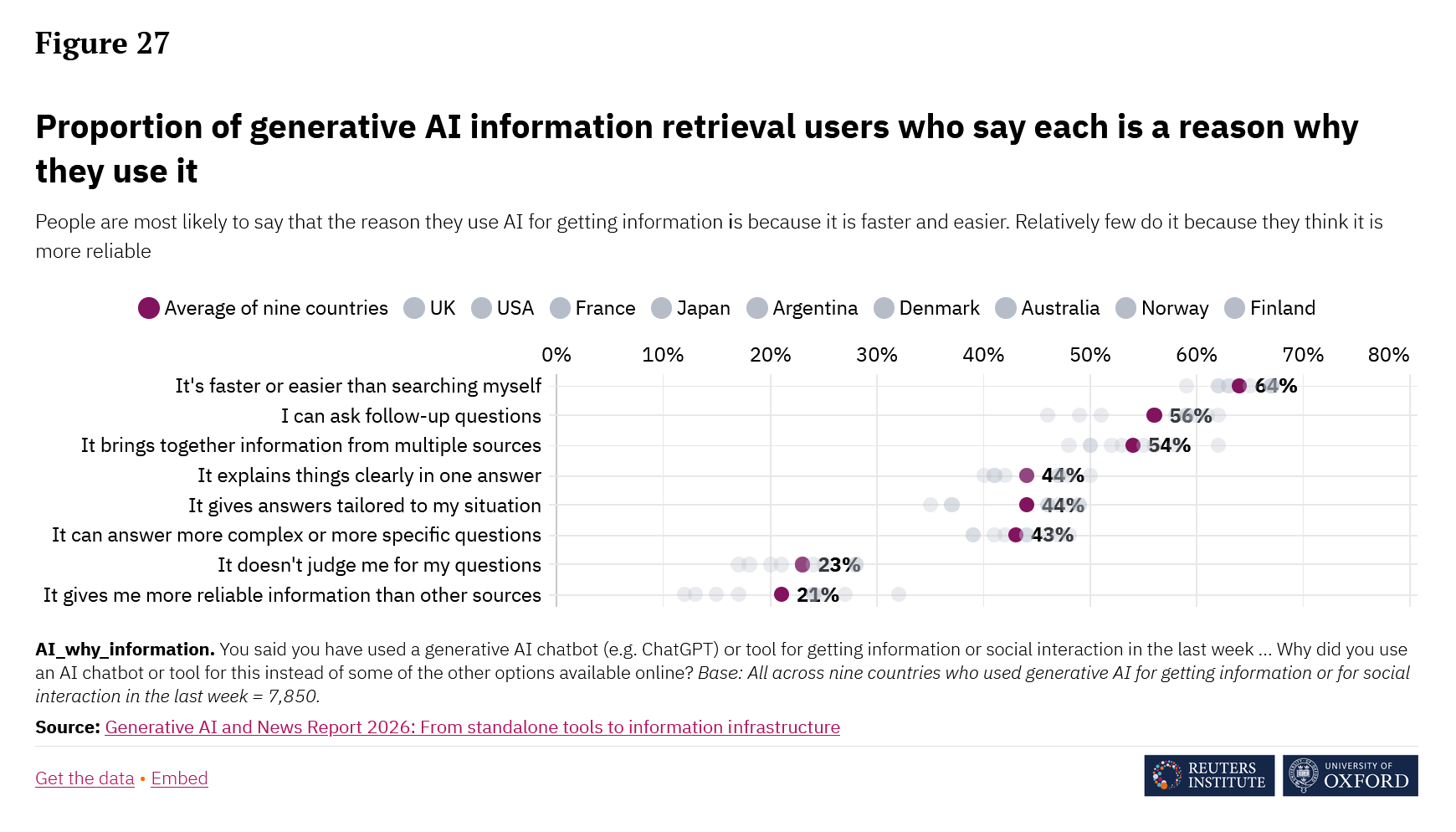
Fast answers, easy access and follow-ups make AI attractive for information seeking (Reuters Institute)
For publishers, editorial quality needs to translate into an immediate benefit. A service should get to the point quickly, answer clearly and help users move forward. Requiring a lengthy explanation of how an AI assistant works before it delivers a useful answer creates unnecessary friction.
Product development should therefore start with the questions audiences actually ask. What information do they seek regularly? Where do they currently need to read several articles or combine multiple searches? At which points do they need more context or guidance?
This is where journalism can demonstrate its value. A useful AI assistant combines intuitive interaction with credible sources and answers that users can check. The quality of the underlying content becomes tangible at the moment someone needs it.
Research and Local Services Broaden the Opportunity
Looking beyond breaking news reveals further possibilities. Across the six comparison countries, 24% use generative AI each week to research a topic, 20% to seek advice, 18% to answer factual questions and 15% to get recommendations.
News organisations and specialist publishers can therefore benefit from looking at their content through the tasks audiences want to complete. A specialist archive can help answer a professional question. Local reporting can explain how a council decision affects a community. Editorial restaurant reviews, guides and recommendations can support a personalised dining service.
The strongest opportunities often involve questions that require information from several sources. The question ‘Which restaurant would suit our family outing today?’ calls for details about location, cuisine, atmosphere and opening hours. A useful service needs to bring these elements together and make clear where up-to-date information is unavailable.
The strategic value lies in turning a publisher’s distinctive expertise into a service that audiences have a recurring reason to use.
AI News Chatbots Need a Relevant Entry Point
Across the nine countries surveyed, 49% of respondents had noticed at least one AI feature on a news website or app in the previous week. These included AI labels, summaries, chatbots and audio or video versions of content. Some 14% said they had encountered an AI news chatbot. These figures measure awareness, rather than active use, but show that AI is already visible within established news products.
For publishers launching their own assistants, this supports connecting the entry point closely to an immediate information need. A relevant follow-up question beneath an article may be easier to understand than the broad promise of a chatbot promoted as a separate destination.
Each publisher needs to test which placements work: within an article, on a topic page, in an archive or as part of search. What matters is whether they lead to useful conversations and repeat visits. Visibility creates an opportunity for use; its impact still needs to be measured.
Generative AI in Newsrooms Starts With the Editorial Outcome
The report examines audience behaviour and attitudes. It does not evaluate newsroom workflows. One practical implication for publishers, however, is that well-structured, current and clearly documented content becomes more valuable as audiences increasingly explore information through conversation.
Generative AI in newsrooms should therefore be applied to specific editorial tasks. AI newsroom assistants could retrieve relevant archive material and identify the passages that support an answer. Other applications could prepare translations, make transcripts searchable or draft versions for different publishing channels.
AI-assisted editorial workflows need clear responsibilities. Which sources may a system use? What must an editor check? How are corrections incorporated? Which information may be published?
Performance should be assessed across the whole workflow. Faster content generation offers limited value, if it creates substantial checking and correction work afterwards. More useful measures include the time required to reach an approved result, the quality of that result and reliable integration into existing editorial processes.
Trust Requires Visible Sources and Clear Accountability
The findings on trust need careful interpretation. Among respondents who had used AI for news in the previous week, 72% trusted the results. The corresponding figures were 75% for factual questions and 76% for advice. These percentages refer to the respective groups of users and cannot be generalised to the entire audience.
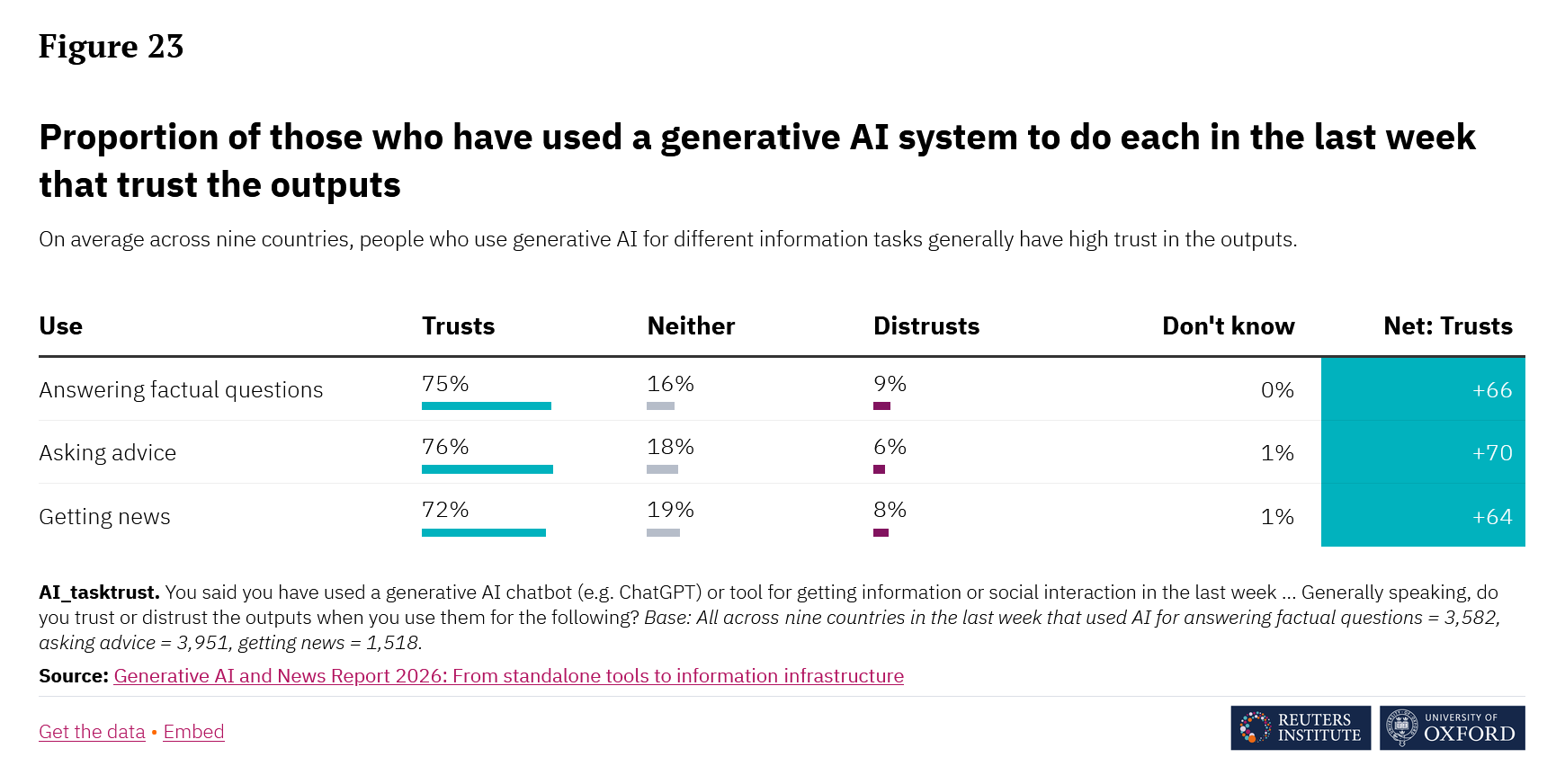
People who use AI for factual questions, advice or news generally trust the answers they receive (Reuters Institute)
At the same time, scepticism about AI in journalism persists. Using a chatbot and supporting AI-assisted news production are different things. The report also highlights the importance of perceived openness about AI use.
For publishers developing their own information services, trust needs to be visible in the product. Users should be able to see which articles support an answer, how current the information is and who is accountable for the service. Source links, clear AI labelling and opportunities to provide feedback should be part of the experience.
Handling gaps in knowledge is equally important. An assistant should explain when information is missing or sources conflict. Editorial provenance provides a valuable foundation, while generated answers still require quality controls of their own.
Political Echo Chambers Require Careful Interpretation
Among chatbot users surveyed, 37% said the views and arguments they encountered were neither aligned with nor opposed to their own. Some 32% perceived agreement and 13% disagreement. The share who saw their own views reflected was similar among users on the political left and right, at 34% and 36% respectively.
These findings leave open the possibility that chatbots could encourage more moderate political conversations than social media. They do not demonstrate that chatbots reduce polarisation. The survey measured subjective perceptions, rather than changes in political attitudes, and perceived agreement is no evidence of balance.
For journalistic AI services, this creates a clear design responsibility. Different evidence-based perspectives should be presented transparently, with facts clearly distinguished from judgements. An assistant should help users assess arguments and understand the wider context.
Agentic AI Needs a Viable Business Case
Across the nine countries, 14% of respondents said they had used an AI agent for a real task in the previous week. For publishers, this supports testing agentic capabilities through clearly defined applications.
An assistant might first clarify a user’s information need, then retrieve relevant journalism, add current data and organise the findings around the question. A local service, for example, could combine archive articles with events listings or transport updates.
The benefits must be measurable. Do users find a helpful answer more quickly? Do they return? Do they follow links to the underlying sources? Does the service support registrations, subscriptions or other revenue models? These outcomes need to be weighed against development, operating and support costs.
High conversation volumes alone do not prove commercial success. A viable business case depends on meeting a recurring need and making a demonstrable contribution to the publisher’s objectives.
Turn Editorial Content Into Interactive Services With Retresco
Retresco helps news organisations and publishers make their content accessible through article and topic chats, conversational archives, specialist assistants and local information services. Semantic technologies and agentic AI help retrieve relevant material, connect information and incorporate additional data sources where needed.
The starting point is a specific audience question and a suitable collection of content. Publishers can then define the sources, answer quality, integration requirements and success measures, and test them within a manageable use case.
The Reuters Institute report sends a clear signal: people are becoming accustomed to exploring information through conversation. Publishers can help shape that experience by making their editorial expertise available through interactive services that answer practical questions.
Which audience questions could your content answer more effectively? Please get in touch with Retresco – we would be happy to discuss your use case.
About the Study
The Generative AI and News Report 2026 was published on 29 October 2026. YouGov conducted an online survey of 18,921 respondents between 14 August and 28 September in Argentina, Australia, Denmark, Finland, France, Japan, Norway, the UK and the USA. Comparisons over time refer to the six countries surveyed since 2024. The findings provide an international perspective, with results varying across markets.
Recent Blog Posts