Blog
Zero-Click Search Is the New Reality: What Google, ChatGPT and AI Search Mean for Publishers

Harald Oberhofer
Head of Marketing, Retresco
For many years, search traffic has been one of the most reliable growth engines for publishers. Technical SEO, topical authority and fast publishing workflows could turn search demand into page views, leads, advertising revenue and subscriptions.
But with the introduction of generative AI into search things are changing. Publishers have to adapt.
Why Search Visibility Is No Longer Enough for Media Companies
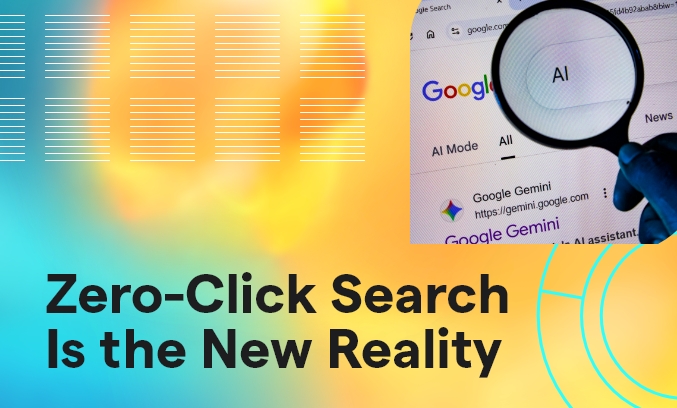
Google is still the dominant gateway to information. But it is no longer simply a gateway to the open web. Increasingly, it answers questions directly, keeps users within its own environment, and redirects attention to Google-owned surfaces and AI-generated results. At the same time, ChatGPT, Claude, Gemini and other AI search interfaces are changing user expectations: people no longer just search for links. They ask questions and expect direct, contextual answers.
For publishers and media houses, this marks a strategic turning point. Search visibility still matters. But visibility alone is no longer enough.
Zero-Click Searches Are Now the Baseline
According to Rand Fishkin of SparkToro, based on Similarweb data, 68% of Google searches in the US ended without a click in the first four months of 2026. In other words: more than two thirds of searches did not result in a click to any destination. For every 1,000 US Google searches, only 232 clicks went to the open web.
The long-term development is just as important as the headline number. SparkToro’s 2024 zero-click study found that only 360 clicks per 1,000 US Google searches went to the open web; by 2026, that number had fallen to 232.
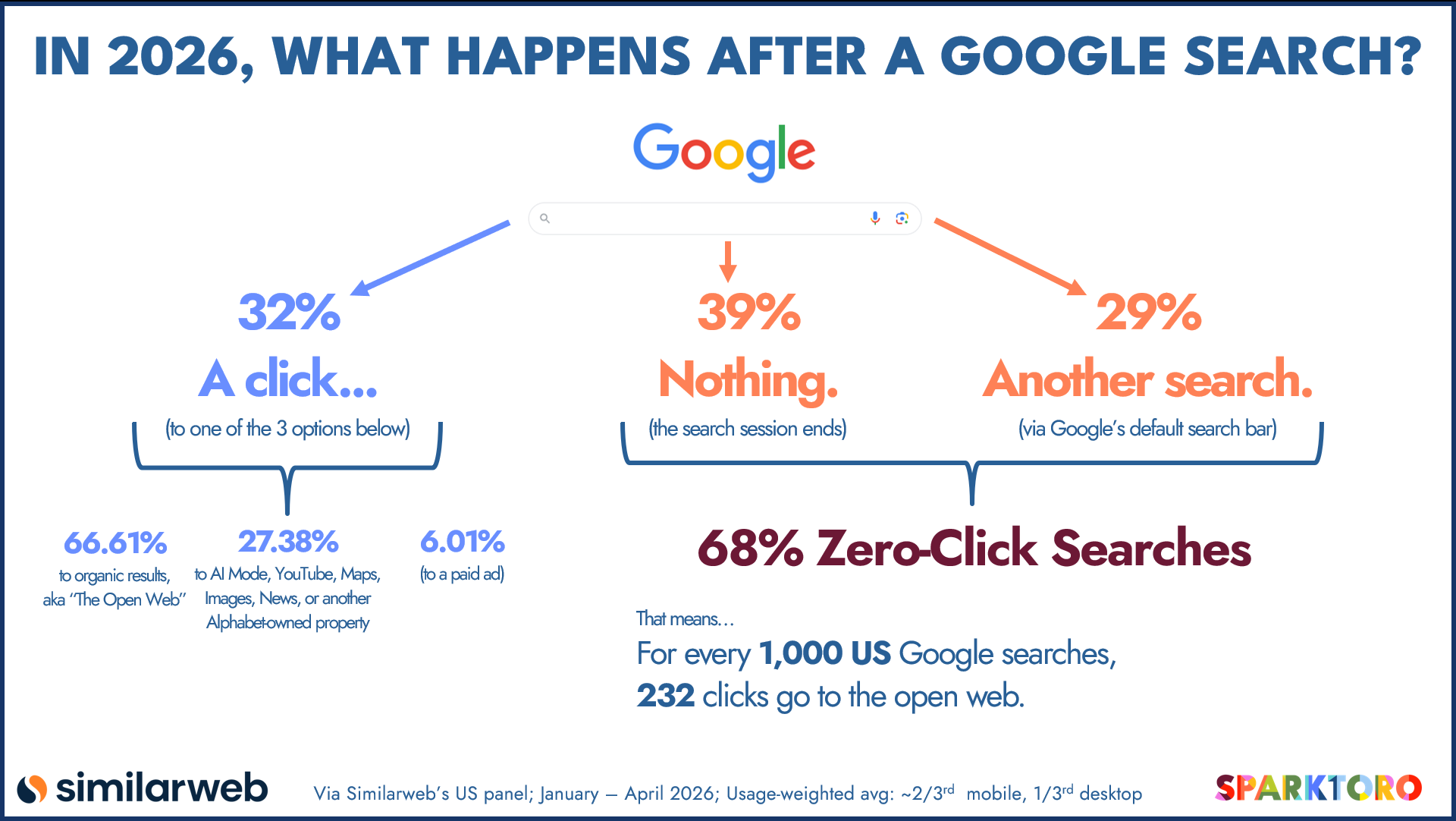
68% of all Google searches in the US currently end without a click to an external website (SparkToro/Similarweb)
This is not a temporary fluctuation. It is a structural shift in how search works. Featured snippets, knowledge panels, “People also ask,” instant answers, AI Overviews and AI Mode all move Google further away from being a referral engine and closer to being an answer engine.
For publishers, the practical consequence is clear: even if rankings remain more or less stable, referral traffic will decline.
What Happens After a Google Search?
The first graphic shows the new reality in simple terms: after a Google search, only around one third of users click somewhere. The rest either do nothing or start another search. The second graphic shows how zero-click searches have grown from 2016 to 2026, with the share of searches involving at least one click steadily shrinking.
For editorial teams, audience teams and commercial leaders, this changes the interpretation of SEO performance. A page can rank, appear in an AI Overview, be cited by Google, and still receive little or no traffic. The value of the content may still be captured – but not necessarily by the publisher who produced it.
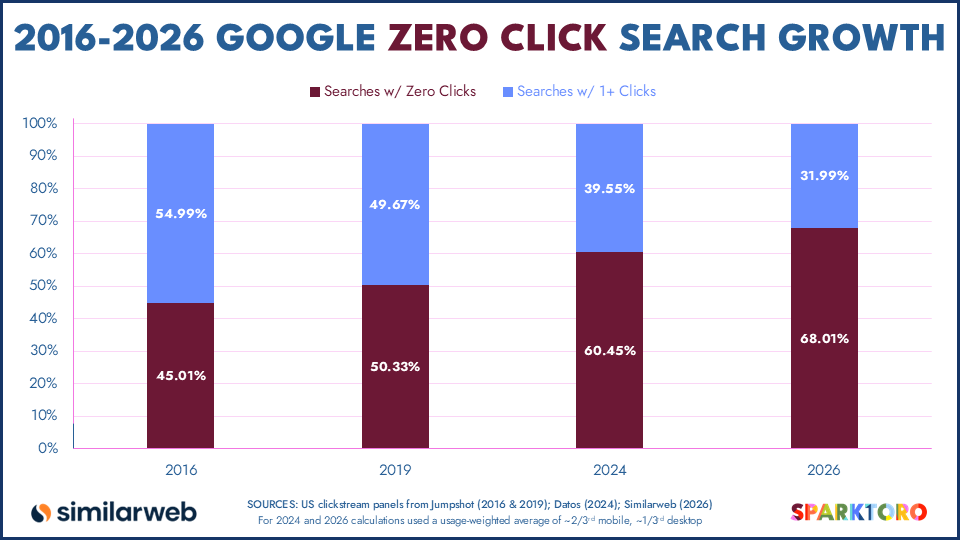
Zero-click searches have risen sharply by 23% in ten years (SparkToro/Similarweb)
That is why the discussion should not be reduced to “SEO is dead.” SEO is not dead. But classical SEO, understood as ranking optimisation for traffic acquisition, is no longer sufficient.
AI Overviews and AI Mode Intensify the Pressure
Google AI Overviews are especially relevant for informational queries. These are precisely the queries where many publishers have historically built reach: explainers, service journalism, background articles, definitions, comparisons, guides and evergreen content.
When Google surfaces an AI-generated answer at the top of the search results page, many users get enough information without clicking through. That does not mean the underlying publisher content is irrelevant. On the contrary: high-quality editorial content is often part of the knowledge base that makes the answer useful. But the user interaction increasingly takes place on Google’s surface, not on the publisher’s site.
AI Mode will intensify this even further. Instead of one search query followed by a list of links, users move into a conversational search journey. They ask follow-up questions, narrow the context, compare options and request summaries. In such a setting, the publisher’s website is no longer automatically the destination. It becomes just one potential content source within a broader AI-generated answer environment.
This is a major challenge for publishers because many editorial business models depend on the visit: the page view, the ad impression, the registration prompt, the newsletter sign-up, the subscription offer and the brand experience.
Google Discover Remains Powerful, but Unpredictable
Google Discover is a different case. For many publishers, Discover can still deliver substantial traffic peaks. It rewards topical relevance, local content, strong headlines, visual presentation, authority and user interest signals. But Discover does not create a direct relationship either, because visibility cannot be managed as systematically as rankings in search.
It is an algorithmic distribution channel controlled by Google. It can support growth, but it cannot replace a first-party audience strategy. A publisher that depends heavily on Discover remains exposed to changes in ranking logic, interface design and user behaviour.
The strategic question is therefore not whether publishers should optimise for Google Discover. They should. The real question is: what happens after the Discover visit? Does the user remain anonymous, or does the publisher convert that moment of attention into a known relationship?
The Traffic Decline Is Already Visible
Piano’s benchmark data across hundreds of publisher sites shows how serious the shift has become. According to Piano, search traffic dropped by 36%, revenue fell by 16%, and overall audience across all sources declined by 9%.
The important detail is that traffic and revenue are no longer moving in parallel. Piano also found that during the last two years, roughly half of its benchmark sites lost traffic, but 80% of those sites still grew revenue. The publishers that performed better focused on levers such as pricing, churn reduction and channels they could control.
That is the lesson for publishers: the answer to declining search traffic is not simply more traffic. It is a stronger direct relationship with audiences through publishers’ own offerings – and better ways to bring users back without relying on Google, ChatGPT or social platforms.
From Anonymous Reach to Known Users
The most urgent strategic task is to reduce dependence on anonymous traffic.
If most users arrive once from Google and leave without registering, subscribing to a newsletter, installing an app or returning directly, the publisher has little defence against further referral decline. There is no email address, no account, no preference profile, no push channel and no reliable way to build habit.
Registration walls, newsletters, free accounts, app onboarding and personalised content experiences all serve the same purpose: they turn a one-off visitor into a known reader.
For publishers and media houses, this is not only a subscription issue. It is also a product, data and editorial issue. Known users can be addressed more precisely. Their interests can be understood better. Their behaviour can inform product development. Their loyalty can be strengthened through relevant experiences rather than generic page-view optimisation.
The KPIs Publishers Should Prioritise Now
If organic page views remain the primary success metric, publishers risk optimising for a channel that is structurally shrinking. Search traffic will remain relevant, but it should no longer be treated as the main KPI.
More useful metrics focus on channels, relationships and KPIs publisher actually own:
- Registered users instead of anonymous reach
- Newsletters, apps and logged-in experiences
- Personalised reader journeys based on first-party data
- Trusted, source-based AI experiences
- Known-user and registration conversion by traffic source
- Engagement quality, including return visits, pages per session and newsletter engagement
- Subscriber lifetime value and citation visibility in AI search and AI Overviews
The core question changes from “How much traffic did Google send us?” to “How many valuable relationships did this traffic create?”
Why Interactive AI Experiences Belong on Publisher Platforms
A strong strategy for reducing the impact of zero-click searches is to offer users the kind of experience they increasingly expect from AI search – but within the publisher’s own environment.
If users like asking questions, publishers should let them ask questions on their own sites and apps. If users value summaries, publishers should provide trustworthy summaries based on verified editorial content. If users want context, publishers should offer transparent, source-based AI assistants that explain where answers come from.
This is where AI-powered publishing products become strategically important. A publisher’s own AI chatbot can help users explore archives, understand complex topics, ask follow-up questions, discover related articles and move deeper into a branded editorial environment.
For specialist publishers, the opportunity is even clearer. Professional audiences often have specific, high-intent questions. They are not simply looking for generic answers from ChatGPT, Gemini or similar AI tools. They need reliable responses based on trusted sources, deep market knowledge, authoritative legal texts, verified pharmaceutical information, robust technical documentation or other domain-specific expertise.
In this environment, trusted content is not a commodity. It is the foundation for differentiated AI services.
From SEO to GEO, AIO, AEO and Reader Relationship Management
The next phase of publishing will not replace SEO. It will extend it.
Publishers still need technically sound websites, structured data, fast pages, topic authority, strong internal linking and high-quality content. But they also need to optimise for AI answer systems, citation environments and conversational discovery.
That means content must be understandable not only for search engines, but also for AI systems. Sources should be clear. Entities should be structured. Topics should be connected. Archives should be machine-readable. Editorial authority should be visible. Content should be updated, linked and enriched in ways that help both users and AI systems understand its relevance.
But the strategic goal should not be merely to appear in AI Overviews, AI Mode or ChatGPT. The goal should be to make every external visibility moment a starting point for a direct relationship.
What Publishers Should Do Next
The first step is to audit dependency. How much of the current audience comes from Google Search, Google Discover, social platforms and other referral sources? How much is direct, registered, logged-in, newsletter-driven or app-based?
The second step is to identify vulnerable content segments. High-volume informational articles, evergreen explainers and service content are particularly exposed to AI Overviews and zero-click behaviour. These formats still matter, but their role must be reconsidered. They should not only attract visits; they should guide users towards deeper engagement, registration, newsletters, topic follows or interactive tools.
The third step is to build owned AI experiences. Article chat, archive search, election assistants, topic assistants, professional Q&A tools and personalised content discovery can help publishers create the kind of conversational experience users increasingly expect – without handing the entire relationship to Google or ChatGPT.
The fourth step is to connect editorial, product and commercial strategy. Zero-click search is not just an SEO or GEO issue. It affects subscriptions, advertising, data strategy, product design, newsroom workflows and brand positioning.
Retresco’s Perspective: The Next Phase of Digital Publishing
At Retresco, we believe the answer to zero-click search is not retreat. Blocking AI crawlers may be part of a rights and licensing strategy, but it is not a growth strategy on its own. Publishers should continue to optimise for Google, AI Overviews, AI Mode, Google Discover and emerging AI search environments — just as they have always optimised for traditional Google search.
But they also need to build much stronger first-party strategies: direct user relationships, owned channels, interactive user experiences and AI-powered services based on verified editorial content and transparent sources.
The next phase of digital publishing will be shaped by publishers that can do both: remain visible in external discovery environments and create trusted destinations on their own platforms.
For publishers and media houses, the opportunity lies in transforming high-quality content into interactive, personalised and trustworthy experiences. Not just to be found, but to be used. Not just to generate reach, but to build relationships. And not just to appear in AI answers, but to become the trusted environment where users continue the conversation.
Do you have any questions, comments or feedback on liquid content? Get in touch – I will be happy to get back to you!
Recent Blog Posts