Blog
OMR Festival 2027: With Event Chatbots Information Becomes an Interactive Experience

Harald Oberhofer
Head of Marketing, Retresco
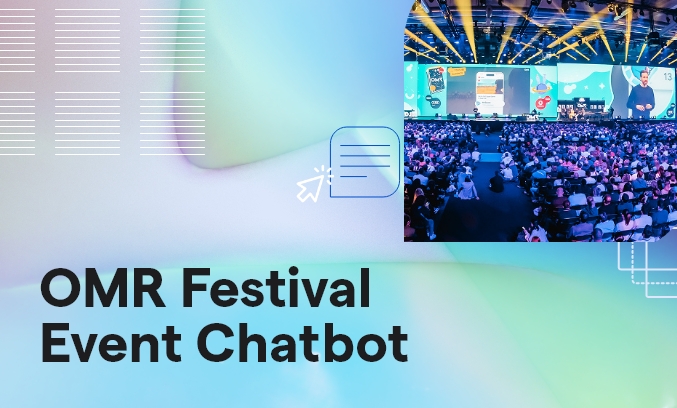
OMR Festival 2027 is set to show where marketing and digital communication are heading: away from static touchpoints and towards dialogue-driven experiences.
The OMR Festival chatbot is an amazing example to show where event- and topic-specific interactive services are going. The bot was built specifically to inform guests on topics around the event. But the success of this new format depends less on the technology itself and more on the editorial curation of the content it accesses.
Event Chatbots: Communication Becomes a Real-Time Experience
Traditional event apps are often overloaded and, as a result, used only sporadically. By contrast, well-designed event chatbots meet users exactly where there is a specific need for information.
What these interactive services can deliver:
- Direct interaction instead of static content
- Tailored agenda recommendations based on individual interests
- Information on presentations, side events, services and marketing opportunities
What was once seen as a nice add-on is becoming an important part of the user journey – both before and during events. In the run-up to OMR Festival 2027, the chatbot is expected to become an even more visible element of pre-event communication, for example in accreditation, planning and service-related touchpoints: ‘Have any questions? Contact the OMR Festival chatbot.’
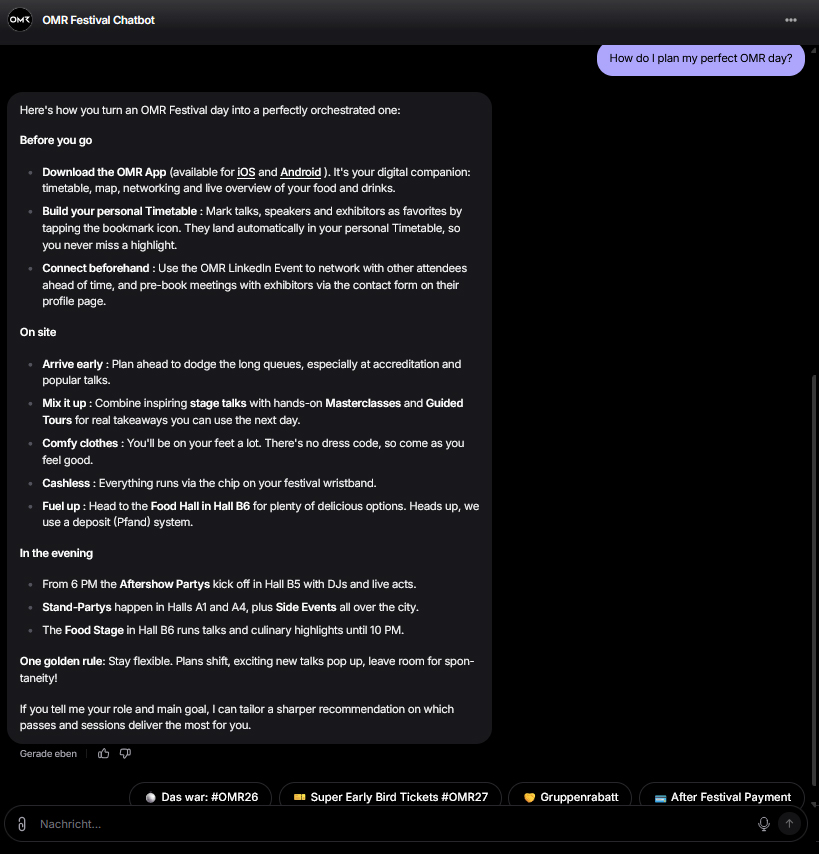
The OMR Festival chatbot delivers precise answers
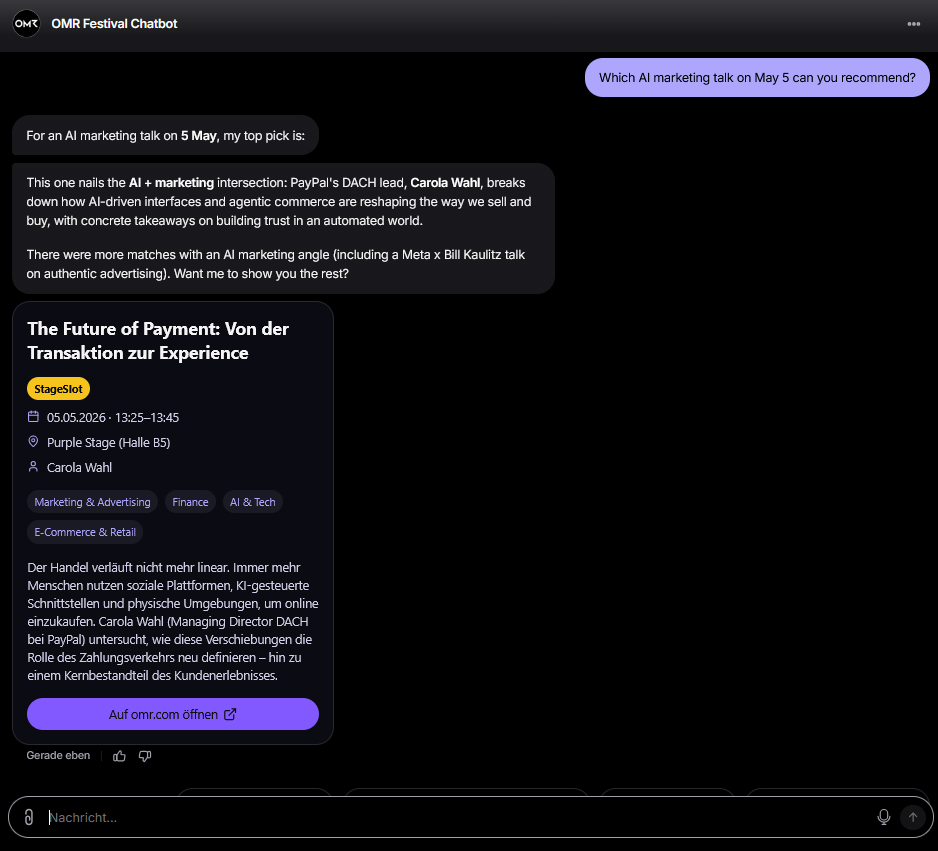
The OMR Festival chatbot provides precise follow-up responses
From FAQ Bot to Conversational Information Hub
The era of simple FAQ bots is over. Chatbots are increasingly developing into conversational information hubs. The OMR Festival chatbot shows how these interactive services can be much more than basic question-and-answer systems. Instead, they can act as intelligent interfaces that answer user questions in a targeted way by connecting internal information, services and content.
Modern chatbots, particularly in the event environment, go far beyond recognising keywords. They understand the context of user questions, access current and dynamic content, and provide personalised answers in real time. At the same time, they can be seamlessly integrated into marketing and service funnels, actively supporting user guidance and information delivery.
This means chatbots are evolving from pure support tools into bidirectional communication channels that connect users and companies in new ways.
The Real Gamechanger Is Not AI, but Proprietary Content
The performance of such chatbots depends on the quality of the data and content on which the interactive service is based. This is where it becomes clear who has done the groundwork: a smart bot needs clearly structured content, semantically enriched data, well-defined topic clusters and continuously maintained and updated information.
Companies that fail to organise and prepare their own content systematically will struggle to create a convincing chatbot, even with the best AI technology. One key lesson from the OMR Festival chatbot is therefore clear: AI alone does not determine success. What matters most is the underlying content architecture combined with internal data.
In practice, the OMR Festival chatbot demonstrates how effective this can be. The chatbot can answer complex questions such as ‘How do I plan my perfect OMR day?’ while also enabling targeted follow-up questions about exhibitors, the programme or specific topics, such as: ‘Which session on AI in marketing on 5 May would you recommend?’ The event chatbot also creates genuine added value by providing interactive information on suitable partner hotels offered by the organiser.
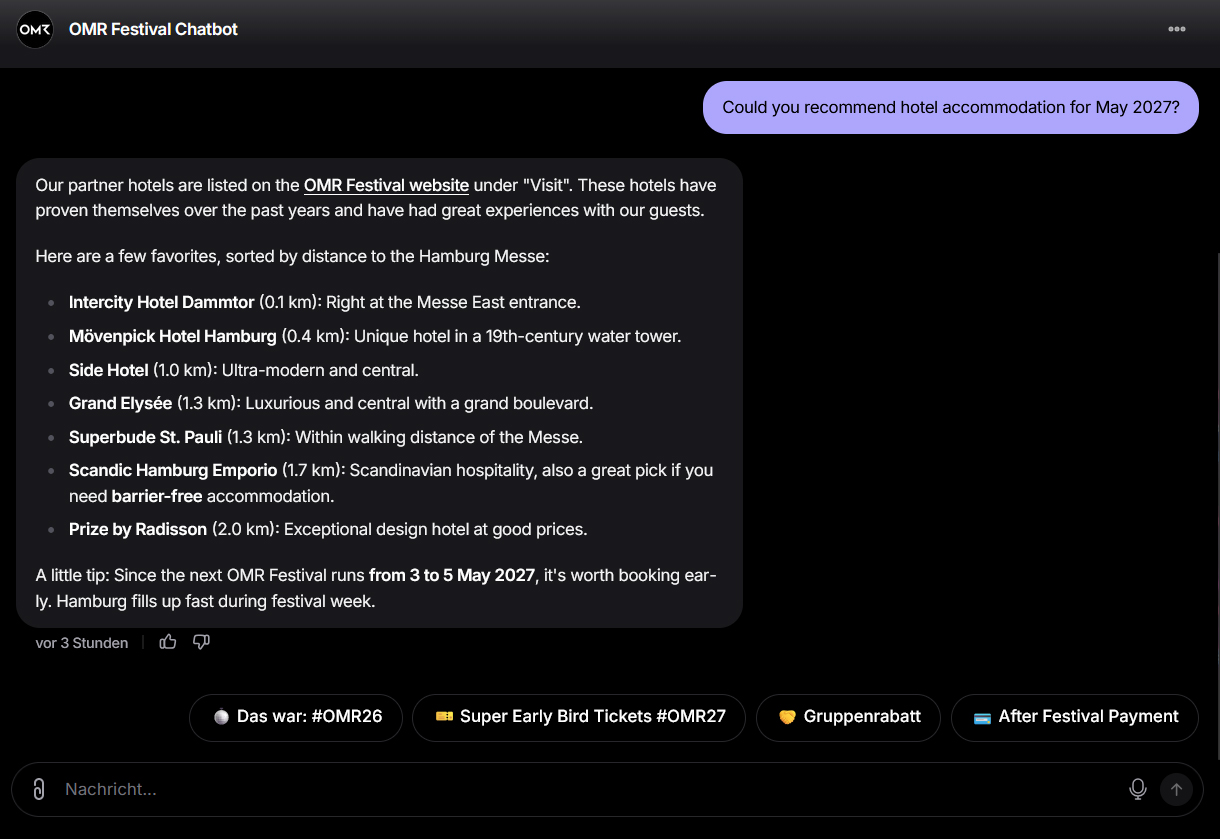
The OMR Festival chatbot provides valuable hotel information
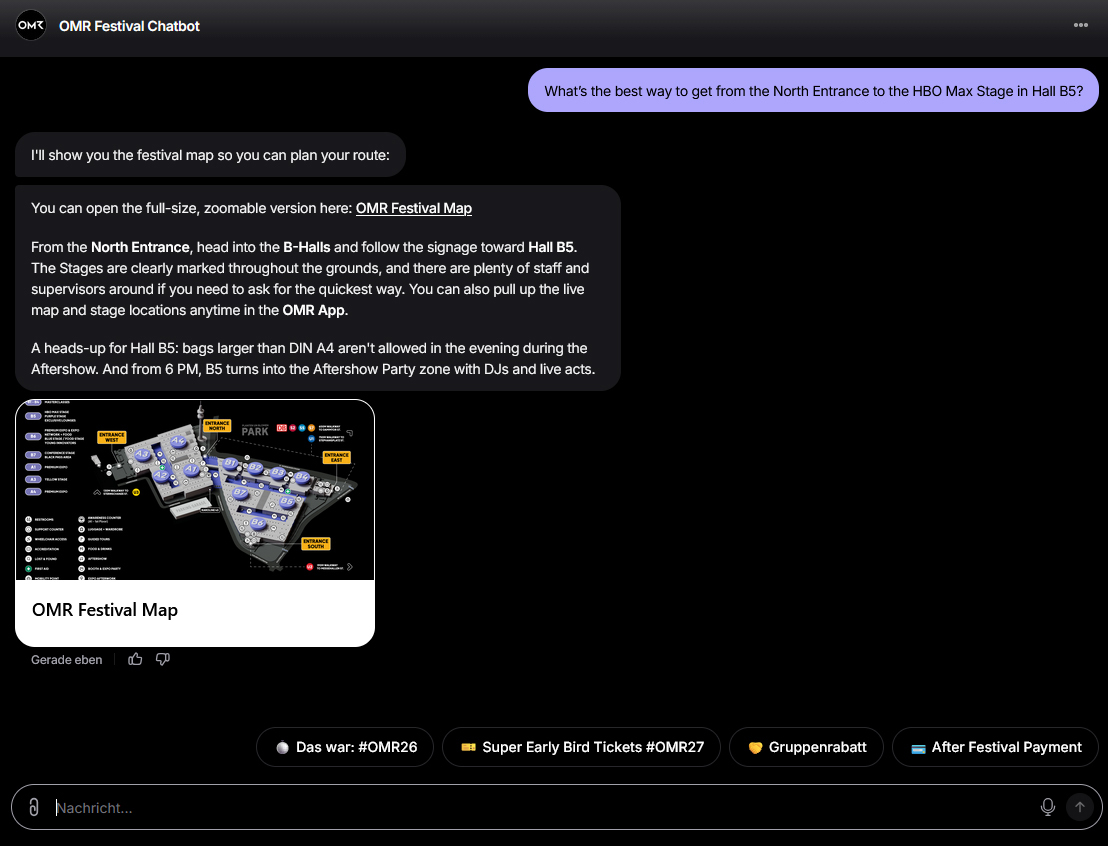
The OMR Festival chatbot provides valuable service information
Conversational AI Is Becoming the New Standard
For a long time, conventional search functions and clear navigation were sufficient. Today, however, users increasingly expect one thing above all: direct answers – instantly, precisely and relevant. This expectation is driving a fundamental shift in the way users and companies interact.
Websites, apps and digital services are increasingly becoming dialogue-based environments in which interaction takes centre stage. Campaigns are no longer primarily designed around clicks, but around genuine conversations and moments of exchange. At the same time, content is no longer thought of as linear, but as modular, enabling it to respond flexibly to individual user needs. Chatbots are becoming an essential interface in this development.
Interactive Services: How Chatbots Make Efficiency Scalable
Modern chatbots combine efficiency with scalability by closely aligning themselves with users’ needs. For companies, the advantages are clear: they are available around the clock, answer user questions automatically and do not require additional human resources for every interaction.
At the same time, they create direct, seamless information paths without media breaks and provide reliable insights based on real user interests.
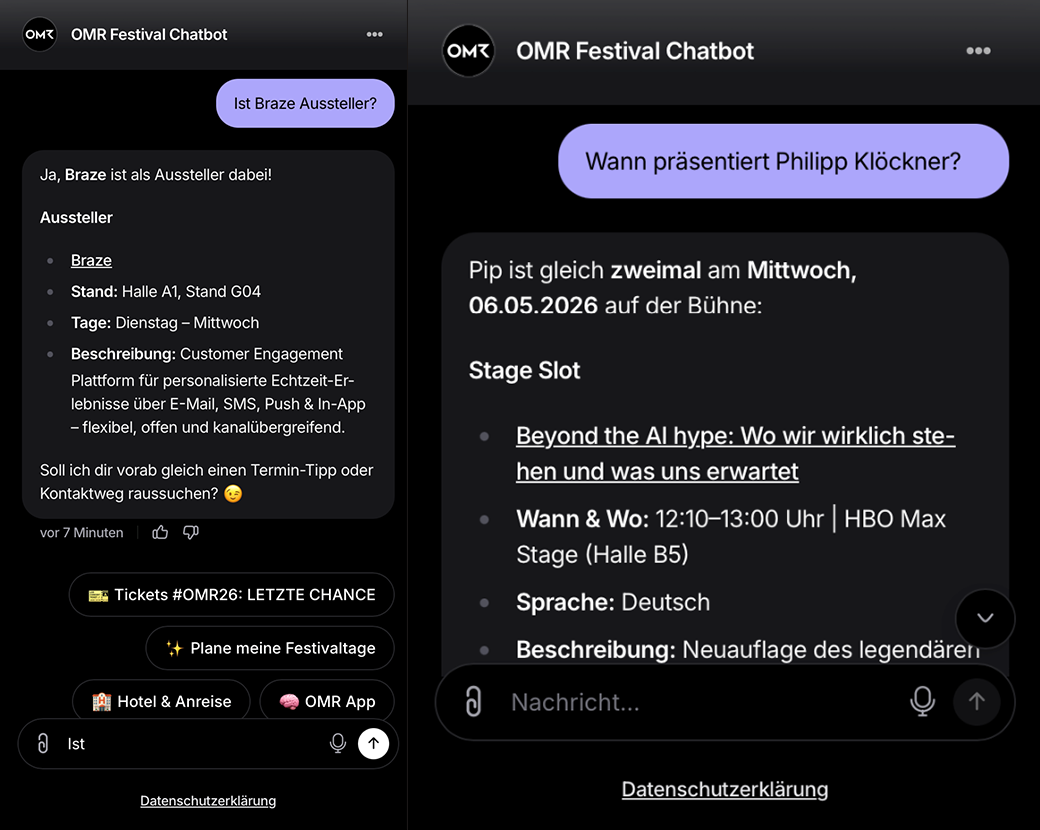
The OMR Festival chatbot also provides precise programme and exhibitor information within the app
Data-Based Insights That Genuinely Help
The biggest shift in the event sector is not technological, but conceptual. Events are no longer one-way communication formats. They thrive on interaction. Event chatbots make precisely this kind of exchange possible.
They are much more than automated response systems. They generate data-based insights:
- Which questions are users asking most frequently?
- Which topics attract the greatest interest?
- Which content remains unnoticed?
These insights are highly valuable. They can be used to optimise future events and marketing activities, sharpen content strategies and further develop both product and programme offerings in a targeted way.
Events and Beyond: Without Chatbots You Lose Interactive Potential
The OMR Festival chatbot shows that interactive information and service offerings are no longer just a trend. They are becoming part of the infrastructure of modern events.
Companies that invest in chatbots now can secure:
- Better user experiences
- More efficient processes and dialogues
- Continuous user activation
The key question is no longer whether a chatbot should be used, but how successfully it responds to users’ varied interests and needs.
My take as a marketer: The future belongs to companies that listen and enter into continuous dialogue. Event chats such as the OMR Festival chatbot currently offer one of the most effective ways to do this at scale.
Further insights and use cases for the application of AI in events and special interest media environments can be found here. Do you have feedback, comments or questions? Get in touch – we look forward to the exchange!
Recent Blog Posts