Blog
From Static Articles to Liquid Content: How Media Organisations Can Reuse, Personalise and Monetise Content with AI

Johannes Sommer
CEO, Retresco
AI is dramatically expanding the creative and editorial possibilities available to media organisations. At the same time, audience expectations are rising just as quickly: users increasingly expect content to reflect their individual context, interests and specific usage patterns.
This is putting Liquid Content firmly on the strategic agenda for media organisations and publishers.
The idea itself is not new. But generative and agentic AI now make it possible to implement Liquid Content far more efficiently, across channels and at scale than ever before.
The number of channels that editorial teams have to serve at ever greater speed is already enormous. Alongside websites, apps, print and digital newspaper and magazine editions, publishers need to produce content for newsletters, social media and messaging services – as posts, articles, podcasts, videos and increasingly in real time.
Liquid Content therefore raises a fundamental strategic question: What is the actual product of a media organisation in the future – the finished article, or the knowledge from which new content, formats and user experiences can continuously be created?
What is Liquid Content?
Liquid Content refers to content built on a consistent knowledge base that can be flexibly delivered in different formats, lengths, levels of complexity and forms of presentation. A single journalistic dossier, for example, can become the basis for a wide range of different content assets.
Instead of treating content exclusively as finished, immutable publications, media organisations can model it as structured, reusable and recombinable units of knowledge – including facts, quotations, data points, people, places, events, images, scenes and sources.
AI applications can then dynamically select and combine these elements according to the channel, audience and usage context. Crucially, editorial control does not have to be sacrificed. Editorial teams can define which sources may be used, which rules and tone-of-voice requirements apply, and which approval processes and quality standards must be followed.
Liquid Content therefore creates the foundation for scalable, cross-channel and cross-format journalistic storytelling while preserving editorial governance.
Why Liquid Content Matters Now
Two developments are accelerating the relevance of Liquid Content.
Firstly, generative AI makes content transformation scalable. Articles, documents and structured data can be summarised, simplified, translated, converted into audio, visualised or adapted for different target audiences. Images, audio and video can increasingly be generated and edited through multimodal AI systems.
Secondly, audience expectations are changing.
People are becoming accustomed to accessing information through chatbots, voice assistants, personalised feeds and other AI applications. At the same time, users are not always willing to read one or several articles in full. Increasingly, they are looking for a concrete answer, a concise overview, a comparison or an explanation tailored to their current situation.
Liquid Content enables audiences to have greater control over how they consume information: as a summary, an audio briefing, a presentation, a checklist or an interactive conversational answer.
From Finished Articles to a Structured Knowledge Foundation
The current transformation goes far beyond automatically creating additional editorial formats.
To unlock the potential of Liquid Content, media organisations need to stop thinking of their content solely as completed articles or individual publications. Instead, they need to develop a structured, machine-readable knowledge base or content archive.
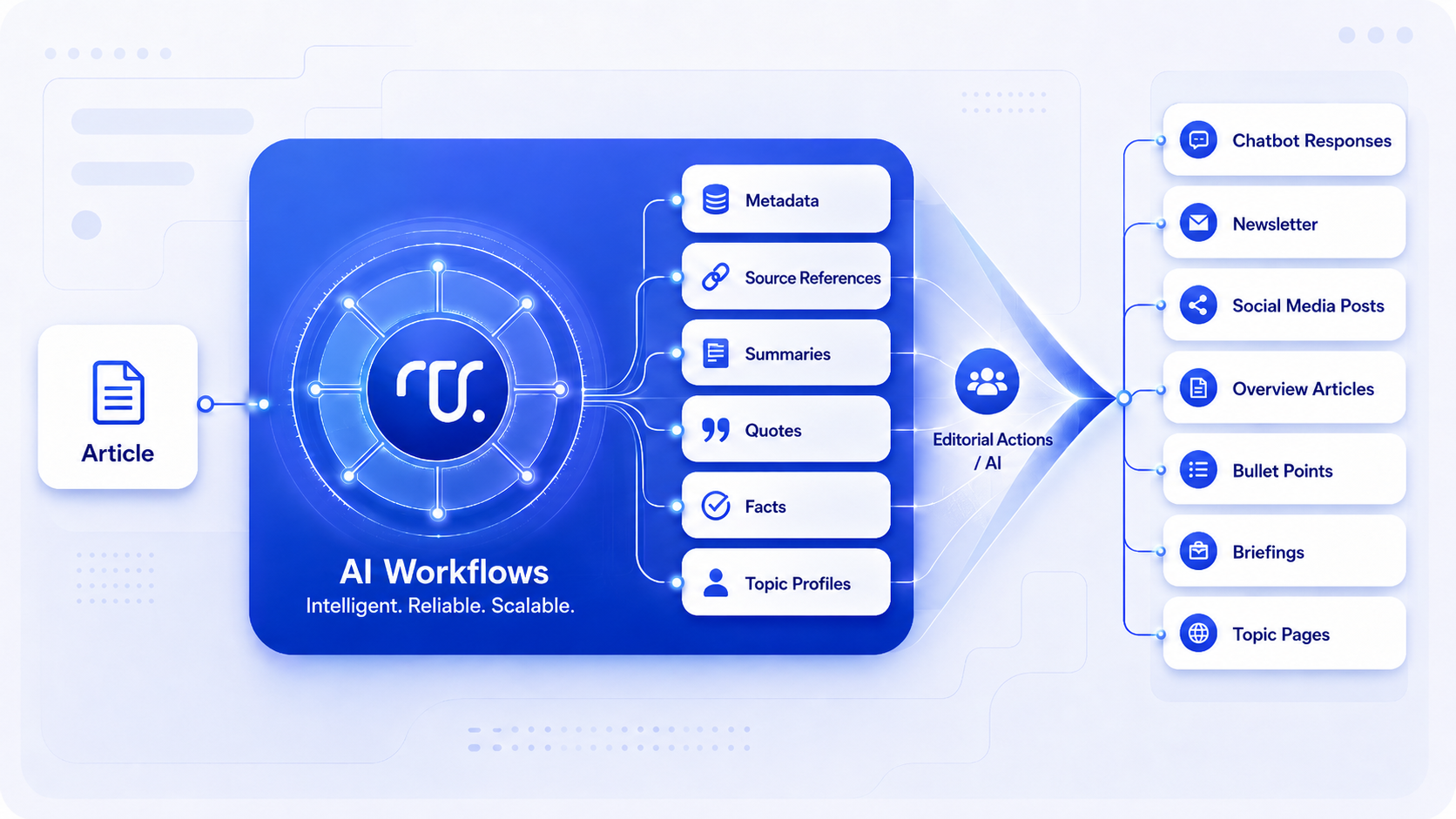
Liquid Content workflows: from the original editorial article to flexible and recombinable content elements.
This knowledge foundation can include current articles, historical archives, images, podcasts, videos, documents, databases and other content repositories.
The crucial requirement is that these assets are discoverable, connected, machine-readable and available for automated processing.
Agentic AI can build on this foundation by taking contextual signals into account and determining which level of detail, presentation format and combination of information is most appropriate for a specific user or situation.
AI systems can also learn from usage patterns and feedback which content, formats and functions are particularly relevant to different audiences.
Editorial teams no longer need to produce every format from scratch. Instead, they can focus more strongly on research, analysis, editorial judgement, storytelling, quality assurance and the enforcement of journalistic standards.
How Liquid Content Unlocks Greater Value From Existing Content
Liquid Content does not simply increase the output generated from current editorial production. It can also unlock information, data and material that has previously been used only once – or not at all.
- An interview that was only partially published, for example, could become the basis for a podcast.
- Research data could be transformed into explanatory graphics, new articles or interactive information formats.
- An existing article could be broken down into facts, quotations and contextual information, then made available to an AI-powered conversational service.
As a result, the lifecycle of journalistic content can be extended significantly. Its value is no longer limited to the moment of initial publication. Content can remain available as part of a structured knowledge base or content archive and become relevant again when new events, questions or usage contexts emerge.
This makes unique content particularly valuable – especially material that requires substantial research effort and contains information that is difficult to gain through freely available sources.
Turning Media Archives Into an Active Knowledge Base
For established media organisations with archives accumulated over decades, Liquid Content presents particularly significant opportunities.
Media archives contain a rich body of background information, historical context, local news, profiles, data and original research that may be unavailable or insufficiently represented in freely accessible sources. Traditional search functionality only unlocks a limited proportion of this value. Users generally need to know relatively precisely what they are looking for and where they should search.
In the past, relationships between articles, people, locations, topics and events have often remained invisible to many search algorithms. Generative and agentic AI can transform a passive archive into an active AI-powered knowledge base. Content can be structured, semantically indexed and contextually connected for different use cases.
The archive therefore stops being merely a repository of previous publications. It becomes a strategic asset from which new products, services and user experiences can be developed.
Delivering Personalised Content More Efficiently
Hyper-personalisation has been discussed within the media industry for years. In practice, however, its implementation has often been constrained by insufficient data, complex content models and high production costs.
Liquid Content offers a more pragmatic and scalable route to personalised content for publishers: Content can be adapted to different audience segments, personas, regions or specific usage patterns.
- Special interest media could generate different versions of the same information for senior management, procurement teams and operational staff.
- News services could adapt an explanation according to a user’s existing level of knowledge.
- Chatbots could respond to follow-up questions and gradually increase the level of detail provided.
The result is a more relevant user experience without requiring every individual application or content asset to be produced entirely from scratch.
Creating Local Services From Existing Content
Liquid Content also creates new opportunities for local and regional media organisations:
- Nationally or centrally produced content can be adapted to individual distribution areas by combining it with location-specific information, local data and regional events.
- Traffic updates could highlight the routes, roadworks and disruptions that matter in a particular region.
- Election coverage could incorporate local candidates, positions and results.
- Sports, events and weather information can likewise be tailored to individual locations.
- Regional specialities, examples and even variations in tone of voice can be incorporated into overarching editorial narratives.
This variety of possibilities creates opportunity for local information services, information hubs and community-focused formats. The key prerequisites are reliable local data and clearly defined editorial rules governing its selection, prioritisation and integration.
Which Applications Can Liquid Content Enable?
For media organisations and publishers, Liquid Content can enable a broad range of AI-powered applications:
- Chatbots and interactive information services turn articles, archives and data sources into conversational answers. Users can ask their own questions, explore connections in greater depth and receive sources, examples and relevant follow-up questions.
- Magazine and news services can transform editorial dossiers into personalised feeds, podcast briefings, social media snippets, videos and interactive explainers.
- Knowledge and documentation portals can provide dynamic “answer views”. Instead of receiving an entire article, users are presented with a context-specific combination of explanation, instructions, examples and checklists.
- Newsletters can be assembled automatically from relevant news, specialist information and content recommendations, with variations according to subject, region or interest profile.
- Websites and media platforms can serve different versions of text, images and related content according to the user context, behaviour and interests.
- Training and e-learning services can transform specialist content into flashcards, quizzes, compact learning modules and in-depth case studies.
- Streaming and audio services can offer “pick your format” experiences in which users choose the length, topics and presentation format themselves.
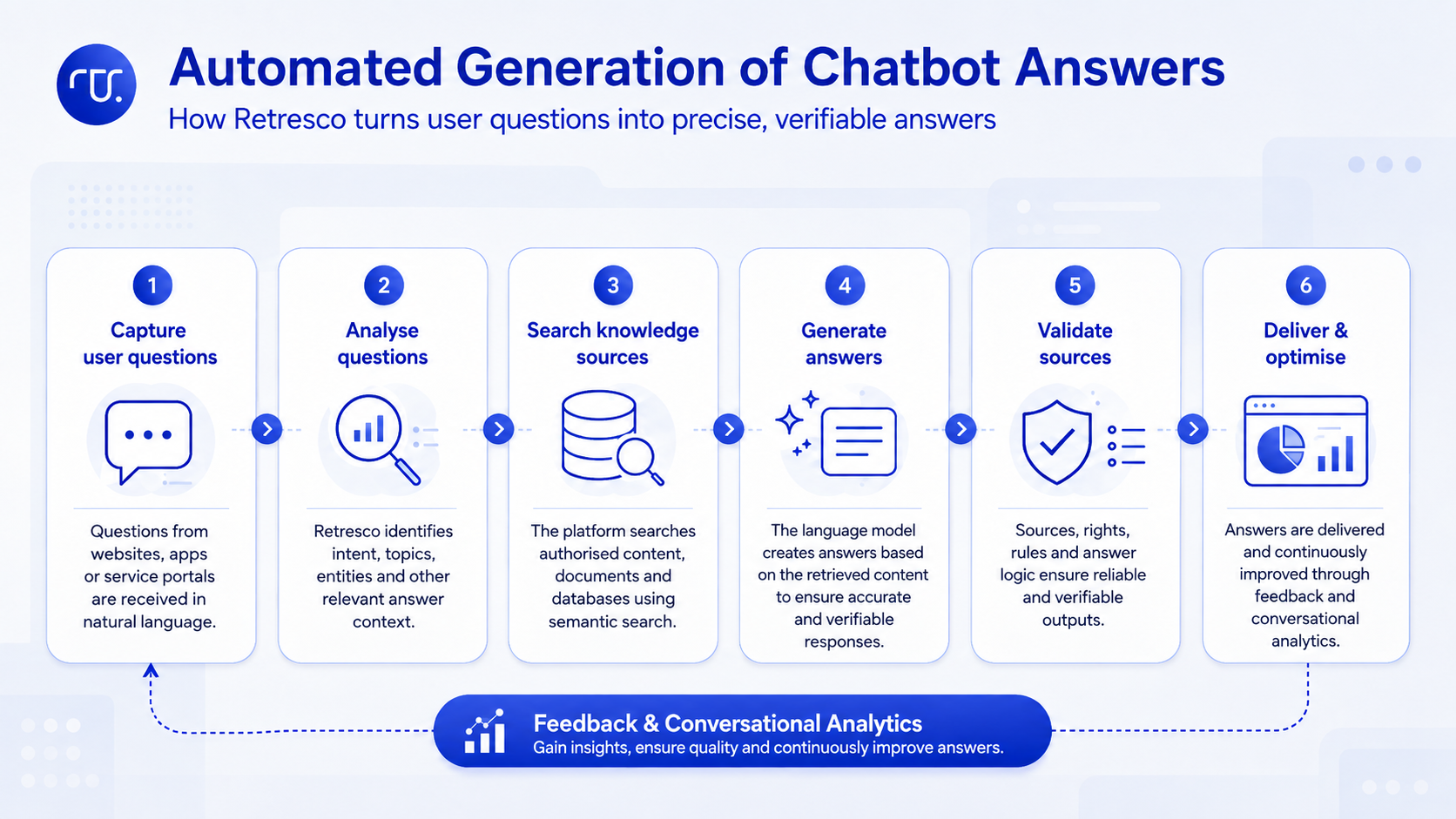
Liquid Content in practice: a multi-stage Retresco workflow for generating chatbot answers.
How media organisations can monetise Liquid Content
Liquid Content can strengthen existing revenue models while enabling new monetisation opportunities. Personalised formats and interactive AI services can increase the perceived value of a subscription. Paywalls can be strengthened through new services at relevant entry points, personalised recommendations and additional explanatory content. High-quality, interactive information can be offered as a premium feature, an additional service or a standalone product.
At the same time, media organisations gain the ability to commercialise their editorial knowledge independently of existing publishing formats. Potential business models include:
- Specialised research and analysis services
- New subscription, usage-based and licensing models
- Data as a Service
- API publishing and content syndication
- B2B knowledge platforms
- Automated corporate publishing
Instead of monetising only predefined end products such as articles, newsletters or podcasts, publishers can provide reliable, structured know-how from which context-specific products, services and user experiences can be dynamically created.
The decisive competitive advantage lies in the quality and structure of a publisher’s own content across the media value chain. AI models can be replaced. Exclusive archives, editorial expertise, trusted data and established subject-matter knowledge are far more difficult to replicate.
What does Liquid Content require?
For Liquid Content to work effectively, media organisations need to establish a number of technical, editorial and organisational foundations.
Structured content models
Content needs to be organised into clearly defined content types with fields, metadata, relationships and rules governing reuse. Articles, quotations, people, places, data and media assets should be individually addressable and interconnected.
Metadata and automated content tagging
Metadata describes what a piece of content is about, which people or organisations it refers to, the geographical area concerned and when the content was published or updated. Without this information, AI systems have only a limited ability to classify, select and combine content reliably.
Automated content tagging can automate much of this work by identifying relevant entities, topics and relationships and adding this structured information to the content.
Machine-readable content elements
Articles should be capable of being broken down into meaningful units such as headlines, paragraphs, quotations, information boxes, profiles and captions. This process – often referred to as content chunking – allows individual content components to be retrieved, recombined and linked back to their sources.
API-ready architecture
A headless or API-first architecture separates content from the way it is presented. Content components can therefore be distributed flexibly across websites, apps, newsletters, chatbots and other AI interfaces.
APIs and emerging standards such as the Model Context Protocol (MCP) also make it easier to expose both content and functionality to AI agents in a controlled way.
Model-agnostic AI architecture
Large language models can perform tasks including summarisation, rewriting, structuring and question answering within Liquid Content workflows. However, models differ substantially in terms of quality, cost, speed, data protection requirements and specialisation – and the market continues to develop rapidly.
A model-agnostic AI architecture enables media organisations to select, replace or combine models according to the requirements of each individual use case. This reduces technological dependencies and makes AI infrastructure more adaptable over time.
Clear workflows, governance and quality rules
Editorial and product teams need to plan content for modular reuse and multi-channel distribution from the outset. At the same time, clear rules are required for approvals, permitted sources, timeliness, tone of voice, rights management and AI labelling.
The more dynamically content is selected, generated and distributed, the more important AI governance, transparency and quality assurance become.
How media organisations can get started with Liquid Content
The starting point for Liquid Content should not be the selection of an AI tool. It should begin with a strategic question:
Which Product or Service Do We Want to Create First – And for Whom?
A clearly defined AI use case helps media organisations focus on tangible value rather than becoming overwhelmed by the growing number of technologies, models and potential applications.
1. Audit content and usage rights
The first step is to assess which knowledge assets are already available:
- Which content exists in a digital, structured format?
- Which archives and existing content offer the greatest potential for reuse?
- Which information is unique and cannot easily be replaced by freely available sources?
A content audit also requires a legal assessment. Text, images, audio and video may be subject to different licensing, usage and personal rights. The fact that an asset is technically available does not automatically mean that it can be reused for new formats or AI-powered services.
2. Build metadata and AI-ready infrastructure
The next step is to structure relevant content, enrich it with metadata and make it available for automated content processing. This requires clearly defined content types, interfaces, permissions and reuse rules. AI can help by automatically identifying people, places, organisations, topics and events and by enriching historical archives retrospectively.
In parallel, publishers should define which systems take priority and how content should move between the content management, archives, databases, AI applications and distribution channels.
3. Start with a clearly defined Liquid Content pilot
Rather than immediately attempting to build an entire Liquid Content ecosystem, it is generally more effective to start with a manageable pilot project. Potential starting points include:
- An AI-powered article chatbot
- An internal AI research assistant
- An interactive media archive
- Automated reuse of a selected editorial format
- A personalised information service
What matters is having clear objectives:
- Should production effort be reduced?
- Should the usage of proprietary editorial content increase?
- Should the service generate more interactions or longer user sessions?
- Should a new premium service be created?
A successful pilot does more than demonstrate technical feasibility. It also reveals which editorial rules, metadata, quality controls, AI guardrails and organisational responsibilities will be required for broader implementation.
Liquid Content as a Strategic Response to the Growing Number of Channels
Liquid Content is about far more than automatically turning a single article into several different formats. It fundamentally changes how media organisations produce, structure, store, distribute and monetise their content. At the centre is no longer just the finished media product, but a structured, trusted and machine-readable knowledge foundation.
Depending on the channel, usage patterns and information needs, this foundation can be used to dynamically generate different formats and user experiences. This enables media organisations to respond to an environment in which audiences increasingly access information based on context, through conversations and via AI-powered interfaces. Publishers that make their proprietary knowledge modular can reuse content more efficiently, activate their media archives, develop personalised services and unlock new revenue models.
This is where Retresco’s approach to agentic AI for media organisations comes into play: connecting proprietary content, archives, databases and controlled external sources while giving publishers clear control over sources, permissions, workflows and output. The goal is not simply to generate more content. It is to make a media organisation’s existing knowledge discoverable, reusable and dynamically accessible across channels and AI-powered user experiences.
Would you like to explore how Liquid Content, content automation or agentic AI could unlock more value from your editorial content and archives? Please get in touch with Retresco – we would be happy to discuss your use case.
Recent Blog Posts