Interactive
AI Chatbots and Information Services
Turning data and content into tailored conversations
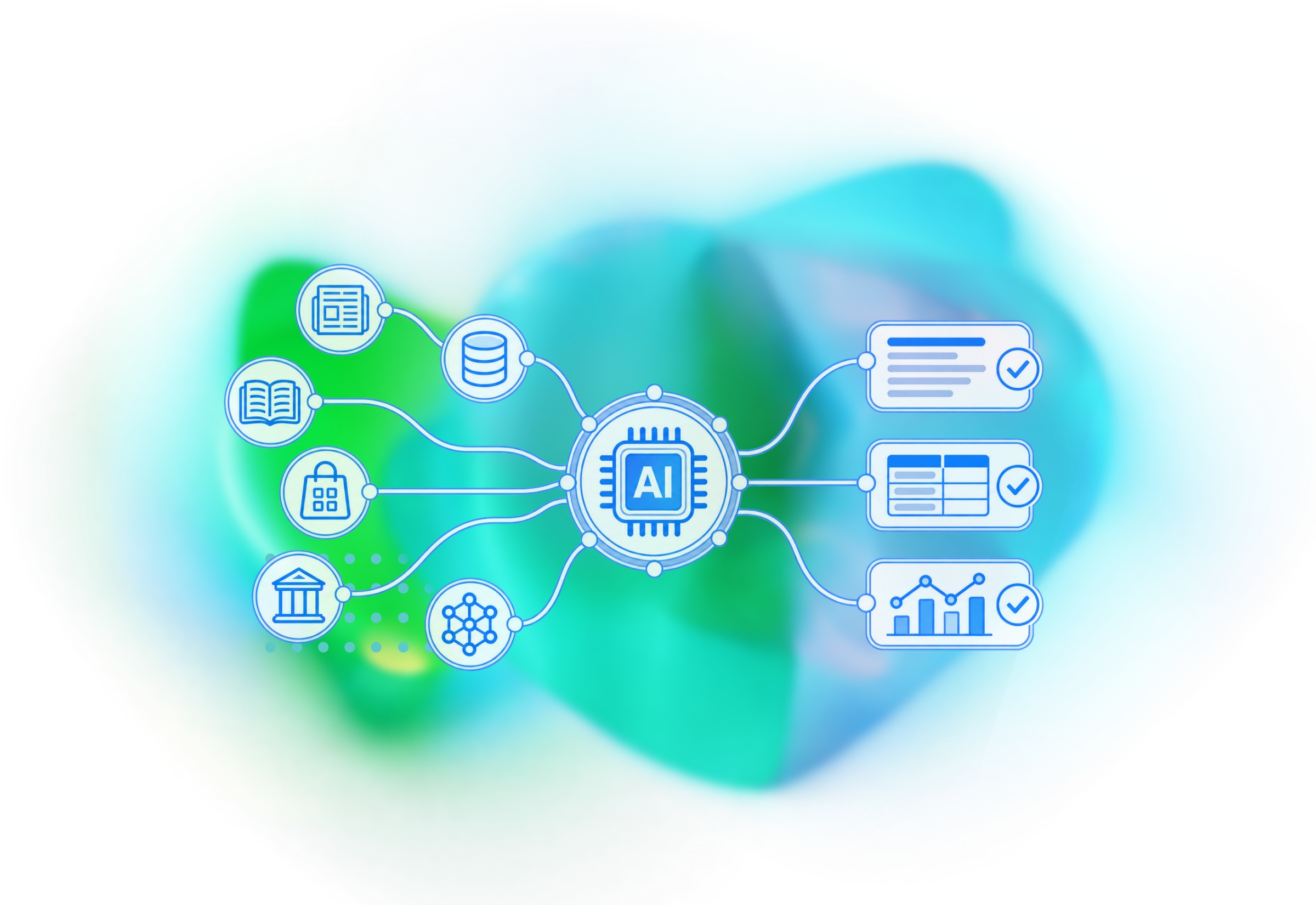
Unlock your content through conversation – with agentic AI from Retresco
Retresco enables media companies, specialist publishers and digital commerce providers to make their content accessible through intelligent AI chatbots, research assistants and interactive information services.
Agentic AI understands search intent, autonomously selects the most relevant internal and external data sources and delivers well-founded answers in real time – complete with source references, follow-up questions, tables, filters and relevant timeframes.
Ready for immediate integration. Securely scalable. Designed for a wide range of databases, content repositories and documents.
More than just answers. Intelligent access to your content.
Traditional RAG systems search within a predefined collection of documents. Retresco goes further: agentic AI dynamically determines which data, tools and methods are needed to handle each query.
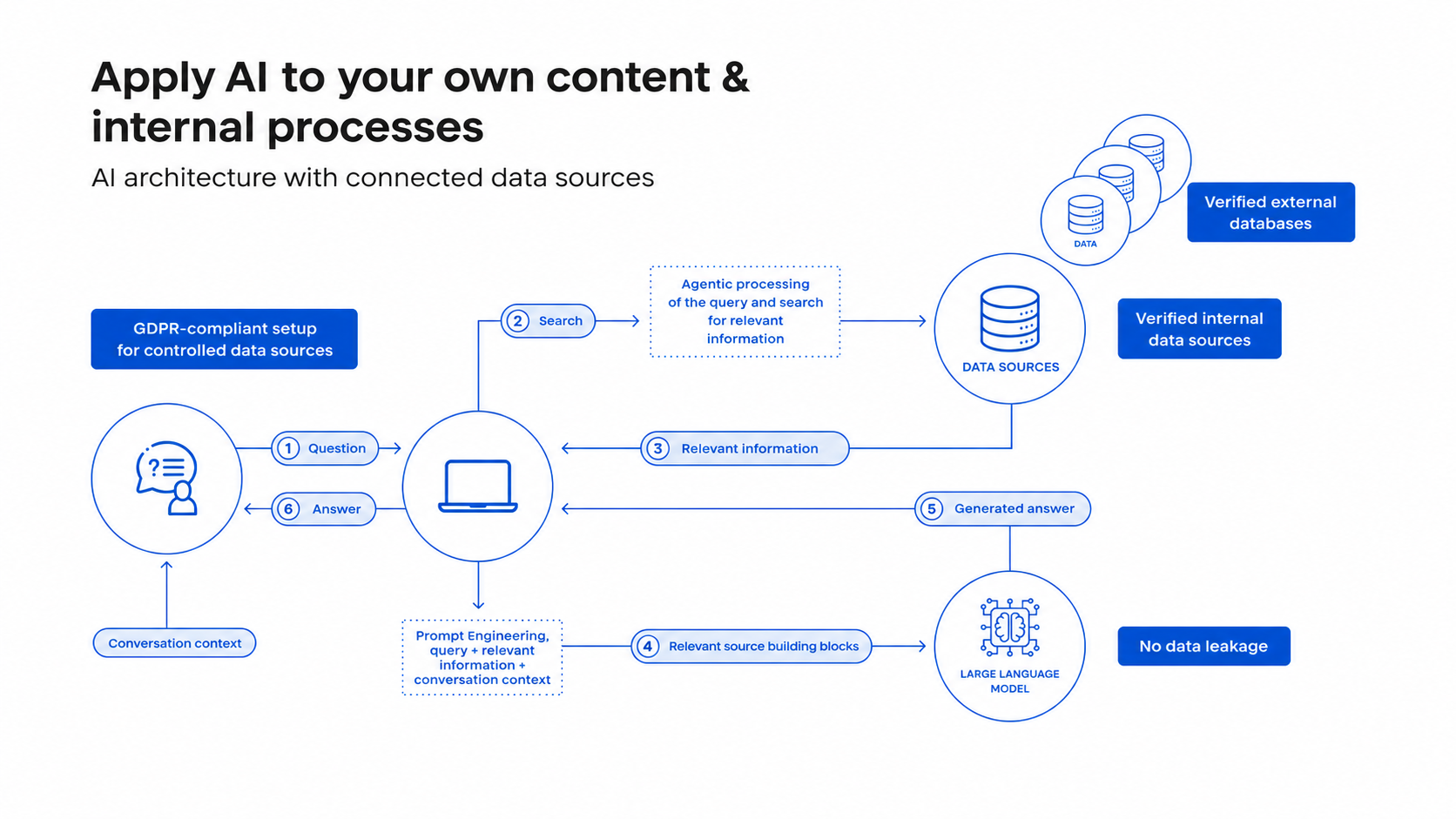
Agentic AI can, for example:
- Search editorial content, archives and product data
- Incorporate live data through APIs and MCP
- Compare information from different sources
- Prioritise and filter results
- Ask clarifying questions and maintain context throughout conversations
- Format answers according to the user’s needs and context
The result is interactive services that do more than simply display documents. They answer specific questions and support users with research, finding relevant information and making purchasing decisions.
































Agentic AI – Integrated Directly into Your Systems
Retresco provides more than individual AI components. It delivers a ready-to-use, scalable service for publishing, editorial and commerce platforms.
Get Started Quickly – Expand Flexibly
Why Retresco?
Agentic AI with Retresco: A Comparison
What sets Retresco’s agentic AI apart from conventional chatbot and RAG solutions?
Retresco combines agentic data and tool orchestration with controllable data sources, industry-specific semantics and scalable integration.
|
Agentic AI with Retresco
|
Conventional Chatbot and RAG Solutions
|
||
|---|---|---|---|
| Processing user queries | Understands search intent, context and the processing steps required. AI agents dynamically select the most appropriate data sources, tools and methods. | Typically process queries through predefined prompts, search queries or simplified retrieval workflows. | |
| Data and tool orchestration | Connects internal and external sources, including CMS platforms, archives, databases, product catalogues, documents, APIs and live data. Multiple sources and tools can be combined within a single query. | Often limited to individual document collections, static indexes or predefined integrations. | |
| Up-to-date information and live data | Dynamically incorporates current information such as news, stock market prices, weather, traffic, events and election data into answers. | Answers are primarily based on the most recently indexed data. Real-time information generally requires additional custom development. | |
| Answer quality and source control | Uses editorially curated, verified or customer-owned content. Answers include transparent source citations, references and links to relevant passages. | Sources may not always be visible, clearly attributable or drawn from controlled knowledge repositories. | |
| Complex queries and follow-up questions | Breaks down complex questions into individual processing steps, takes conversational context into account and handles follow-up questions dynamically. | Often limited to individual question-and-answer interactions with restricted contextual understanding. | |
| Structured results | Delivers clearly formatted answers, including tables, filters, timeframes, lists, recommendations and other structured elements. | Primarily presents results as continuous text. Additional development is often required for structured output and formatting. | |
| Specialist and industry-specific semantics | Combines semantic search, vector-based systems, taxonomies and industry-specific ontologies to accurately identify relationships, entities and specialist terminology. | Often relies on generic embeddings or keyword searches without extensive industry-specific terminology or domain knowledge. | |
| Scalability | Processes heterogeneous datasets containing large volumes of documents, extensive archives and continuously updated data streams. | Performance and answer quality may decline with large, distributed or frequently updated datasets. | |
| Integration into digital services | Provides a responsive, brand-consistent frontend widget for websites, apps, articles, dossiers, online shops and restricted-access areas. Alternatively, integration is possible via API and MCP. | Often provides standalone standard chat interfaces or requires custom frontend development without close integration into existing services. | |
| Personalisation and business logic | Takes account of user roles, context, regions, access permissions, paywalls, product data, target audiences and other customer-specific rules. | Personalisation is often limited to language preferences, basic user profiles or general prompt instructions. | |
| Control and governance | Enables transparent configuration of sources, answer logic, prompts, rules, roles, disclaimers and output behaviour. Business teams retain control over content and usage. | Control often depends on technically complex configurations. Retrieval and generation processes may remain opaque to non-technical users. | |
| Conversational Insights | Analyses user questions, topic clusters, usage patterns, response times, source clicks and content blind spots. Results are available through dashboards or via API push to third-party systems. | Typically offers basic chat logs or usage statistics without systematic analysis of conversational content. | |
| Model independence | Supports a range of state-of-the-art and domain-specific language models. Models can be selected according to the task, cost, quality or data protection requirements. | Often closely tied to a specific language model, cloud provider or closed ecosystem. | |
| Data protection and deployment options | Supports controllable architectures, clearly defined data environments, and hosting and integration models tailored to customer requirements. | Standardised SaaS solutions may offer only limited control over data processing, model usage and data storage locations. | |
| Industry expertise and implementation | Combines advanced AI technology with extensive experience in media, specialist information services, digital commerce and the public sector. Retresco supports concept development, integration, operation and continuous improvement. | Often provides generic AI technology without a detailed understanding of editorial workflows, product data, specialist information or public information services. | |