Blog
Owned Interactions: Why AI Chatbots Are Becoming Strategic Tools for Publishers

Johannes Sommer
CEO, Retresco
Artificial intelligence is fundamentally changing how and where people consume media content. News is no longer merely consumed passively; it is actively queried, contextualised, commented on and challenged.
As a result, the value of digital journalistic products is shifting away from the simple provision and curation of content towards personalised, dialogue-based and interactive platforms. Chat interfaces are developing into new points of contact and engagement – including news and other forms of media content.
From Feed to Chat: How News Consumption Is Changing
A recent Reuters Institute survey illustrates how far this development has already progressed. The shift is particularly evident among younger audiences: 15% of 18- to 24-year-olds use AI chatbots for news every week. Although this remains an early-stage development, it is also a clear indication that patterns of news consumption are changing.
The way these tools are used is even more revealing. According to the Reuters Institute, their use extends across the entire news journey: users actively retrieve current news, ask follow-up questions and request clear explanations of complex topics by probing further. Younger audiences in particular are disproportionately likely to use chat interfaces to explore background information and gain a better understanding of relationships and context.
This shows that AI chatbots are not only being used to obtain information quickly. Increasingly, they are also helping users contextualise, understand and examine topics and issues in greater depth.
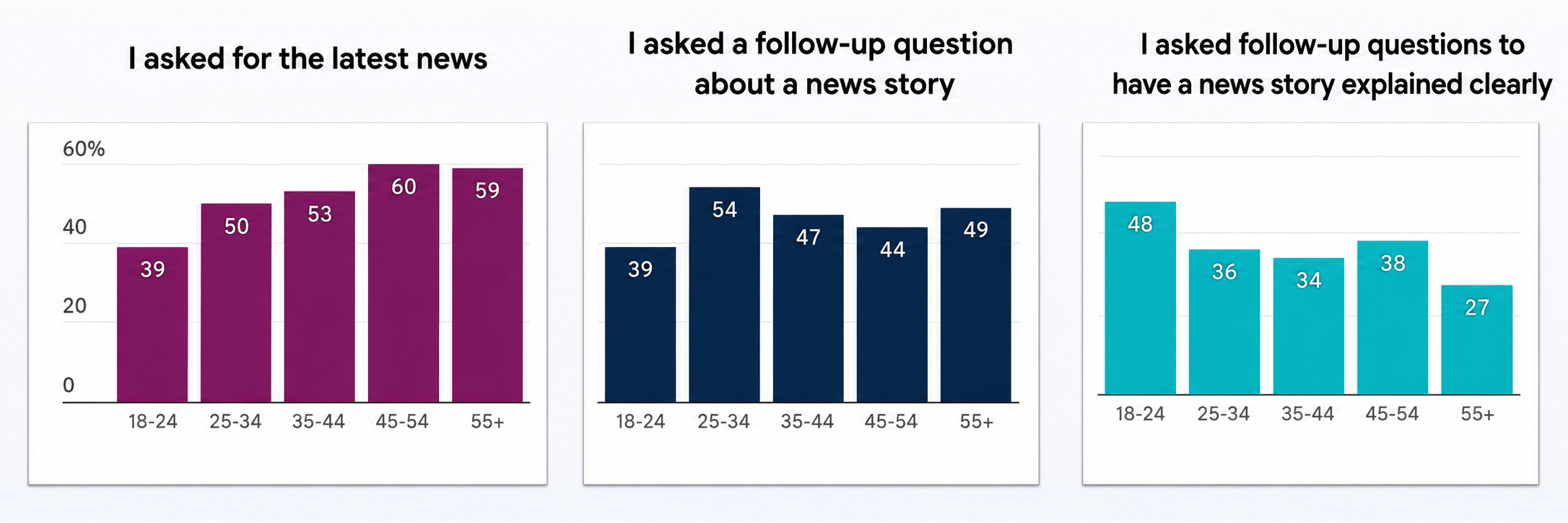
The varied use of news in chat applications (Reuters Institute)
Turning Content into Conversations: How Publishers Are Rethinking Engagement
Dialogue-based information services on publishers’ own news platforms create an opportunity to strengthen user engagement and loyalty.
The technological foundation for proprietary chat applications is provided by retrieval-augmented generation, or RAG, and agentic AI systems. These technologies make publishers’ own content accessible, place it in context and transform it into personalised interactions. Everything else depends on editorial decisions and the orchestration of the media experience:
- What objective should a chat format on the publisher’s own platform achieve?
- Which topics should it cover, and how extensive should it be?
- Which content should it access?
- Where should it be integrated?
- How should it be promoted?
Three Strategic Approaches Are Emerging for Building Interactive Relationships
1. Event- and Topic-Based Chats
These chats generally focus on a clearly defined topic or a time-limited event. Süddeutsche Zeitung has developed an AI election assistant that guides users through complex political decision-making processes such as European and German federal elections.
The Rheinische Post Media Group uses its “Gastrobot Yummy” to address food lovers and provides an accessible gateway to editorial restaurant recommendations in Düsseldorf and the surrounding area. “BreznBot”, developed jointly by Bayerischer Rundfunk and Ippen Digital, is a chatbot that brings together all relevant information about Munich’s Oktoberfest.
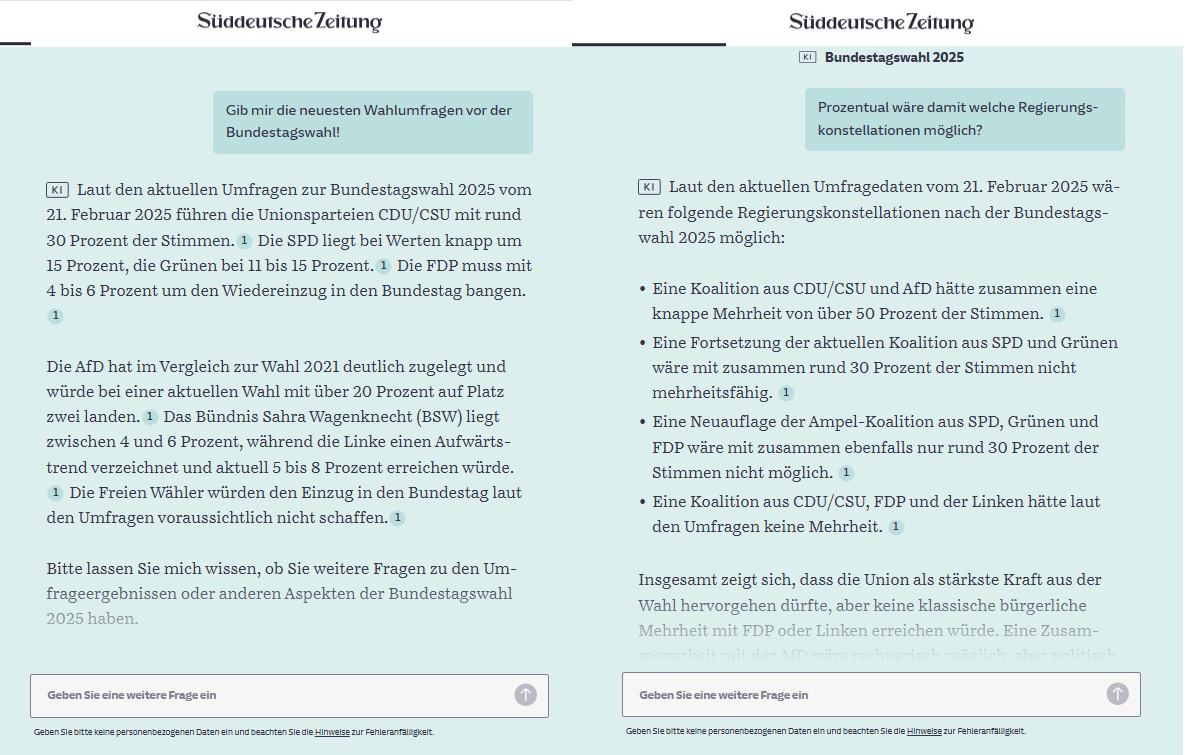
Süddeutsche Zeitung’s AI election assistant uses the newspaper’s article archive and supports follow-up questions (SZ)
Event- and topic-driven chat formats have the potential to develop from one-off use cases into modular, reusable templates. With a manageable level of technical effort, they can be adapted to a wide variety of subjects – from elections and sports games to service areas such as restaurants, events, regional business and local politics.
The editorial curation of the content available to the chat is crucial, as is the continuous editorial management of the service. These conversational assistants also make it possible to integrate different internal and external data sources and select them according to the question being asked.
2. Regional and Section-Specific News Chats
These chats have a somewhat broader scope and provide an additional service that allows users to engage with a publisher’s content in a new way.
Frankfurter Allgemeine Zeitung offers a Rhein-Main assistant that exclusively covers regional content from the relevant section published during the previous twelve months. Neue Osnabrücker Zeitung has launched “frag noz”, a chat service for local reporting.
Neue Pressegesellschaft offers a comparable service through the “Frag Mich” chatbot for the papers Südwest Presse, Märkische Oderzeitung and Lausitzer Rundschau. It combines local relevance with interactive user guidance in the respective news apps.
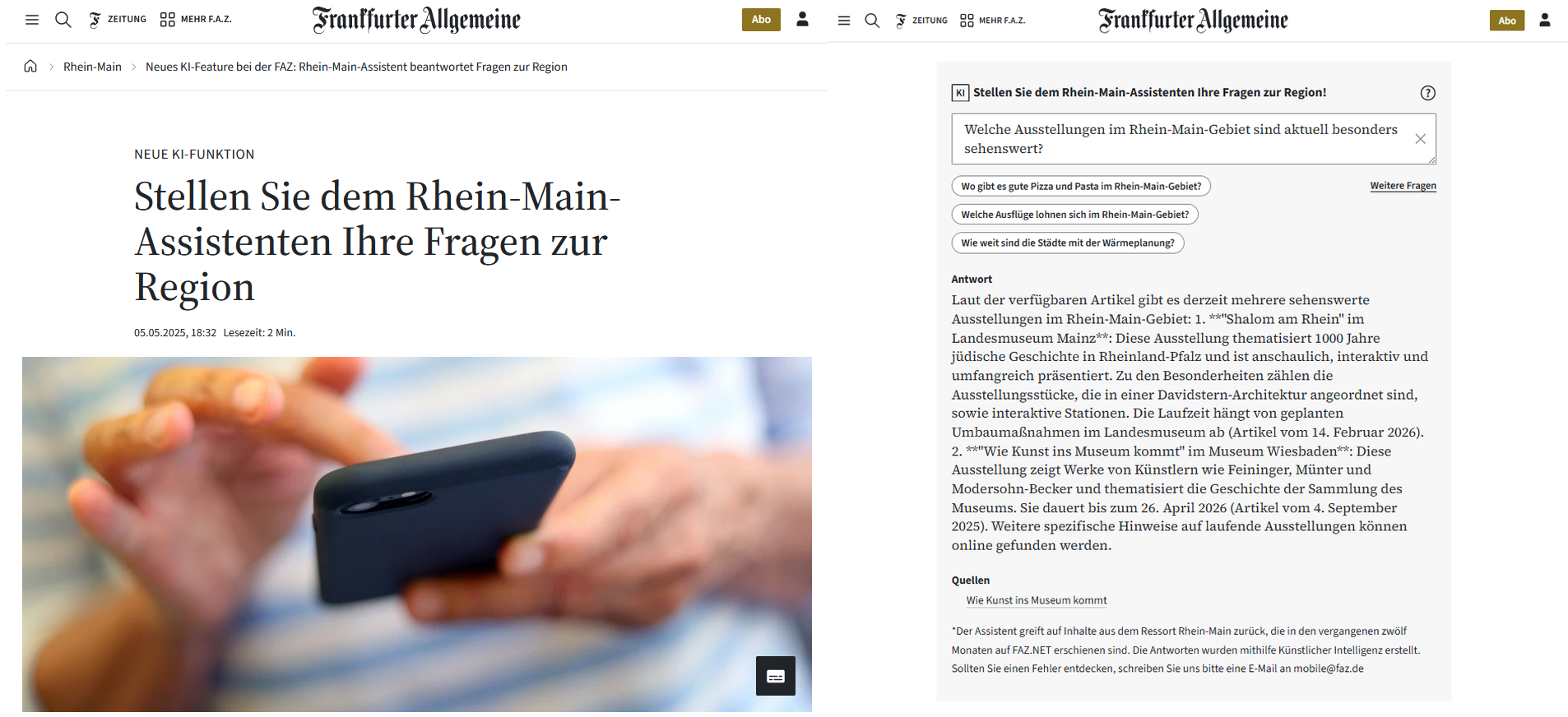
FAZ’s Rhein-Main Assistant provides interactive information about regional news and events (FAZ)
News chats of this kind have considerable potential to connect users more closely with a publisher’s offering and encourage more intensive use.
Dynamic starter questions are a central element in achieving this. They direct users towards relevant content while also demonstrating how the chat can be used and what it can do. The combination of specific information, individual user preferences and editorial context gives these chat formats significant potential for differentiation.
3. General News and Service Chats
The most comprehensive strategy involves holistic, chat-based information services that extend beyond individual sections or specific topics.
With “BILD hey_”, the BILD magazine is pursuing a cross-source approach that guides users through different subject areas. Internationally, The Washington Post demonstrates with “Ask the Post AI” how editorial content can be transformed into a comprehensive conversational experience.
DIE ZEIT is also using AI to develop its traditional archive search into a dialogue-based service and make its extensive archive newly accessible. Content from an archive built up over several decades is contextualised, condensed and summarised in response to the user’s question. The relevant sources, some of which are behind the paywall, are also referenced.
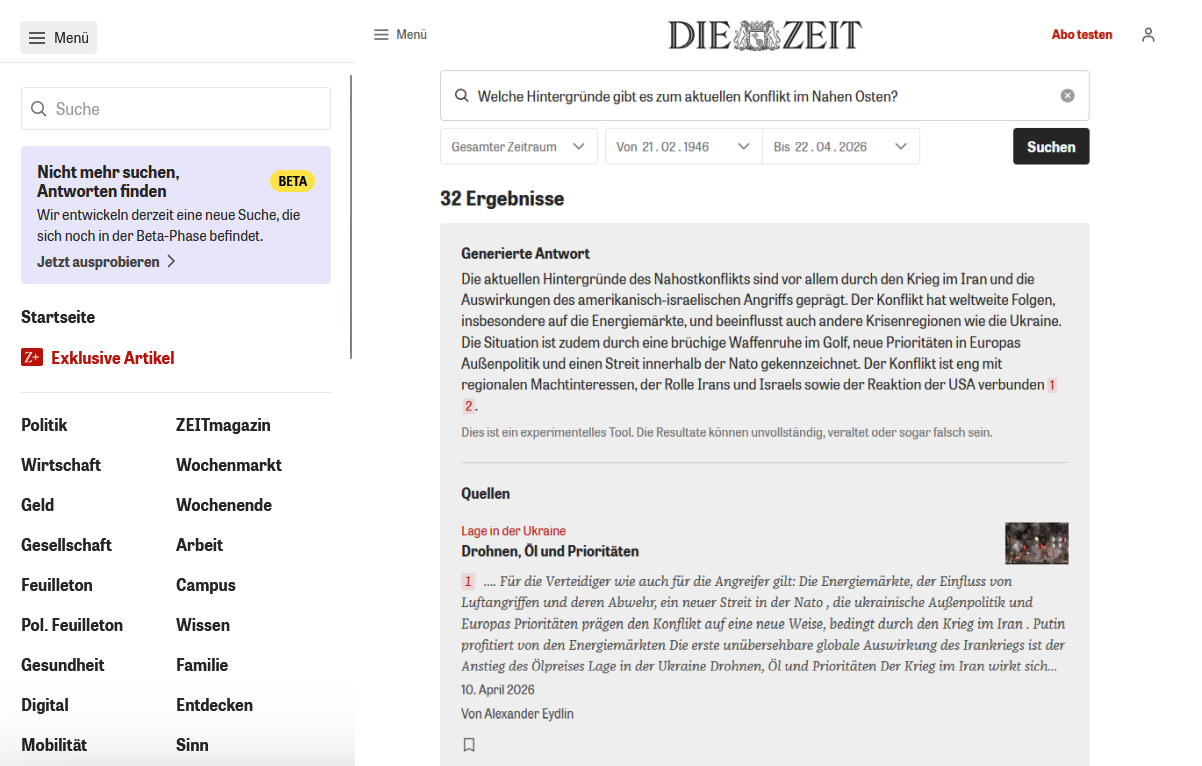
AI-based, cross-article topic search at the German newspaper DIE ZEIT
In these formats, chats serve as the central interface through which users can access and explore content.
Although only a small number of news publishers have introduced such services so far, AI-powered chats are likely to become a permanent addition to existing navigation structures on media portals. AI search services such as ChatGPT and Perplexity as well as Google’s AI Mode, are already having a significant influence on user interfaces and are fundamentally changing expectations of good websites and search functions.
The central objective is to differentiate from competitors through exclusive content, remain relevant and build lasting relationships between potential users and the publisher’s own platform and brand.
Owned Interactions Instead of Platform Dependency
All these use cases have one thing in common: publishers are expanding their offerings beyond the curation and distribution of content and moving towards direct interaction with users. The aim is to reduce dependence on intermediaries such as Google and OpenAI and establish “Owned Interactions” – directly controlled, conversational touchpoints throughout the user journey.
The individual article is no longer the sole focus of the offering. Instead, the emphasis shifts towards continuous interaction within the publisher’s own platforms. Chatbots are developing into a central interface: a universal gateway that brings together content, services and context in a personalised environment.
Ideally, users will no longer merely enter search queries but formulate specific needs and requests. This creates a strategically valuable pool of data. Every interaction provides signals about individual information interests, or “intents”, as well as needs and usage contexts.
Such data not only enables better personalisation but can also support product development, editorial prioritisation and monetisation.
In short, “Owned Interactions” are far more than a buzzword. They provide a conceptual foundation for the data-driven management of contemporary media products.
Attention or Relationship? Defining User Loyalty Strategically
As with the introduction of any new service, clear objectives should be defined at the outset.
1. Open Versus Exclusive Services
Open services are chatbots that are freely available to all visitors outside the paywall. Examples include the shown services from BR and Ippen Digital, the Rheinische Post Media Group, noz, BILD and DIE ZEIT. These services primarily aim to generate broad reach and intensive use.
Exclusive services are chatbots that are available only to subscribers behind the paywall. Examples include the services offered by Süddeutsche Zeitung, FAZ, The Washington Post and Neue Pressegesellschaft. Their aim is to strengthen long-term user loyalty, support subscriber retention and encourage further engagement, for example through clicks on source articles.
When conversational formats are also designed as general-purpose services and partially link to content behind the paywall, as is the case with ZEIT, they can also contribute to acquiring new users.
2. Event-Specific Versus “Ask Me Anything” Services
Event-specific formats have a clearly defined thematic scope and generate peaks in attention and engagement around their subject matter. They are easy to understand and particularly suitable for gaining initial experience with artificial intelligence. Their greatest impact lies in attracting attention and immediately activating users. While event-specific chats are tailored to clearly defined applications, general approaches derive their value from comprehensive access to an extensive data foundation.
General “ask me anything” approaches are structurally more demanding and should be regarded as a long-term strategic investment. They offer advantages in terms of scalability and allow for broader use beyond individual use cases, although they place greater demands on design and operation. Broadly designed chats can reveal recurring patterns of use, topic clusters and gaps in the available information. These findings can then be used, among other things, to develop personalised services.
Important metrics for evaluating a chat service include:
- interaction frequency
- depth of dialogue
- fulfilment of information needs
- return rates
- click-through rate to source articles
- subscriber retention
- conversion into subscriptions, where applicable
Users Learn How to Engage in Conversations
Our own customer analyses show that users’ engagement with interactive services becomes more intensive over time. At the beginning, many users primarily rely on predefined starter questions to initiate an interaction. As they become more familiar with conversational services, however, the proportion of questions they formulate themselves increases considerably.
The number of questions asked within each conversation also rises the longer a chat service is available on a media platform. Individual, isolated questions gradually develop into multi-stage exchanges. This is an expected reflection of the users’ learning process.
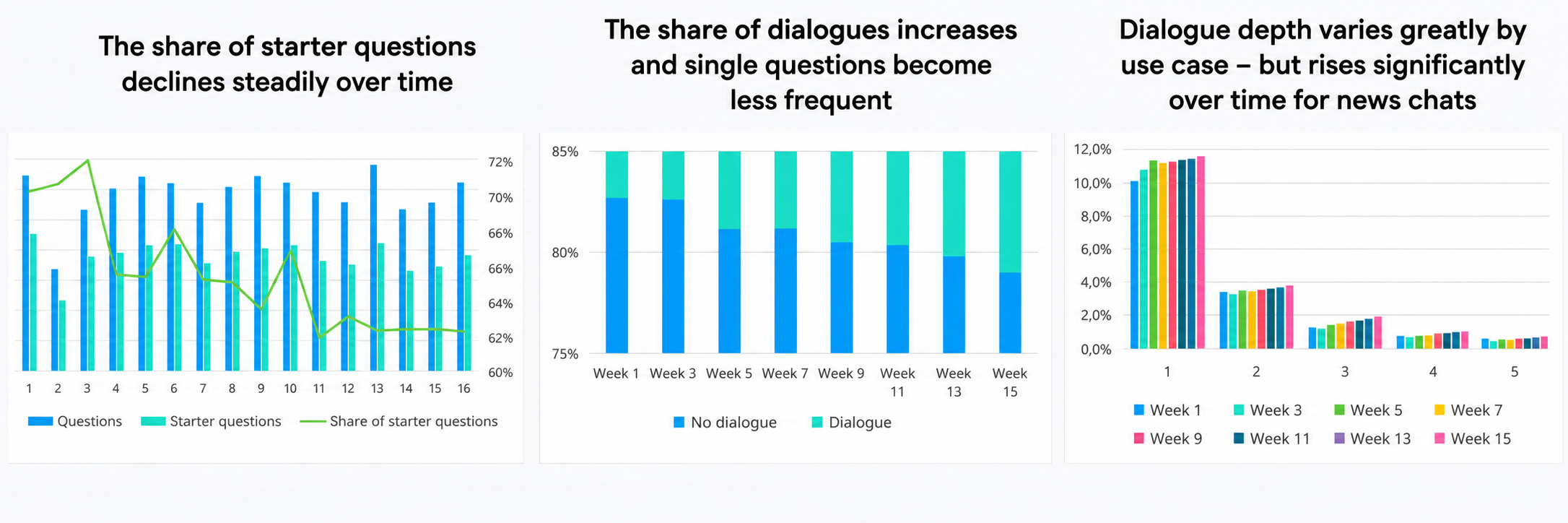
Growing acceptance of interactive services over time (anonymised Retresco customer analysis, April 2026)
At the same time, users increasingly expect more than lists of articles or search results. They expect relevant, context-specific answers to specific questions that allow them to continue the conversation.
From Chat to an Owned Service Ecosystem
This development is still at an early stage. Nevertheless, there are strong indications that chat interfaces will become established throughout the media value chain. Publishers should aim to create direct and controllable interfaces with their users, strengthen their own communities and generate valuable data.
From Answers to Services Through Agentic AI: Transforming Media Products
With the help of agentic AI, media portals can evolve from purely informational offerings into active, service-oriented platforms. Interactive formats such as chats and personalised feeds can become intelligent everyday companions. In future, they will not only provide editorial content but will also connect users with suitable and relevant services.
This development will be driven by agentic pipelines that increasingly and autonomously connect information intake, analysis and action within integrated processes.
New Advertising Opportunities Through Conversational Advertising
Dialogue-based interfaces create opportunities for new, integrated advertising formats. Contextual, interactive recommendations that fit thematically into the conversation offer promising approaches to monetisation. It remains to be seen whether, and to what extent, such formats will become established.
One point is clear, however: transparency is essential. Advertising must not only be clearly labelled but must also be visibly and comprehensibly separated from editorial responses and content.
Better User Understanding Through Conversational Analytics
Continuous dialogue with users provides qualitative insights that go far beyond traditional performance metrics, clicks and time spent on a platform. Chats reveal users’ information interests, specific needs and gaps in the editorial offering. This helps publishers target content more precisely, activate users regularly and improve conversational services iteratively.
Interactive Services and Chats Are the Future
The emergence of chat interfaces associated with AI is far more than a short-lived trend. It is a permanent feature of a fundamental change in information behaviour. Users expect immediate, contextual and personalised interaction with content. At least as a complement to existing services, they will also expect this type of user experience from media platforms.
The strategic opportunity presented by proprietary dialogue-based services lies in the data they generate and in their potential to build sustainable user relationships. Interactive interfaces can act as intermediaries between editorial offerings and users, providing conversational access to content.
Do you have any questions, comments or feedback? Get in touch – our AI experts will be happy to speak to you.
Recent Blog Posts