Blog
Monetising AI Chatbots: New Revenue Models for Media Companies

Nadine Jakob
Marketing Manager, Retresco
Artificial intelligence is not only changing how content is produced, searched for, and distributed. It is also changing how media companies can monetise digital offerings. While traditional display advertising, native advertising, sponsorships, and paid content remain relevant, AI chatbots and interactive information services are creating a new product category:
Conversational services where users no longer simply read articles, but ask specific questions, explore content in greater depth, prepare decisions, and formulate individual information needs.
This also changes the logic of monetisation. The focus is no longer solely on the reach of a media offering or the placement of an ad within an editorial environment. What becomes decisive is the specific user intent: What question is someone asking? In what context does this question arise? Where is the person in their information or decision-making journey? And how can a media company respond without putting journalistic integrity, transparency, and trust at risk?
These are precisely the questions Retresco addressed in this article by CEO Johannes Sommer: Monetising Chatbots: AI Between Editorial Content, Advertising, and User Interactions. For media companies, chatbots are not simply an additional advertising space, but a strategic instrument for user engagement, topic authority, data intelligence, and new business models. At the same time, the article emphasises that advertising elements in AI chats only make sense when editorial content and commercial monetisation remain clearly separated.
Why AI Chatbots Are Becoming New Monetisation Spaces
Over the past few months, many media companies have started testing their own AI chatbots, interactive article archives, topic chats, and research assistants on their websites and in their apps. The underlying idea is obvious: editorially reviewed content, databases, service-oriented articles, and current news should not only be accessible through search, navigation, or recommendation systems, but also through natural language.
For users, this creates a much more active experience. They can ask follow-up questions, narrow down topics, compare information, request summaries, or be guided through complex subjects. A static article archive becomes an interactive information product. A topic page becomes a conversational hub. A service section becomes a personal decision-making assistant.
For media companies, this opens up new monetisation opportunities. First, it creates new, high-value touchpoints with particularly clear user intent. Second, user questions provide valuable insights into topic interests, information gaps, and specific needs. Third, AI chatbots can support existing revenue models, for example by improving subscription conversion, enhancing paid-content offerings, or enabling new B2B services in specialised media environments.
One thing is clear: monetising AI chatbots should not be understood as simply transferring conventional banner advertising into a new interface. Precisely because users often ask very specific questions in a chat, trust in the answers and follow-ups is especially sensitive. Advertising, sponsorships, and recommendations must therefore be transparent, contextually relevant, and clearly separated from editorial content.
Google AI Mode Shows Where Search and Advertising Are Heading
Recent developments at Google show that conversational search and AI-based advertising are moving from experimentation to mass adoption. During its I/O developer conference, Google announced that AI Mode had reached more than one billion monthly active users worldwide one year after its launch. At the same time, AI Mode queries have more than doubled every quarter since launch.
Google also stated that the average AI Mode search is three times longer than a conventional search query, and that planning-related queries in AI Mode are growing significantly faster than overall usage.
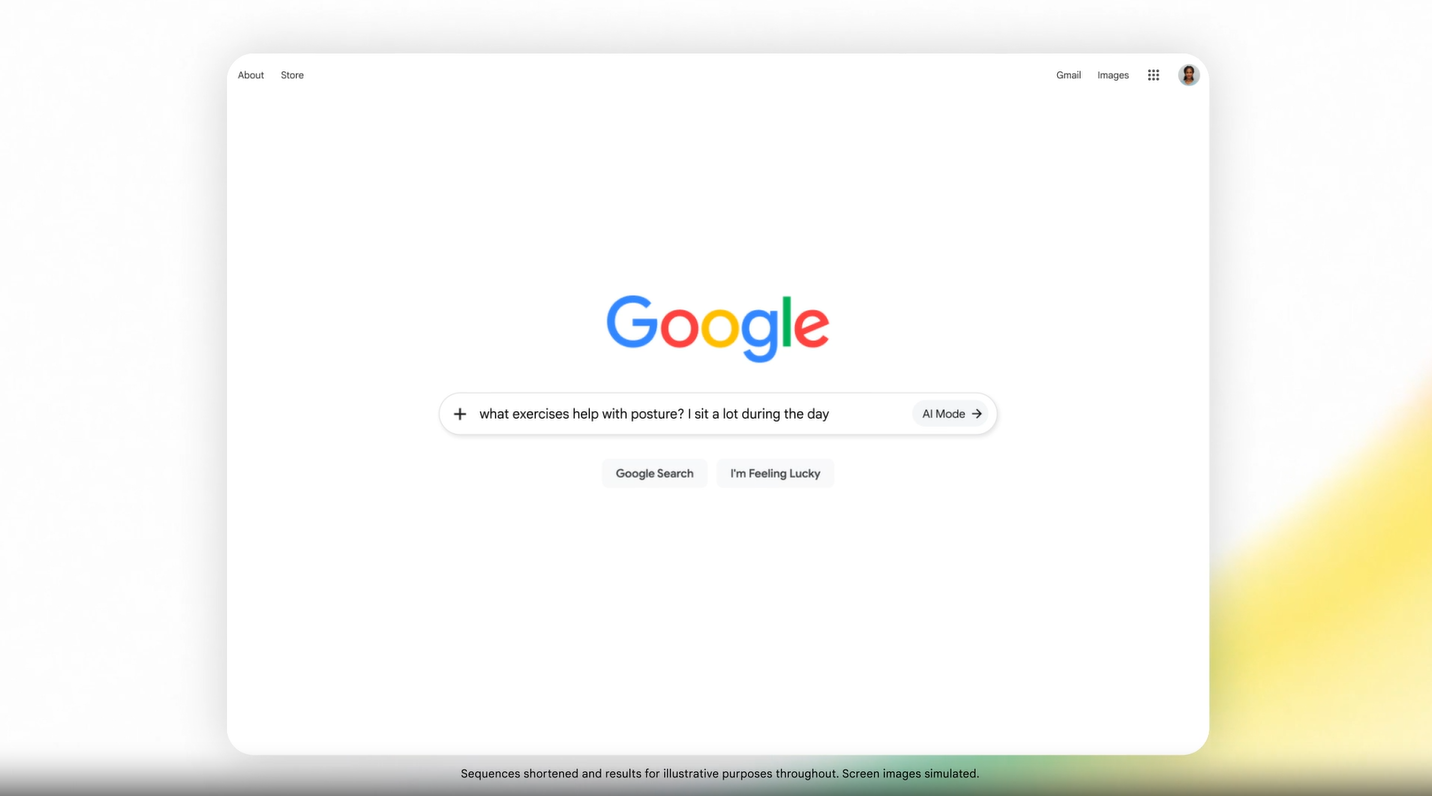
Google’s advanced AI search at the I/O developer conference (Google)
These figures are highly relevant for media companies. They show that users are not using AI search only for simple factual questions. They are asking longer, more complex, more situational questions. They are planning trips, purchases, learning processes, health or financial decisions, leisure activities, and professional projects. These are precisely the kinds of usage situations where media brands have traditionally been strong: they provide context, explain, compare, verify, recommend, and build trust.
From AI Search Visibility to Owned Conversational Experiences
Google I/O also made clear that Google Search is evolving into an AI-based, interactive interface. TechCrunch described the shift as the definitive end of the familiar “ten blue links” logic: Google is expanding search with a smarter search box, longer conversational queries, follow-ups, interactive elements, and agentic features that can monitor or gather information for users in the background.
For media companies, this means that visibility will no longer come simply from ranking well in search result lists. Content must be prepared in a way that makes it understandable, citable, up to date, structured, and conversationally usable for AI systems. Interestingly, Google has now confirmed for the first time that optimising for AI-powered search experiences does not fundamentally differ from proven SEO principles: high-quality content, clear structure, freshness, technical accessibility, and clearly identifiable sources remain essential.
At the same time, it would be risky for media companies to focus their strategy solely on visibility in Google AI Mode. If users increasingly ask their questions directly in AI search environments, the direct relationship between media brands and their audiences could shift to Google. That makes it all the more important to strengthen and develop owned channels, direct user relationships, and proprietary interactive information services.
Media companies should therefore not only optimise their content for AI search, but also turn it into their own conversational products – such as AI chatbots, research assistants, topic hubs, or self-service offerings on their own platforms.
Google Marketing Live: When Ads Respond to Questions
This development becomes even clearer when looking at Google Marketing Live, which was also presented as part of the Google I/O developer conference. There, Google introduced new Gemini-based ad formats designed specifically for AI Mode and AI-powered search. These include Conversational Discovery Ads, Highlighted Answers, AI-powered Shopping Ads, Direct Offers, and the Business Agent for Leads. Google describes these formats as a new generation of ads for the AI era of search.
The direction is clear: ads should no longer merely appear next to a search query, but respond directly to users questions. According to Google, Conversational Discovery Ads can generate advertising content tailored to specific, longer questions. Highlighted Answers are intended to appear in AI-generated recommendation lists. AI-powered Shopping Ads can not only display products, but also explain why they fit a particular search intent. The Business Agent for Leads integrates an AI agent directly into ads, allowing users to ask questions instead of filling out a static form.
In short, Google ads will increasingly respond to specific user questions. Conversational Discovery Ads and Highlighted Answers are already being tested, Direct Offers are being expanded, and the Business Agent for Leads is intended to enable conversational lead generation directly from ads.
For media companies, this is an important signal. If Google increasingly thinks of advertising as part of an answer, a recommendation, or a conversational interaction, the monetisation of journalistic AI offerings will not stop at banners in a chat window. The real question is: How can monetisation information be integrated into interactive offerings in a way that remains useful, transparent, and trustworthy?
Monetisation Opportunities for AI Chatbots in Media
1) Monetisation Through Native Cards and Contextual Partner Notices
The most obvious monetisation format is clearly labelled native cards around chat answers. They can appear below an answer and be marked as “Ad,” “Sponsored,” or “Partner Notice.” Unlike traditional ad banners, however, such cards should not be displayed randomly. Instead, they should be tied to topic clusters, intent categories, and editorially defined contexts.
For example, if a user asks a regional leisure chatbot for family outing ideas for the weekend, a clearly labelled partner card for a museum, amusement park, or local event could make sense. In a financial advice chatbot, sponsored references to webinars or advisory services could appear, provided they are transparently labelled and clearly separated from editorial content. In B2B specialised media, vendor profiles, white papers, studies, or event notices could be integrated into suitable professional contexts.
2) Sponsored Topic Hubs With Editorial Control
Another option is sponsored topic hubs. In this model, it is not the individual answer that is monetised, but an entire interactive section. A specialised publisher, for example, could provide an AI assistant on sustainability, energy efficiency, construction law, HR management, or digital transformation and connect it with a clearly labelled partner or sponsor. What matters is that the sponsor does not control the editorial answers. Editorial authority, source logic, and quality assurance must remain with the media company.
3) Lead Models Along Specific User Needs
Lead models are another interesting option. Especially in specialised media, advice-driven content, and B2B environments, users often ask questions that indicate a concrete need. A chatbot can help qualify these interests more effectively. Users who engage deeply with topics such as tax questions, professional training, or funding programs can, with their consent, be directed to relevant offers, downloads, events, or advisory options. The difference from conventional lead forms is that qualification happens through dialogue – along actual questions and needs.
4) Premium Features and Subscription Value
Another monetisation opportunity lies in premium and subscription models. AI chatbots do not have to be monetised primarily through advertising. They can also enhance paid content. A media company could offer a freely accessible basic chat, while deeper features such as archive access, topic dossiers, source comparisons, personalised briefings, or professional research functions become part of a subscription. For specialised publishers in particular, this can become a standalone digital service product.
5) Data-Based Insights for Editorial, Product, and Monetisation Teams
AI chatbots also enable interactive data and insight products. Aggregated analysis of user questions can show which topics are searched for most frequently, which terms users use, where editorial content is missing, and which decision-related questions arise in a particular industry. These insights can inform editorial planning, product development, SEO activities, newsletter strategy, and monetisation alike.
Why Intent Data Is Becoming More Valuable Than Reach Alone
Digital monetisation has traditionally been based primarily on reach, target audiences, topic environments, and performance KPIs. AI chatbots add a new dimension to this logic: explicit intent. In chats, users often state very precisely with what they want to know, compare, buy, plan, or decide.
This kind of intent data is especially valuable because it is not merely inferred from click behaviour, but emerges directly from questions. A user who asks, “Which heating subsidy fits my single-family home?” signals a different need than someone who simply opens an article about energy policy. A question such as “Which legal changes do I need to be aware of as a managing director in the new year?” gives a specialised media company a much more precise indication of need, context, and possible follow-up offerings than a page view.
For media companies, this can create a structural advantage. They have editorially reviewed content, strong brands, topic authority, and deep audience knowledge. When these assets are connected with conversational interfaces, new opportunities arise for qualified user interactions and high-value monetisation models.
Which Advertising Formats Make Sense and Which Do Not
Not every advertising format belongs in an AI chat. I have already mentioned the need to be transparent when it comes to labelling. Automatically generated product recommendations in sensitive topic areas can also damage trust in a journalistic offering. Politics, health, law, disasters, topics involving children and young people, or personal crisis situations should be treated with particular caution.
More suitable are formats that remain clearly recognisable as separate units. These include sponsored cards, partner notices, thematically relevant service boxes, download recommendations, event notices, vendor profiles, or clearly marked commercial follow-up offers. The key point is that editorial answers must not be influenced by advertising clients. Commercial elements may connect to the context, but they must not determine the editorial direction.
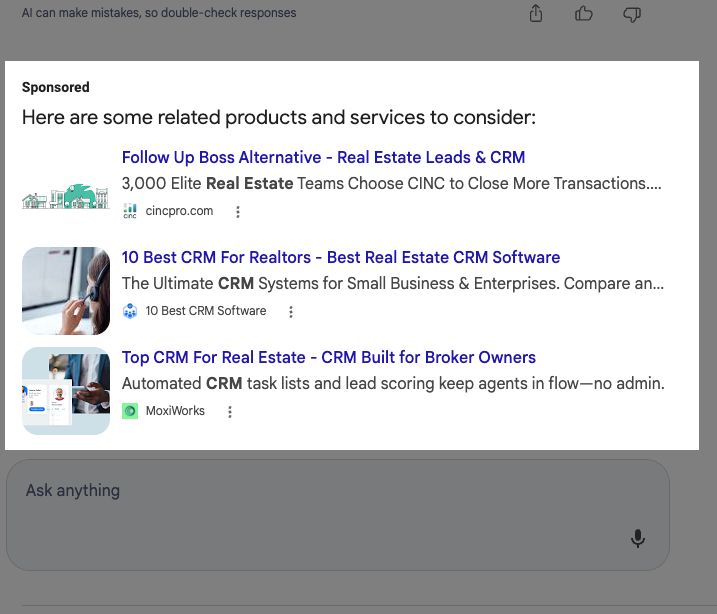
Early Google ads in AI Mode – labelled as “Sponsored” (Chris Long)
Google also emphasises that its new AI Mode ad formats will continue to be labelled as “Sponsored” and that AI-based explainers are intended to create transparency. For media companies, however, this kind of platform logic is not enough. They need their own standards that fit their journalistic brand, audience, and specific usage context.
Interactive Information Services as a New Product Class
AI chatbots are currently developing into a new product class. They combine editorial content, search, databases, user guidance, personalisation, and service within a single interface. This creates new formats:
Election chats that explain platforms, candidates, and positions. Health or legal topic assistants that make reliable content easier to find. Advice chatbots for users who are ready to make purchasing decisions. B2B research assistants for specialist audiences. Article archives for subscribers. Shopping and product advisors in e-commerce environments. Event guides, local leisure assistants, or interactive topic dossiers.
Such interactive offerings have their own monetisation value. They can generate recurring engagement, strengthen user loyalty, support subscriptions, provide new data, qualify leads, and create sponsorship opportunities. Above all, they strengthen the direct relationship between media brands and their audiences.
What Media Companies Should Do Now
Media companies should first clarify the strategic role AI chatbots are meant to play in their offering. Is the goal user engagement, subscription growth, reach, lead generation, service, research, archive usage, or monetisation? Only once this goal is clear can they decide which monetisation model makes sense.
The next step is to identify suitable use cases. Particularly suitable are topic areas with high information needs, recurring questions, extensive archives, publisher-owned sources, and recognisable follow-up usage. These include service journalism, specialised information, local services, political and election information, business, consumer topics, law, health with special caution, careers, education, real estate, energy, mobility, and B2B specialised topics.
The third step is a clean technical and editorial architecture. This includes RAG systems, semantic search, source logic, rights and access concepts, update processes, monitoring, feedback mechanisms, and analytics. Advertising delivery should not be “added on” later, but embedded in a governance model from the outset.
The Future of Media Monetisation Is More Conversational, but Not Arbitrary
AI chatbots and interactive information services open up new monetisation opportunities for media companies. They create high-value usage situations, make user intent visible, unlock archives in new ways, and can transform editorial products into digital services. At the same time, they raise the bar for transparency, governance, and trust.
Recent developments at Google show where the market is heading: search is becoming more conversational, ads are becoming more contextual, recommendations are increasingly embedded in AI answers, and users increasingly expect interactive, action-oriented information services. Media companies would therefore be well advised to develop their own conversational offerings in order to strengthen and expand the direct relationship with their audiences — rather than lose even more of it to platforms such as Google.
The best monetisation strategy is therefore not to integrate as many ads as possible into chat interactions as quickly as possible. What matters is a model that brings together user value, editorial credibility, and commercial viability. Those who master this balance can turn AI chatbots into more than a new interface: they can create a strategic media product with its own revenue potential.
Do you have questions, comments or feedback? Please get in touch – we would be happy to hear from you.
Recent Blog Posts