Blog
Model Context Protocol (MCP): The New Standard for Integrating AI Applications in Media Organisations

Aleksandar Petrovic
Head of Sales & Customer Advisory, Retresco
Conversational AI is changing how people use journalistic information. Many users no longer rely solely on section navigation or search boxes. They ask specific questions, expect concise and reliable answers, and explore topics further through dialogue.
For media organisations and publishers, this raises a new infrastructure question: how can their own content, archives, databases, sources and external data services be connected in a way that allows AI applications to work with them reliably – without giving up editorial control, rights management, source logic or brand trust?
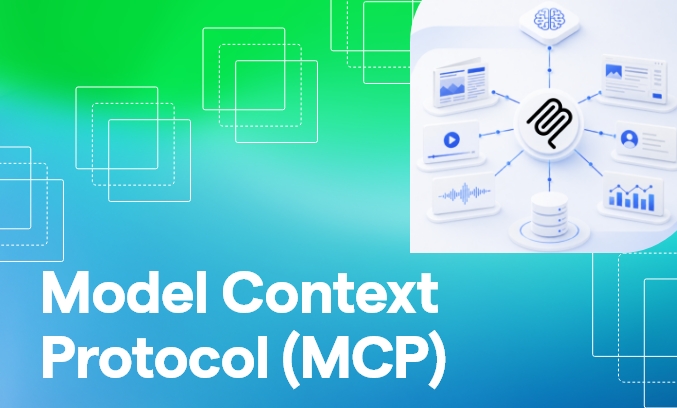
This is where the Model Context Protocol (MCP) comes in. MCP is not an AI application in itself. It is an interface that enables AI chatbots, RAG systems and agentic workflows to access content, data sources, systems and tools in a controlled way.
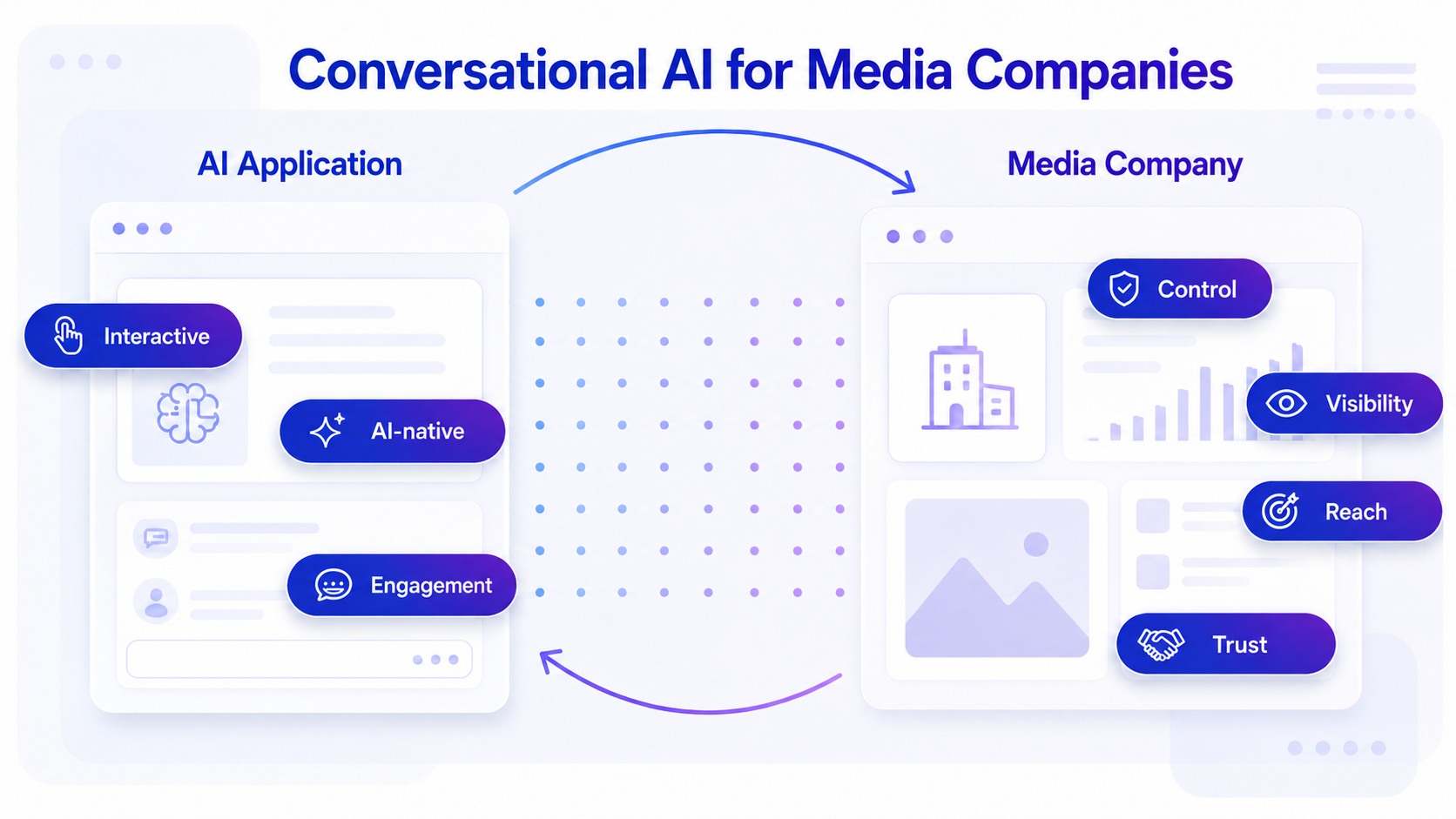
Conversational AI turns journalistic products into interactive, bidirectional information services.
What Is MCP – And What Is It Not?
MCP is an open standard initiated by Anthropic that allows AI applications to access external data sources, content, tools and functions in a controlled manner. Put simply, MCP describes how an AI system discovers which capabilities a connected system provides, how those capabilities can be called, and which results are returned.
For media organisations, this is especially relevant wherever AI chatbots, RAG applications, internal assistant systems or agentic workflows need to access media archives, topic databases, editorial systems or analytics tools. Instead of building individual integrations for every data source, archive, tool and AI interface, functions and data access can be described and provided consistently via MCP.
However, it is important to be clear about what MCP does not do. MCP does not replace existing API architectures or RAG. It is not an answer logic, an agent or a search method. Rather, MCP governs standardised access to data sources, systems, tools and executable actions.
RAG: Relevant content as the basis for better AI answers
To understand MCP properly, it is useful to first look at RAG. Retrieval-Augmented Generation enables AI applications to retrieve relevant content from defined data sources and use it as context for accurate, source-based answers. In a media environment, this can include archives, articles, dossiers, topic databases or other editorially verified content. RAG therefore primarily answers the question: “Which content is relevant to this query?”
Agentic AI: When applications plan and execute steps autonomously
Agentic AI describes AI applications that do more than generate a single answer. They process questions and tasks in multiple steps: researching information, comparing sources, checking results, prioritising content, calling additional systems or tools, and deriving follow-up actions. Agentic AI therefore primarily answers the question: “Which steps are required to answer this question meaningfully?”
MCP: A standardised interface for AI applications
MCP describes a standardised interface through which AI applications can access external data sources, tools and functions in a controlled way. It makes it possible to define which systems are connected, which actions are permitted, and how information is provided securely. MCP therefore primarily answers the question: “How can an AI application interact safely and consistently with connected systems?”
In production scenarios, these approaches complement one another: RAG brings relevant content into interactive services. Agentic AI organises multi-step processes, decisions and responses. MCP provides a standardised access layer for data sources, systems and tools.
Why MCP Matters for Media Organisations
For media organisations and publishers, MCP is not simply another technology trend. It is about connectivity in a media environment where content increasingly needs to be made available to AI interfaces.
An AI chatbot on a news website may already use RAG to access article archives. MCP can extend this kind of service. In addition to editorial content, it can connect knowledge bases, metadata, topic dossiers, image archives, rights checks, event data, weather, traffic or financial market data, and other sources.
The value of MCP does not lie in automatically making AI applications produce better answers. Its real value lies in structuring access to data, content and functions in a controlled way.
MCP defines the conditions under which an AI application may access external resources. This includes questions such as:
- Which sources is the AI allowed to use?
- Which tools or systems are available to it?
- Which information or results are returned to the AI?
- Which sources must be shown transparently in the answer?
- Which actions is the AI application allowed to trigger?
For media organisations, these are fundamental questions. Journalistic and editorial AI applications need more than plausible text. They need reliable sources and traceable references.
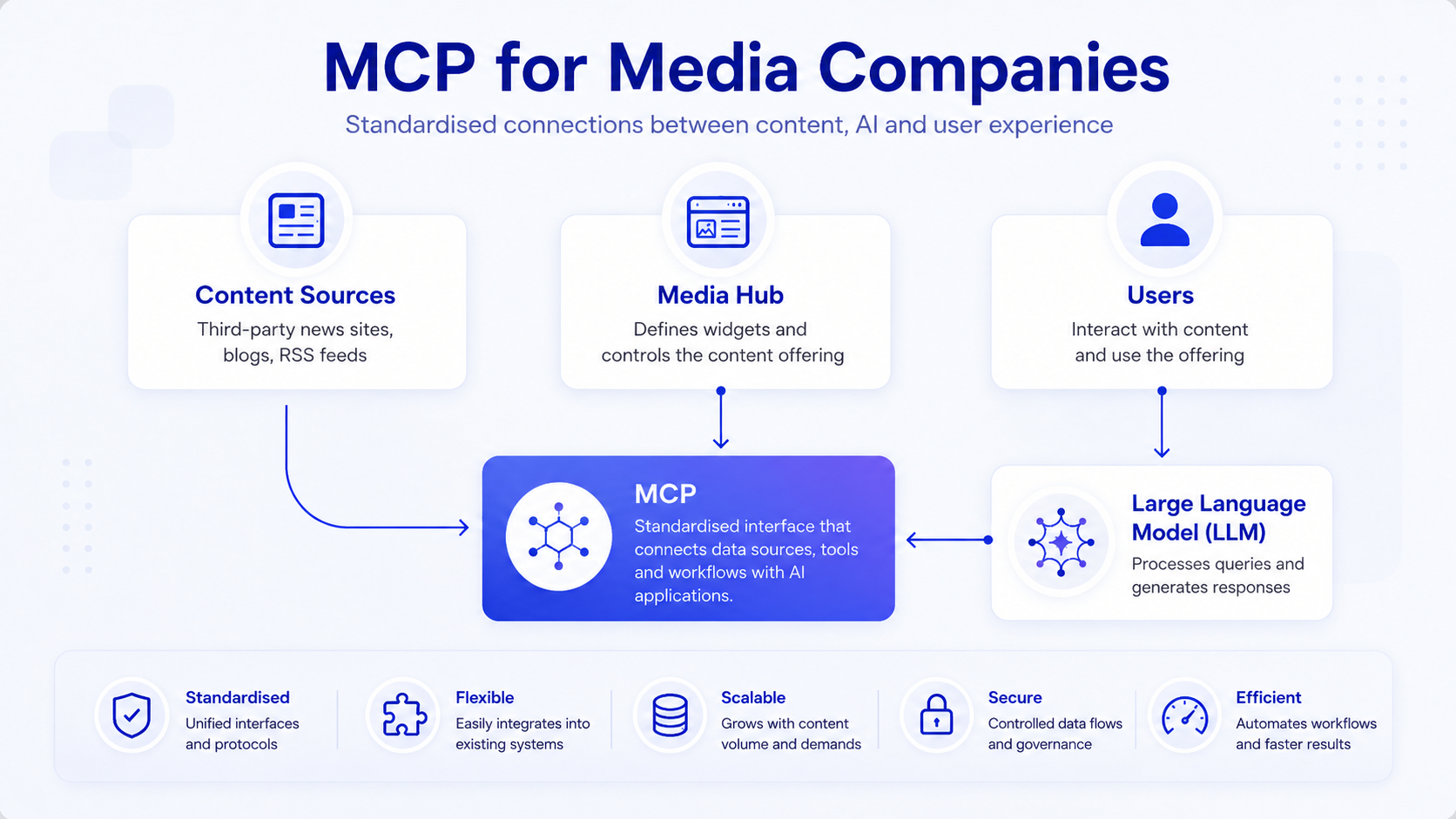
MCP as a standardised connection layer for AI-supported content, tools and workflows.
Different approaches to MCP integration
When implementing MCP, media organisations can broadly follow two approaches, which differ in complexity and scope: building their own MCP servers to provide content, data and functions in a controlled way, or developing flexible MCP clients to orchestrate different tools and data sources.
MCP Servers: Providing content and functions
An MCP server makes internal publishing content, data assets and specialist applications accessible to AI applications. The publisher acts as a provider and makes selected capabilities available in a controlled manner.
Typical use cases include structured archive search, access to current articles, topic dossiers, metadata queries, image rights checks or proprietary topic databases.
The advantage is that media organisations retain control over which data, content and functions AI applications are allowed to use. Their own content can be integrated flexibly into different internal or external AI interfaces, chatbots and apps.
The effort remains manageable when use cases are clearly defined – for example, a single archive, a specific topic dossier or a domain-specific specialist application.
MCP Clients: Orchestrating agentic pipelines
An MCP client is the part of an AI application that connects to attached MCP servers. Through this client, the application can access data sources, content, functions and tools. The client therefore sits on the side of the AI application – for example in an internal research bot, an editorial workspace or an AI assistant. It ensures that the application can communicate with approved MCP servers in a controlled and structured way.
An MCP client is not necessarily an agentic pipeline. It first creates the technical basis for AI applications to use different MCP servers and their capabilities. The AI system becomes agentic only when the application autonomously plans intermediate steps, selects appropriate tools, queries data sources, evaluates results and derives further actions.
Typical use cases are found above all in complex editorial workflows. Instead of merely querying a search index, an AI application can validate data sources, retrieve current dates or events, initiate rights checks, combine content from different systems, and prepare results in a structured way for multi-step dialogues, research tasks or editorial workflows.
The advantage is that MCP clients enable more sophisticated AI applications than simple search or answer systems. They form the basis for agentic research processes, automated fact-checking, personalisation, validation and workflows involving different roles or specialised agents.
The effort is correspondingly higher. An agentic pipeline requires intelligent prioritisation of available tools, the integration of role and rights models, and full traceability of the data sources, tool calls and results used.
MCP for AI Chatbots and Interactive Information Services
Many media organisations are already developing AI chatbots, Q&A services and interactive information products. RAG often provides the foundation: the AI searches editorial content, selects relevant sources and generates source-based answers.
MCP extends this approach. A standardised access layer makes it possible to connect additional data sources, specialist systems and tools. These integrations no longer have to be implemented as proprietary one-off solutions.
For publishers, this creates more robust information services. Answers are based on approved sources, source displays can be managed systematically, and current data can be integrated selectively into the answer logic. What matters is precise, traceable and reliable answers based on defined content, up-to-date data and transparent references.
MCP and Agentic Workflows
Agentic workflows are useful when AI applications do not simply generate individual answers but pursue a goal across several steps. MCP supports such workflows by standardising and controlling access to approved data sources, functions and tools. As a result, AI applications can search, compare, check, update, summarise, prioritise or provide follow-up questions in a structured way.
This is particularly relevant for media organisations: for editorial research, fact-checking, personalised briefings, updating existing content, automated content processes or multi-step Q&A dialogues. For example, an agent can first search an internal article archive, then check external data, weight sources, and finally produce an answer with references and possible follow-up questions.
Clear guardrails are essential. Agentic systems must not have unrestricted access to every tool and data source. It should be defined in advance which sources are permitted, which data takes priority, which results should be discarded, when answers are not sufficiently reliable, and when editorial approval is required.
MCP Creates Transparency and Control for Reliable AI Answers
MCP makes it possible to control source access, tool use and reference logic in a standardised, transparent and traceable way. For media organisations, this is a key advantage: external data sources can be integrated in a structured manner, tool results can be documented, and answers can be systematically linked to the sources on which they are based. This strengthens user trust and supports editorial quality assurance.
This is especially relevant for sensitive topics, local information, specialist content and areas such as law, health, finance or election reporting. In these contexts, AI-generated answers must be based on highly reliable and verifiable sources, reflect the most current information available, and incorporate relevant subject-matter expertise.
With MCP, Tool Calls Remain Editorially Controllable
MCP brings into focus which tools AI applications may access. Just as important is how the results of these tools are processed, weighted and incorporated into answers.
This raises important editorial questions: Which sources are prioritised? How many results should be considered? What role do recency, topical authority, paywalls, regional proximity or editorial focus play? How are external tool results combined with a publisher’s own content? And how do these inputs feed into answers, follow-up questions or longer dialogues?
This type of control determines whether agentic AI can be used reliably in editorial environments. For media brands, the issue is not only technical security. It is also about tone of voice, traceability, source authority and user experiences that fit their own media products. MCP does not automatically provide the finished editorial logic. But it creates the technical foundation for implementing such requirements.
A Practical Entry Point Into MCP
A sensible entry point into MCP does not begin with building a comprehensive infrastructure. It begins with a clearly defined use case. The key question is which application should be extended or further developed – for example, an internal research assistant, a chatbot for local questions, a specialist information service, or an election chat or topic dossier.
This is followed by a technical and editorial assessment: Which content is suitable? Which sources are reliable? Which role and rights models should be applied? Which tools may the AI application use? Which results must be documented? And which answer logic leads to reliable, traceable results?
Only on this basis should organisations start implementing MCP. The implementation should not simply mirror existing internal APIs. Instead, it should provide deliberately curated capabilities, such as search, source retrieval, rights checks, freshness checks, access to topic dossiers and structured output formats.
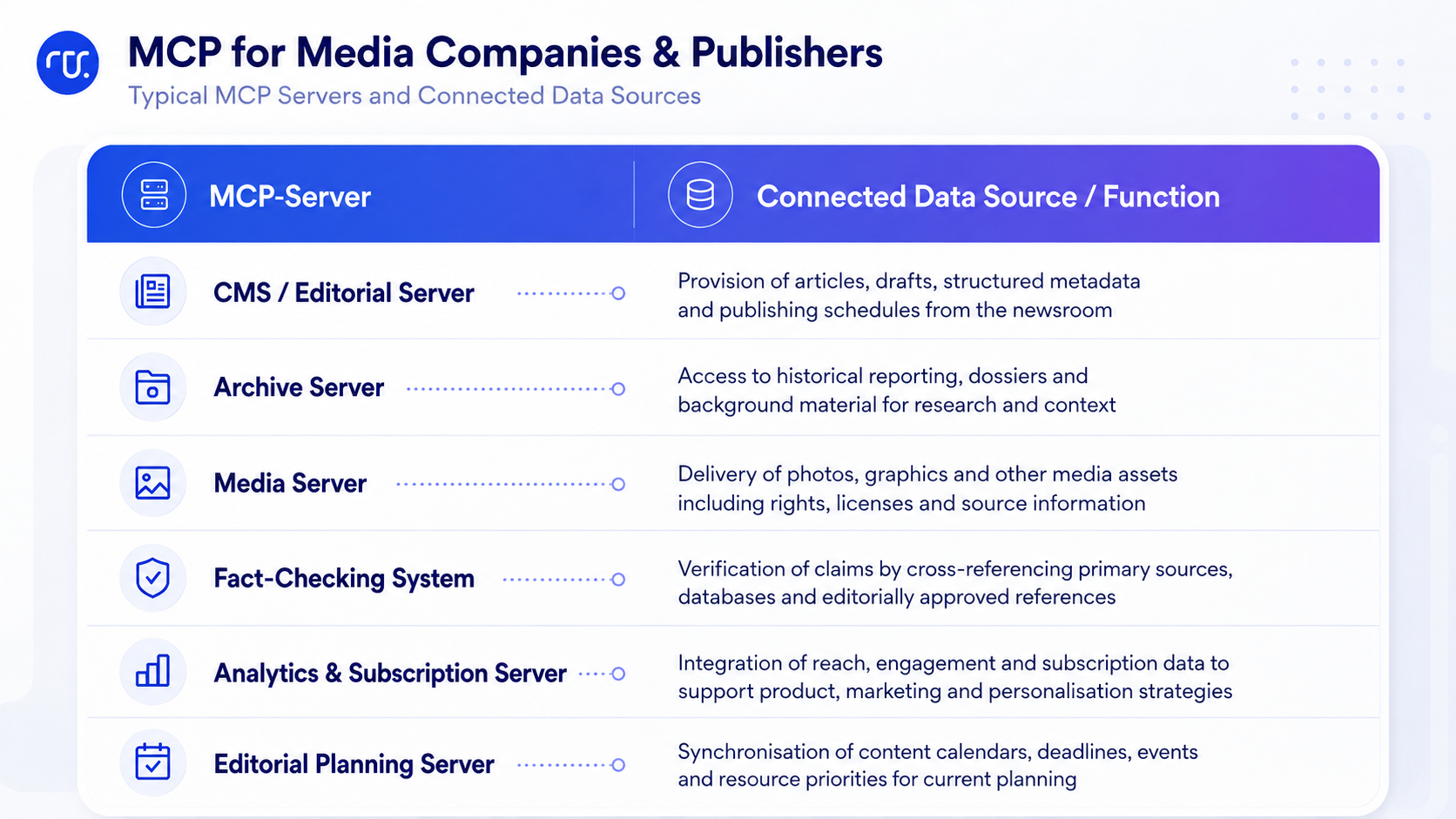
Typical publishing use cases via MCP: standard interfaces for data, content and editorial workflows.
In practice, many media organisations are already facing this challenge as they move from RAG-based applications to more agentic systems. The reason is clear: AI applications require more than text generation. They require controlled access to verified data sources, approved tools, rights information and traceable publishing logic.
FastAPI and FastMCP as Technical Building Blocks
In Python-based implementations, two terms often come up: FastAPI and FastMCP. Both can play an important role in an MCP architecture, but they serve different purposes.
FastAPI is a web framework. It is typically used to develop backend services and HTTP interfaces. In a publishing architecture, these may include search and content services, rights checks, analytics endpoints and internal data services.
FastMCP operates at a different level. It is designed to implement MCP servers and MCP interfaces. FastMCP helps provide selected tools, resources and prompts in such a way that MCP-enabled AI applications can recognise and use them in a controlled manner. At the same time, FastMCP also offers client functions. AI applications can use these to establish connections to MCP servers and integrate the capabilities they provide.
In simple terms: FastAPI exposes existing technical services. FastMCP makes selected functions from those services available to AI applications. The two technologies are complementary and operate at different levels of the MCP architecture.
MCP as Infrastructure for an AI-Supported Media Environment
For media organisations, MCP becomes relevant when RAG applications and agentic workflows move beyond individual pilot projects. RAG makes editorial content discoverable and usable for interactive services. Agentic AI extends this foundation into multi-step assistance and automation processes. MCP provides the technical layer needed to integrate content, data sources, tools and rights into AI applications in a controlled way.
MCP is not a silver bullet. It does not replace clean data structures, clarified rights, editorial quality assurance or a viable product strategy. However, the standard addresses a concrete infrastructure challenge: AI applications need a reliable, traceable and controllable way to work with internal and external sources, functions and systems.
For media organisations and publishers, MCP can therefore become an important infrastructure component – not as a replacement for websites, apps, newsletters, SEO or RAG, but as a complementary layer for AI chatbots, interactive information services and agentic workflows.
Do you have questions, comments or feedback? Please get in touch – we would be happy to hear from you.