
What is Conversational Performance?
Conversational Performance refers to the systematic, quantitative analysis and evaluation of the performance of AI chatbots, voicebots and comparable AI-based interaction systems. It focuses on measurable KPIs that reflect the usage, efficiency and effectiveness of dialogue systems.
Compared with Conversational Insights, which examine qualitative aspects such as user intent or conversation quality, Conversational Performance provides data-driven decision-making foundations for optimising content, user experience (UX) and conversational design.
The aim of Conversational Performance is to assess and continuously improve the functional performance and operational throughput of a chatbot or interactive offering.
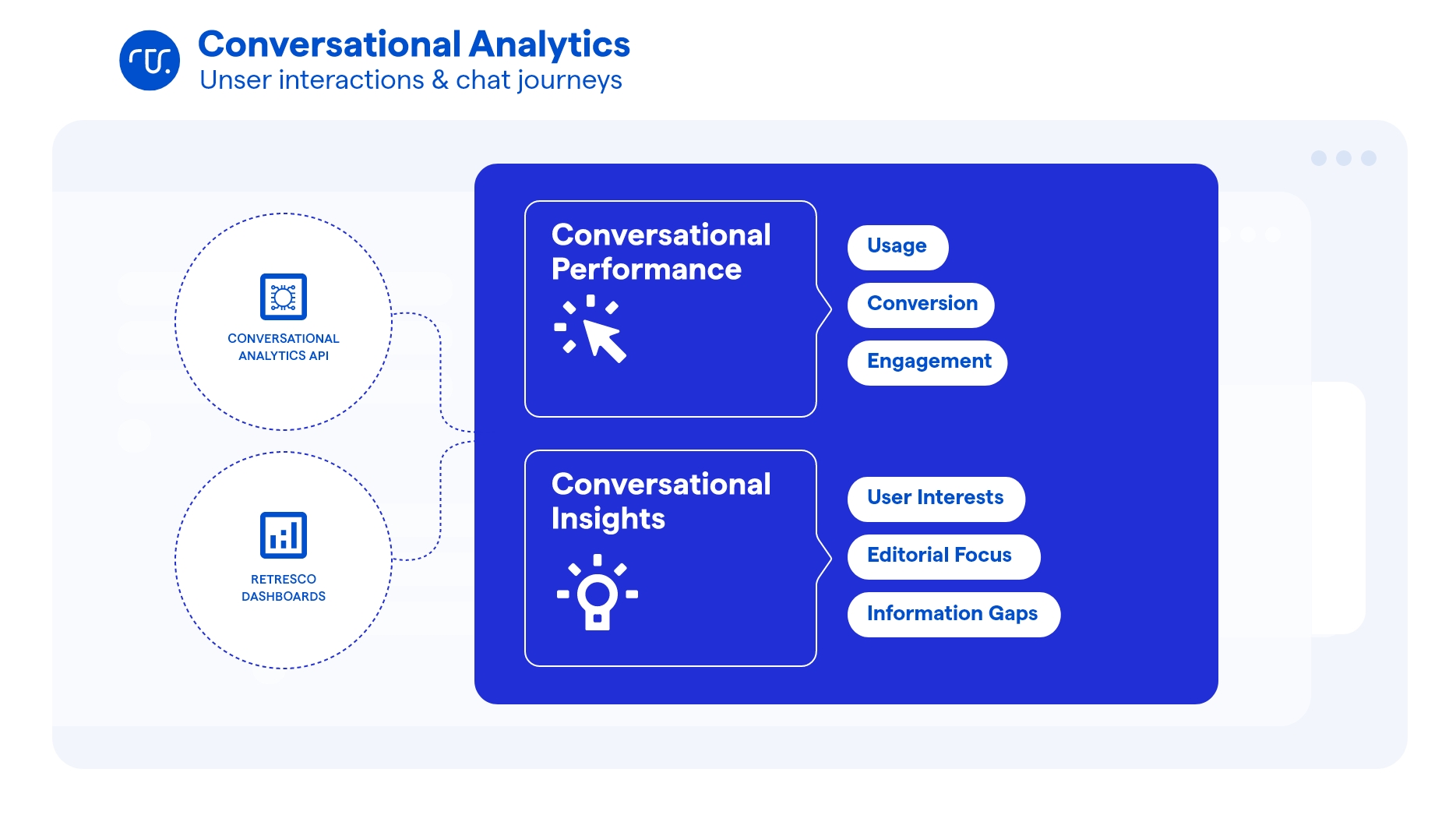
Classification Within Conversational Analytics
Within Conversational Analytics, the performance layer creates the basis for ensuring that qualitative optimisations are built on a stable interaction platform. For providers in the media sector, strong Conversational Performance is essential to safeguard brand reputation through fast and reliable information delivery.
Conversational Performance is the metrics-based perspective within Conversational Analytics. It answers questions such as:
- How intensively is a chatbot used?
- How successfully are questions answered?
- Which content or sources are clicked?
- How does usage develop over the long term?
This enables data-based optimisation and ROI assessment of AI applications.
The Importance of Conversational Performance
The growing spread of Conversational AI increases the importance of such performance analyses, as data-driven interactions are becoming the standard for digital offerings. Conversational Performance KPIs are used to systematically measure and continuously improve the quality, effectiveness and economic viability of dialogue-based services and chatbots. The focus is on several objectives:
Measuring Content Relevance in Dialogue Systems
KPIs make it possible to assess how well the information provided actually matches user queries. This reveals whether answers are helpful, understandable and appropriate to the context.
Improving Monetisation
Performance indicators such as click-through rates (CTR) on sources, referrals or conversion rates provide insight into how effectively dialogue-based systems contribute to value creation and where there is potential for optimisation.
Increasing User Retention
Data-based insights help make interactions more personal, efficient and satisfying. This promotes long-term usage and strengthens users’ loyalty to the offering.
As Conversational AI becomes more widespread, Conversational Performance is gaining in importance. Dialogue-based, data-driven interactions are increasingly becoming the standard for digital services — and with them the need to measure their performance precisely and manage it in a targeted way.
Core Aspects of Conversational Performance
While the complementary area of Conversational Insights highlights qualitative dimensions, such as topic interests and user intentions, Conversational Performance provides the quantitative basis for operational and strategic decisions.
Interaction Metrics Along the User Journey
Analysis of session duration, dialogue depth and drop-off rates within editorial usage scenarios:
- How long do users remain in conversations?
- How many follow-up questions arise on topics requiring explanation, such as business or elections?
- At which points do users drop off, for example at paywall transitions or because of unclear answers?
Such metrics provide valuable indications of content relevance and user experience along the digital value chain.
Technical Efficiency and Timeliness
Assessment of response latency, model availability and the speed with which new content, such as breaking news or live tickers, can be integrated into the conversation. In the media context, speed is not the only decisive factor; equally important is the ability to provide verified, publisher-owned information.
Scalability During News-Related Traffic Peaks
Robustness of the system during sudden traffic spikes, for example during breaking news, elections or major events. Conversational systems must be able to handle thousands of user queries at the same time without compromising answer accuracy or speed.
Monetisation and Conversion Relevance
To what extent do conversational interfaces contribute to subscription conversion, registration or dwell time? This includes measuring transitions from the conversation into paid content, newsletter sign-ups or personalised offers.
Key Conversational Performance Metrics
1) Users and reach
Measurement of usage and user engagement:
- Active users, daily or weekly
- Ratio of new to returning users
- Growth of the user base over time
The aim is to capture reach, adoption and long-term user retention.
2) Usage depth and engagement
Analysis of the intensity of interactions:
- Total number of chats
- Average chat length, measured in turns per session
- Number of questions asked
The aim is to measure the intensity of usage and user engagement with interactive offerings.
3) Answer quality, quantitative
Measurement of system performance using quantitative indicators:
- Ratio of answered to unanswered queries, or resolution rate
- Fallback rate or no-answer rate
- Click-through rate (CTR) on source references
The aim is to capture the efficiency, relevance and success rate of the answers provided.
4) Source performance and content analytics
Analysis of the use and impact of content:
- List of referenced documents
- Frequency of references, or impressions per content element
- Click-through rate (CTR) on sources, or content engagement
The aim is to identify popular interactive content and systematically uncover existing content gaps.
5) Development over time and trends
Observation of performance over time:
- Daily and weekly developments
- Seasonal patterns, fluctuations and anomalies
- Long-term performance based on historical data
The aim is to identify developments and trends and create a sound basis for forecasts and strategic decisions.
Data Protection and GDPR Compliance
The collection and analysis of Conversational Performance should be GDPR-compliant. Central principles must be observed: in line with minimal data collection, only the data actually required to determine the relevant KPIs should be collected.
It must also be ensured that users cannot be directly identified, for example through data anonymisation. The principle of purpose limitation also applies: the collected information should be used exclusively for performance analysis and optimisation. At the same time, KPIs should be based on aggregated and statistical data, meaning statistical data.
Data Provision and Monitoring
In modern chatbot systems, Conversational Performance is collected through two central approaches, enabling both targeted management and sound strategic performance analyses:
Integrated Dashboards
Within the AI application or interaction platform, quantitative data is visualised in clear dashboards. These provide editorial and product teams with immediate insight into current performance. Thanks to predefined views, trends can be quickly identified and developments assessed.
API Connectivity and Data Push
For more advanced analyses, performance data is transferred via interfaces or APIs to external editorial dashboards, business intelligence systems (BI), data warehouses or comparable analytics environments. An automated push mechanism enables media companies and publishers to connect chatbot metrics with editorial KPIs, topic metrics or other business data. This makes it possible to assess the economic efficiency of AI initiatives holistically.
Retresco and Conversational Performance
Retresco integrates Conversational Performance as part of its dialogue-based AI solutions in order to make chatbot performance continuously measurable and optimisable on a data-driven basis. This enables quantitative usage data to be systematically linked with publishers’ own content strategies.
Conversational Performance helps optimise AI-based interactive offerings along relevant KPIs. In combination with qualitative Conversational Insights, it creates a holistic understanding of user needs, serving as the basis for scalable, personalised and commercially successful AI projects. In this way, Retresco supports companies not only in deploying Conversational AI, but in further developing it as a strategic, data-driven performance channel.
Conversational Performance as a Control Instrument for Rag and Question-Answering Systems
In the context of retrieval-augmented generation (RAG) and question-answering systems, Conversational Performance provides the decisive quantitative signals for optimising retrieval quality and answer generation. It makes measurable how efficiently content is found, processed and converted into usable answers, for example through KPIs such as answer rate, latency or click behaviour on sources. In areas such as digital commerce, media and special interest media, as well as journalism, both conversion paths and the use of editorial content can be managed on a data-driven basis. Conversational Performance thus becomes a central foundation for
Sources and Further Reading
Gleap Blog: AI Chatbot Analytics – Measuring Success in 2026
Kaelio, Conversational Analytics for Self-Service Analytics
CCMA, Contact Centre Technology Report 2026 [PDF]
IGI Global / ResearchGate, Customer-Centric AI: Conversational Technologies [PDF]
MIPRO / ResearchGate: Review of Modern Chatbot Technologies [PDF]