Blog
Make or Buy: Develop Interactive Information Services or Outsource AI Chatbots?

Harald Oberhofer
Head of Marketing, Retresco
Artificial intelligence is changing the way people search for, evaluate and use information. For media companies and publishers, this creates a new distribution strategy for their content: AI chatbots, interactive archives, research assistants, article chats, election chats, service assistants and conversational information services.
Users no longer expect simply to read content. They expect to be able to question it actively. They want tailored summaries, explanations, source references, contextual information and personalised answers.

The Development of AI Chats for Publishers Is Now Strategically Important:
Make or buy? Should AI-based information services be developed internally or implemented with an external specialist? This central question is becoming increasingly urgent for media companies.
The answer is not straightforward. When it comes to journalistic AI services, the issue is not technology alone. It is also about editorial quality, data sovereignty, product development, user trust, speed, profitability and strategic differentiation. RAG – retrieval-augmented generation – is becoming a key technology for publishers. RAG systems connect large language models with verified proprietary content, such as archives, current news feeds, specialist information, databases or service information. This makes it possible to create AI chatbots that provide content conversationally and are based on verified sources.
The decisive question is therefore not: Can we build an AI chatbot? Instead, media companies should examine how such AI chats can be operated in a way that is journalistically, technically and economically sustainable over the long term.
AI Chatbots in the Media Environment: The Challenge Is Not the First Prototype
Most media companies already have solid experience with AI. Initial prototypes are often created. An archive is connected, a language model is used for text generation, an interface is built – and after a short time, it appears possible to speak to one’s own content.
But this is precisely where the real work begins. The biggest challenge lies less in the initial technical implementation than in continuous adaptation. AI tools, language models, interfaces, cost structures and user expectations are changing at great speed. What is considered a good solution today may already be outdated in just a few months. Processes must be reviewed regularly, language models reassessed, data flows adjusted and quality criteria refined.
There is also another challenge: how can the economic viability of AI-based services be assessed reliably without putting the performance of existing products at risk? Media companies are well advised to experiment with new AI services, but they must not endanger existing reach products, subscriptions, advertising activities or editorial workflows. This is exactly why the make-or-buy decision is so relevant.
RAG as a Core Competence for Media Companies
A RAG system based on a company’s own article archive is far more than a technical add-on. It can become the heart of new AI services. Archives, current news streams and specialised data sources contain a central asset of media companies: verified information, editorial interpretation, historical context and thematic depth.
When users can search a media archive, receive summaries and source references, or follow current developments conversationally, new user experiences emerge. Static content becomes interactive information services. Archives become conversational knowledge spaces. Editorial products become services that users regularly incorporate into their information routines.
The strategic insight is therefore clear: for many media companies, RAG is becoming a core competence. But core competence does not necessarily mean developing everything alone. Rather, it means closely managing the relevant capabilities, data flows, quality standards and product decisions.
The Dynamics of AI Development: Standing Still Is Not an Option
At the same time, the rapid dynamics of the AI market make make-or-buy decisions particularly challenging. New language models, frameworks, interfaces, security mechanisms and product standards are emerging in ever shorter cycles. For media companies and publishers, it is therefore not easy to remain permanently up to date technologically, organisationally and editorially. At the same time, there is hardly any alternative to actively confronting this dynamic.
Those who wait too long risk competitors learning faster, offering better user experiences and setting new standards for digital information services. The decisive factor is therefore not to implement every technological development immediately and in-house, but to build an organisation and partner structure that enables continuous learning.
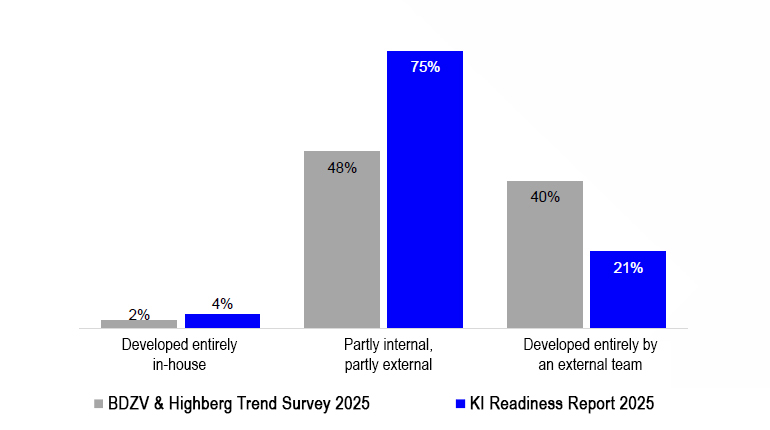
AI development in media: Based on input from media professionals in Germany. Grey: BDZV & Highberg trend survey; blue: Retresco/BDZV AI Maturity Report. Source: Retresco/BDZV
From Prototype to Product: The Five Key Development Steps
A typical learning curve can be derived from many AI projects in the media environment.
- The first step is API connection and initial data integration with the desired content pools. Interfaces are connected, initial content is processed and basic answer functions are tested.
- The second step is archive expansion and fine-tuning. Article archives are not a homogeneous block of data. They contain news, analysis, opinion pieces, interviews, dossiers, agency reports, live blog elements, specialist articles and service formats. The RAG system must be able to process this diversity in a meaningful way.
- The third step is the integration of real-time data. For journalistic conversational services, timeliness is a mark of quality. New reports should be incorporated virtually in real time.
- The fourth step is productisation. An AI chatbot needs an intuitive user interface that presents answers clearly and links them transparently to sources. Feedback functions such as thumbs up and thumbs down help to improve quality systematically.
- The fifth step is systematic testing and evaluation. Editors from different desks should test the AI system from the outset. This requires clear quality criteria: Is the answer correct? Is it complete? Is it understandable? Are the sources appropriate? Are uncertainties formulated clearly? Are problematic questions handled appropriately? These tests produce guardrails that make the system journalistically robust.
Make: When Internal Development Makes Sense
Internal development can make sense when a media company already has strong technical teams, AI expertise, product management, data infrastructure and sufficient development resources. Anyone wanting to build their own AI platforms in the long term needs internal expertise. This includes data integration, semantic search, vectorisation, chunking, prompt and answer logic, evaluation processes, monitoring, guardrails, frontend integrations and editorial quality assurance.
The biggest advantage of the internal approach is control. Media companies can organise architecture, data flows, user experiences and product logic themselves. Sensitive customer data, specific editorial requirements and internal workflows can also be taken into account very precisely. Internal development is particularly suitable when AI chatbots are to be deeply integrated into a company’s own editorial system, paywall, user accounts, CRM systems or personalisation logic.
Another advantage is that knowledge remains within the company. Teams learn how AI systems must be evaluated journalistically, which data sources provide which quality, how users interact with answers and which product ideas actually work. Over time, this learning can prove to be particularly valuable strategically.
However, internal development also has clear limits.
The Cons of the Make Approach
Developing proprietary AI chatbots in the media environment is more complex than it might appear at first glance. A functioning prototype is not yet a stable product. Media companies must not only connect language models, but develop a robust overall system.
This includes clean API connections, continuous data integration, robust rights management, handling different content formats, semantic search, source logic, starter questions, answer quality, context-sensitive follow-up questions, user feedback, integrated insights and security mechanisms. A brand-compliant chatbot design that fits different offerings is just as important, as is a user-friendly UX.
The integration of current news in near real time is particularly demanding. New content should be available within a few minutes. At the same time, corrected, updated or withdrawn reports must be processed properly and displayed transparently in the user interface. Only when technical infrastructure, editorial quality assurance and chat interface work together does an AI service emerge that is reliable, understandable and accepted.
One particular risk lies in the speed of the market. AI models, frameworks and best practices are changing rapidly. Anyone developing everything internally must keep pace with this dynamic over the long term. This ties up resources that are already scarce in many media companies. In addition, AI projects compete internally with other important initiatives: CMS modernisation, app development, data strategies, paid content, subscription optimisation, newsletters, audio, video and community services.
The make approach can therefore become expensive, slow and risky if organisations do not have the necessary internal AI product maturity.
Buy: Why External Specialists Can Be an Accelerator
Working with an AI specialist can prove to be a decisive accelerator for media companies. Such an approach makes it possible to gain experience with a market-ready product, quickly receive reliable customer feedback and precisely identify the technical and editorial requirements of a journalistic RAG system.
Speed is a central factor, especially in the testing and development phase. Those who spend too long planning lose valuable time. Media companies are well advised to connect internal data sources, regularly improve answer quality and develop the product further in close dialogue with users. This is precisely where an experienced partner can help: from initial data integration and chat interfaces to feedback mechanisms, evaluation and guardrails.
A typical development process begins with a kick-off workshop in which the use case, target groups, data sources, quality requirements and product logic are defined. Interfaces are then connected and initial answers generated on the basis of existing data. This is followed by archive integration. This is not only about the quantity of data, but also about editorial fine-tuning: the system must be able to handle different types of reports, including rare or analogue formats, special text structures and technically demanding content.
Journalistic quality is particularly important. An AI service for media companies must not generate false or distorted content. It must make transparent which sources an answer is based on. It must be able to reflect uncertainty. And it must meet editorial standards.
The Cons of the Buy Approach
The buy approach also has disadvantages. Anyone working with an external service provider must consciously manage dependencies. Media companies should avoid handing over central product and data expertise entirely.
It is therefore important that the media company retains strategic control. This includes data sovereignty, hosting, security, transparency about system architecture, interfaces, traceable quality processes, export options and the ability to make product decisions independently.
Another risk lies in overly standardised solutions. Media companies differ greatly: regional daily newspapers, specialist publishers, special-interest offerings, national news brands and B2B information services have different content, target groups, revenue models and quality requirements. A good partner must understand and be able to reflect these differences.
Buy should therefore not mean: we purchase a generalist AI chatbot and apply it to our archive. Buy should mean: we work with a specialised partner in order to bring a robust, market-ready AI product to market more quickly.
The Best Solution: Buy to Learn, Make to Control
In practice, make or buy is rarely a pure either-or decision. A hybrid approach is often sensible, especially for media companies – with a clear emphasis: buy to learn, make to control.
1) External expertise accelerates the start
This means that in an early phase, purchasing external expertise is usually the faster, more economical and lower-risk route. A specialised AI partner helps turn an idea quickly into a robust product or a valid prototype. Media companies can test use cases, gather user feedback, better understand technical requirements and refine editorial evaluation criteria – without first having to build larger internal teams, infrastructures and processes.
2) Learning as a strategic advantage
The decisive advantage lies not only in speed, but also in learning. Those who start with experienced service providers benefit from proven technologies, best practices, existing security and quality mechanisms as well as experience from comparable projects. This reduces typical early-stage losses and prevents internal resources from being tied up too soon in technical details before it is even clear which applications are strategically and economically viable.
3) Buy does not mean loss of control
At the same time, buy does not mean giving up strategic control. On the contrary: a good buy approach creates the basis for building internal expertise in a targeted way. The media company defines standards, develops its own evaluation criteria, learns about the relevant dependencies and gradually assumes more control – for example in product strategy, data quality, editorial governance, user guidance and success measurement.
4) Test faster, decide more soundly
This creates a pragmatic middle ground: implementation is accelerated, risks remain manageable and the organisation learns through real applications. This is essential, particularly in a dynamic field such as generative AI. Anyone who wants to develop everything themselves risks losing valuable time. Those who buy intelligently, by contrast, can learn faster, test earlier and make more informed decisions about which capabilities should be built internally in the long term.
5) Cooperation as a lever for innovation
Innovation research suggests that traditional media companies often become more innovative when they cooperate with experienced partners in the testing and scaling phase of new technologies. Not because they outsource innovation – but because they move into action faster, receive feedback earlier and deploy internal resources where they have the greatest strategic leverage.
Dos: What Media Companies Need to Do Right With AI Chatbots
Media companies should define AI chatbots and interactive information services as strategic product development, not as isolated technology experiments. A clear use case is decisive: should the service improve internal research in the newsroom? Should it help users explore archives? Should it become a paid service? Should it strengthen customer loyalty? Or should it reach new target groups?
The data strategy is equally important. A successful RAG system depends on high-quality and up-to-date data. Media companies should therefore clarify which sources will be connected: archives, news feeds, topic pages, dossiers, databases, images, metadata, user information and verifiable external real-time data such as stock market prices, sports results, weather, traffic, events or election data.
At the same time, media companies should take economic questions into account. Which target groups use interactive services? Is the service part of a subscription? Does it support conversion, retention or engagement? Does it reduce internal research costs? Does it complement or replace conventional search? Does it strengthen proprietary media brands? Only if product value and offering strategy are structured carefully can new, sustainable business models emerge.
Don’ts: What Media Companies Should Avoid
Media companies should not believe that an AI chatbot is complete once a model has been connected. An AI system can unlock, summarise and make content conversational. But editorial standards, source evaluation and quality criteria must be defined internally by the publisher.
Another mistake would be to remain in prototype mode for too long. Many organisations develop impressive internal demos but fail to make the transition to stable live operation. The decisive factor is to test a usable product as early as possible – with real data, real users and clear quality metrics.
The user interface should not be underestimated either. A journalistic AI service needs transparency, source references, understandable answer structures and clear interaction options. Without a good interface, even a technically strong system remains difficult to use – and user acceptance remains correspondingly low.
Total Effort Matters More Than Pure Development Costs
In make-or-buy decisions, media companies should not look only at initial development costs, but at total cost of ownership – in other words, the overall costs across the entire life cycle of an AI service. At first glance, a prototype may appear inexpensive, but in ongoing operation it creates continuous effort: for example through the use of language models, the need for hosting, maintenance, data provision, monitoring as well as rights and role management, prompt and retrieval optimisation, quality assurance, frontend adjustments and support.
Language models in particular can quickly become expensive under pay-per-use models when individual prompts turn into productive applications. Productive AI services do not just generate queries; they also generate volume, longer contexts, follow-ups, tool calls and rising quality requirements. Pay per use is therefore convenient at the start, but without consistent cost control it can become a risk in scaled operation.
An external specialist can make total costs significantly more predictable because infrastructure, chatbot modules, operational experience, further development and best practices are already in place. The decisive question is therefore not which option appears cheaper in the short term, but which solution over 12, 24 or 36 months is faster at learning, more stable to operate and more economically sustainable.
AI in Media Companies: Pure In-House Development Is the Exception
What does this look like in practice for media companies and publishers? Findings from a German industry survey conducted by Retresco and BDZV (German Newspaper Publishers and Digitalpublishers Association) indicate that most media organisations are not pursuing a purely in-house approach to AI development. Only 4% of respondents rely exclusively on internal resources, while 75% combine internal and external development. A further 21% work entirely with external providers.
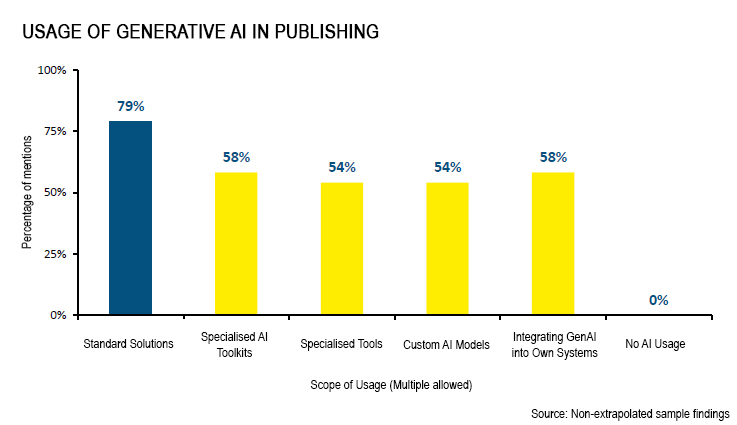
Specialised publishers often combine standard tools, specialised solutions and proprietary systems for AI services (Source: Deutsche Fachpresse is the German trade association for B2B media and professional publishing).
Current statistics from Deutsche Fachpresse show that standard solutions are particularly widespread at 79%. At the same time, 58% of publishers use specialist AI toolkits, and the same proportion integrate AI into their own systems. 54% use specialised tools, while the same share work with their own custom AI models.
Decision Questions for Media Companies: Make, Buy or Hybrid?
In summary, the right decision depends on several factors. Does the media company already have a strong AI and data team? Are there sufficient resources for continuous development? Are relevant content pools, interfaces and data structures in place? How quickly should a market-ready service be created? How important is comprehensive technical control? And how willing is the organisation to involve external expertise?
Those with highly specific requirements, strong internal teams and ambitions to build their own platform should consistently develop internal expertise. Those who want to learn quickly, limit risks and gather user feedback will benefit from an external partner. For most media companies, a hybrid approach is likely to make the most sense: start together with an external service provider, learn internally, manage strategically and gradually develop proprietary capabilities.
AI Chatbots Are Not a Side Project, but Part of Media Strategy
The question of “make or buy” in relation to AI chatbots and interactive information services is ultimately a strategic question. It is not just about who builds the first prototype. It is about how media companies will make their content accessible in future, how they deepen user relationships and how they create trust in the age of generative AI.
RAG systems based on proprietary archives, current news feeds and verified data sources can become a central building block of the digital product strategy for publishers. They make journalistic content conversational, strengthen the use of proprietary offerings and open up new possibilities for research, service, personalisation and customer loyalty.
My recommendation is this: media companies should not blindly outsource AI. Publishers should get into implementation quickly, start with clear use cases, test real products and content, take user feedback seriously and build internal expertise in a targeted way. External specialists can be an important accelerator – especially when they provide not only technology, but work together with editorial, product and technical teams to develop a robust journalistic AI system.
Do you have any questions, comments or feedback on AI development and implementation? Get in touch – Our experts will be happy to get back to you!