Blog
AI Assistants Instead of Search: How Conversational AI Is Rethinking Digital Commerce

Harald Oberhofer
Head of Marketing, Retresco
AI assistants and AI chatbots in online retail markets are increasingly shifting the focus away from traditional product search and toward intelligent, context-based guidance.
For decision-makers in e-commerce, this makes a development towards conversational assistants tangible as something that has been emerging for some time:
What truly matters is the quality of product recommendations and thus their direct influence on purchasing decisions.
The Power of Recommendation: From Product Search to Advisory
Recent data from Similarweb shows that consumers are increasingly relying on AI-powered systems across all stages of the customer journey. AI assistants are taking over the most critical moment in the buying process: the point at which preferences are formed and brands are selected. Being present at this stage of the customer journey has a decisive impact on purchasing decisions.
Conversational AI Instead of Filter-Based Search: The Shift in E-Commerce
The example of the leading retail and services group Otto illustrates this transformation particularly well: modern product discovery centres on the ability to support consumers in their decision-making and provide interactive guidance.
Conversational AI is transforming apps and online shops from static catalogues into dialogue-based advisers. Consumers no longer need to use filters or optimise search terms. They simply express their product needs in natural language. AI assistants understand these inputs, interpret them contextually, and deliver precise answers. When needed, they deepen the interaction through multi-step dialogues with targeted follow-up questions and responses.
The result is “covert” personalisation that simplifies decision-making, reduces uncertainty, and increases relevance. This is where the future of digital commerce lies. AI is no longer just a feature but is becoming the core infrastructure of the customer experience.
Use Case: The Online Shop Becomes a Sales Advisor
The major retailer Otto is consistently taking this step by integrating conversational AI into its offering. Two new applications demonstrate how AI assistants and chatbots create tangible value.
1. Conversational Assistants for Dialogue-Based Product Recommendations
With its new shopping advisor, Otto brings the advisory expertise of bricks-and-mortar retail into its app. Consumers can describe their product needs via text or voice just as they would in a conversation with in-shop staff.
The AI assistant processes natural language, recognises context, and asks targeted follow-up questions to refine needs step by step. Based on this, it generates highly tailored product recommendations that go beyond traditional search results.
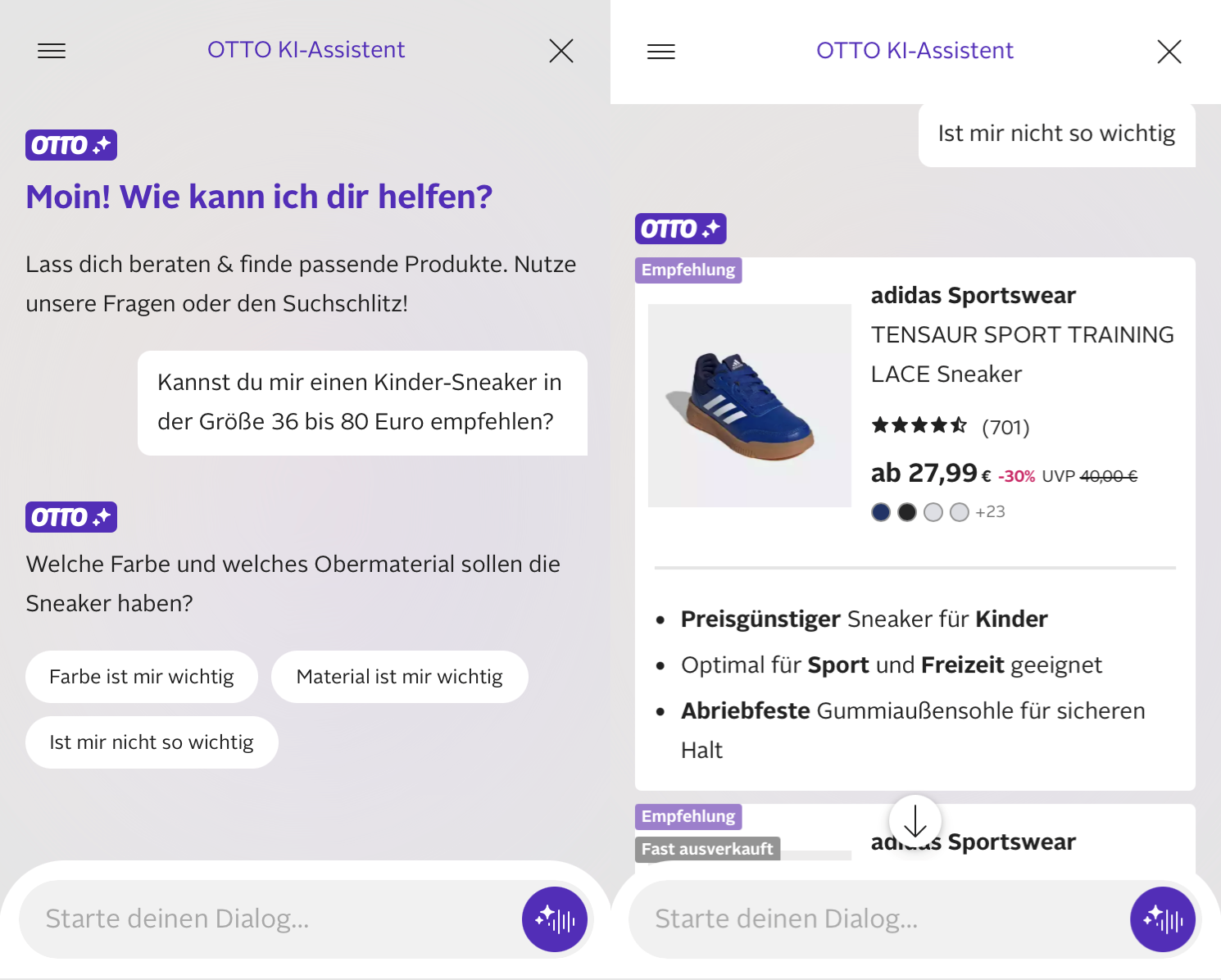
A typical product question to the AI assistant on the Otto-App
Technologically, the solution is built on proprietary data: product descriptions, structured attributes, and millions of reviews feed into the recommendations. Even dialects and colloquial expressions can be processed by the AI assistant.
The goal: shopping experiences that no longer feel like using a store, but like receiving personal advice.
2. AI Chatbots as the Backbone of Customer Service
At the same time, Otto is increasingly relying on AI chatbots in customer service. The chatbot answers enquiries about orders, delivery status, returns, or invoices around the clock without waiting times.
Standard enquiries are handled fully automatically, while more complex issues are routed to human support staff via a routing mechanism. This is enabled by integration with internal systems, a structured knowledge base, and the use of multiple language models.
For online retailers, this brings clear advantages: faster service, lower costs, and better scalability while maintaining consistent service quality.
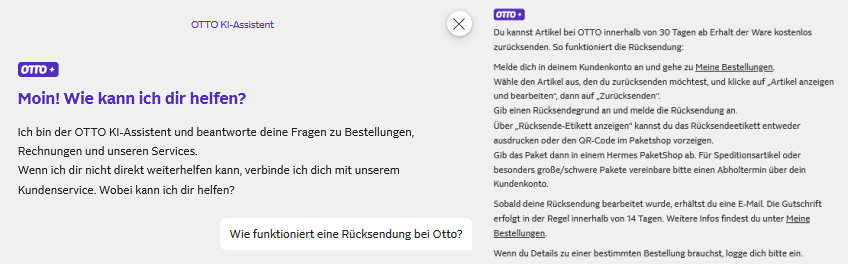
The Otto AI chatbot answers service questions in real-time
Fewer Returns, More Relevance: The Business Impact of AI
The use of AI assistants and chatbots directly improves key e-commerce KPIs. More precise guidance leads to better purchasing decisions. Therefore, fewer incorrect purchases and returns. At the same time, customer satisfaction increases, as consumers find the right product faster and more easily.
Conversational assistants unlock particularly strong potential in categories that require more guidance: products that were previously difficult to explain can now be marketed more efficiently and understood more easily.
Conclusion: The Competitive Advantage Is Dialogue-Based
The next stage of AI implementation in online retail is not better search but better interaction. Conversational AI turns apps and shops into interactive experience spaces where guidance, service, and transactions merge seamlessly.
For decision-makers and practitioners in e-commerce, this means that investing in AI assistants and chatbots today not only creates a technological edge but also provides direct influence over tomorrow’s purchasing decisions. Interactive AI applications offer users contextual, dialogue-based support throughout the entire customer journey.
The key question is no longer whether conversational AI will prevail, but how quickly it will become the central interface in apps and online shops.
Do you have any questions, comments or feedback on liquid content? Get in touch – I’ll be happy to get back to you!