Blog
Liquid content: How AI is breaking down the boundaries between journalistic formats

Harald Oberhofer
Head of Marketing, Retresco
A quick glance at the latest news over your morning coffee, a podcast on your way to work, a few videos in your feed while relaxing at home in the evening: this is exactly where liquid content comes in. Users decide for themselves in which format they want to consume journalistic content. And AI in journalism provides the technological basis for this.
What exactly does liquid content mean?
Liquid content refers to content that is no longer static but can be dynamically adapted. The Reuters Institute’s definition sums it up perfectly: content no longer consists of individual, self-contained articles, but rather content and stories that adapt in real time to the respective context of the user. This includes factors such as location, time and interaction. This is made possible primarily by AI, which tailors content individually to preferences and usage situations.

Definition of liquid content according to the Reuters Institute
For media companies and publishers, this represents a paradigm shift: away from article-centric thinking and towards a modular content architecture. Content is no longer produced for a single distribution channel, but is designed as flexibly combinable building blocks that can be specifically adapted to different channels, target groups and usage contexts. Completed, linear articles are being replaced by a system of atomic content elements that can be dynamically orchestrated, contextualised and played out.
From articles to adaptive content
Having texts read aloud or calling up article summaries is no longer anything special. But it is only with artificial intelligence that liquid content can be effectively interpreted and personalised for specific channels. Whereas previously every playback variant had to be created or adapted manually, AI tools now enable the automated production of texts, audio, videos or visuals – based on a central source of information.
The decisive change lies not only in the format, but also in the variable depth of content. Are concise bullet points sufficient, or is an in-depth analysis required? Liquid content adapts dynamically: in real time, contextually, channel-dependent and personalised.
Liquid content – more than just a buzzword?
Initial industry studies confirm that there is real substance behind this trend. According to the Reuters Institute, 75% of media decision-makers expect AI-driven changes to have a major or even very major impact on media companies and publishers over the next three years.
The reason: content is becoming ‘fluid’. Format, length and presentation adapt dynamically to the context of use, device and form of interaction. At the same time, it is becoming increasingly difficult for media companies to control where their content is consumed – in a browser, via chatbot or via social media. This raises new questions about reach measurement and monetisation.
Everything flows: When media formats dissolve
In its Media Trends 2026 report, German media innovation network Medien Netzwerk Bayern also refers to a ‘post-format era’ and a ‘fluid media experience’:
- Post-format era – from medium to knowledge operating system
The classic media format is losing importance. In the post-format era, rigid content is dissolving into ‘fluid assets’. Information is no longer tied to fixed forms of presentation such as text, audio or video, but circulates as an intelligent module to wherever it is needed in the respective context of use. Media companies and publishers are thus evolving from content suppliers to interactive knowledge operators. - Fluid media experience – journalistic formats overlap
Formats that were originally analogue have become increasingly digitised in recent years. Content is becoming available in a format-independent manner and can be used flexibly. Information no longer flows through specific channels, but follows the needs of users – situationally, personalised and context-dependent.
One example of this is TIME AI: Time Magazine enables interactive, user-centred access to journalistic content that is no longer tied to individual formats, but to questions, interests and moments of use.
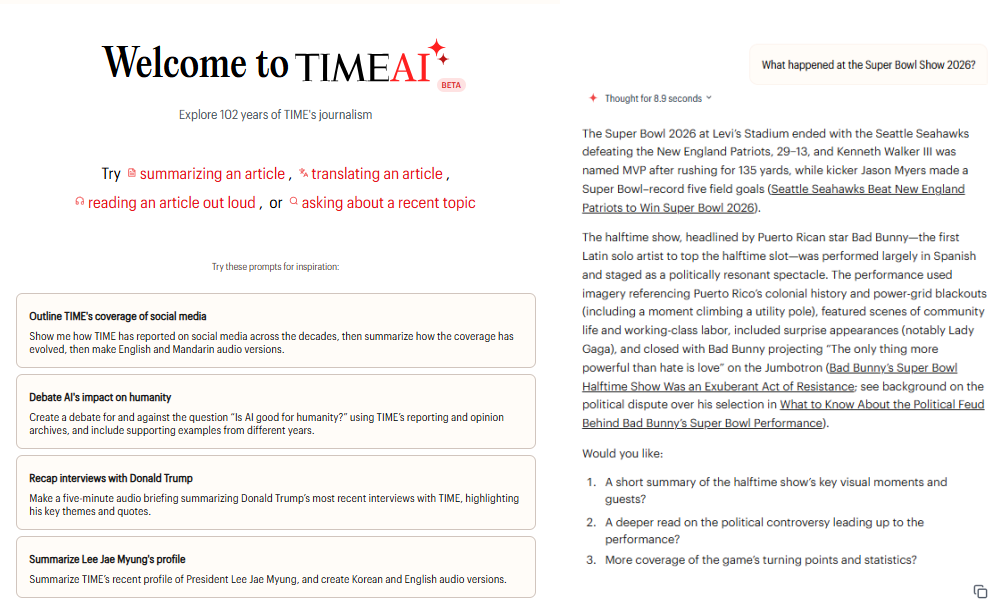
With TIME AI, Time Magazine offers interactive access to its content.
For decision-makers and practitioners in the media sector, this means that relevance is created less by the perfect individual piece and more by consistent user orientation and coherent experiences across a wide variety of contact points.
AI in journalism: liquid content and agents
Liquid content opens up new perspectives for everyday editorial work. In the future, AI-based multi-agent systems should make it possible to automatically orchestrate texts, images, audio and video formats and tailor them precisely to different channels and target groups.
AI creates new scope for editorial teams: even without large moving image or data teams, high-quality multimedia content can be created while journalists retain editorial control. Storytelling thus becomes cross-channel, modular and scalable. Chatbots also play a central role here, developing into the new interface between editorial teams and users. They answer questions, provide highly personalised summaries and guide users through individual questions and complex topics in a dialogue-based manner.
Conclusion: Liquid content with potential
For media companies and publishers, this means that artificial intelligence will bring change to journalism in the new year. The way content is produced, distributed and consumed is changing. Liquid content and its possibilities should therefore be evaluated – not least in order to meet the expectations of one’s own user base and at the same time tap into new potential for efficiency internally.
Those who are able to provide their content in a modular, adaptive and personalisable way will ensure visibility, efficiency and relevance – in a media world where formats are becoming increasingly blurred and users are taking more control.
Do you have any questions, comments or feedback on liquid content? Get in touch – I’ll be happy to get back to you!