Blog
2025: User engagement drives growth in media, publishing and retail

Harald Oberhofer
Head of Marketing, Retresco
2025 was a year of clear focus for Retresco – on robust and interactive customer applications that increase efficiency and enable new offerings through the use of artificial intelligence. Media companies, publishers and retailers need robust AI solutions more than ever to personalise digital products and develop them in a dialogue-oriented manner. The focus is on attracting, retaining and building long-term loyalty among users.

This requires technologies that function reliably in everyday editorial work and content preparation, offer added value and at the same time reflect the current state of AI development. In our 2025 review of the year, we therefore take a look back at the most important milestones. These are the developments that have shaped the AI industry in general and Retresco and our customers in particular.
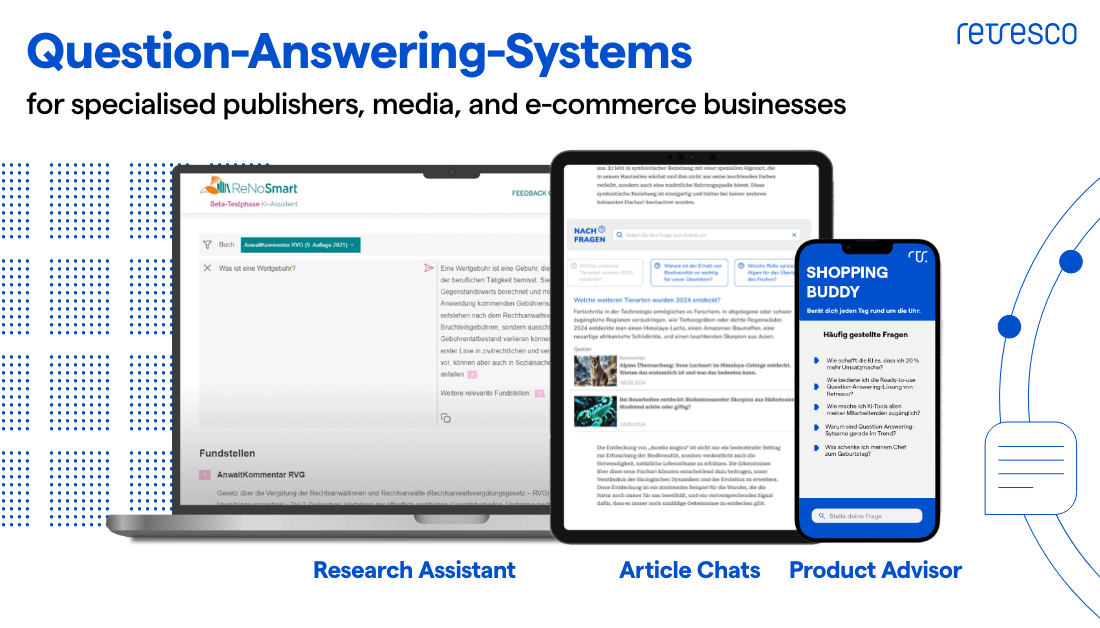
AI Engage for media, trade media and retailers: AI chatbots,
personalised shopping assistants and interactive product chats
AI Engage: AI chatbots are becoming more widespread – thanks to the latest RAG technology
One particularly clear trend in 2025 was the rapid professionalisation of AI chatbots. What was still considered an experiment a year or two ago is now a central component of modern publishing and digital strategies. Accordingly, we have specifically developed and expanded our AI solution portfolio this year.
In the first quarter, we presented the easy-to-use AI solution Question-Answering System (‘AI Engage’), which helps to structure and process internal content and make it available as dialogue-based services. Our interactive AI offering can be used across all industries and is aimed at companies that want to tap into article and knowledge archives or content databases and develop value-adding applications from them.
The new question-answering system is consistently geared towards user engagement and recognises deeper contextual connections – regardless of whether it works with company and article archives, knowledge and product databases, support documentation or audio transcripts. It is based on state-of-the-art RAG (retrieval-augmented generation) technologies, which we have further developed to enable customer-specific implementation with minimal effort. Despite efficient setup processes, this is not an off-the-shelf offering, but a flexibly customisable, industry-specific solution that can be tailored to individual requirements.
The combination of semantic retrieval, neural search, powerful parsing logic and flawless vectorisation creates particular added value – for fast, context-sensitive information retrieval and precise, high-quality answers. Relevant information is reliably extracted from all common content formats via a standard API and then converted into natural language responses by any desired language model.
Companies benefit from stronger user loyalty and new revenue potential through dialogue-oriented information and content offerings. Our proprietary AI solution offers a ready-to-use Q&A system with modules for context-sensitive follow-up questions, integrated user feedback and flexibly customisable online widgets. The AI chatbots can be quickly, efficiently and precisely tailored to different business models and industries:
- Media companies can use our AI solution for automated article chats, intuitive archive searches, interactive news formats or professional research services.
- Specialist media can tap into multi-layered knowledge bases and offer their users precise, reliable Q&A dialogues – for example, on specialised technical content, industry information or regulatory topics.
- Retailers can implement personalised shopping assistants, automated product advice or interactive catalogues.
- Companies can implement intelligent FAQs, internal knowledge bots or dialogue-based knowledge archives as central knowledge hubs for employees or partner networks.
We are particularly proud that by 2025 we will have launched several dozen such tailor-made AI chatbots together with our customers – including FAZ, Rheinische Post and Neue Pressegesellschaft, as well as specialist media such as Hans Soldan and Pharmazeutische Zeitung (Avoxa).
In short, with AI Engage, we offer a simple and quick-to-implement AI solution for question-answering systems for media companies, retailers and brands – setting new standards for the future of content delivery and publishing.
AI Content Assistant: Efficient, easy to integrate, enterprise-ready
We were particularly pleased this year with the success of our AI Content Assistant, which has won over numerous companies in the media and e-commerce industries. A key factor in this success was the fact that our AI editorial assistant can be easily integrated into existing workflows – quickly, efficiently, without major implementation effort and with outstanding quality in tasks such as rephrasing, summarising or shortening texts.
We are continuously developing the AI Content Assistant to offer our users a powerful enterprise-level tool. The improvements we have implemented this year include:
- Introduction of prompt chains for the structured processing of complex tasks
- Development of a fine-tuning function to subsequently adjust prompts and prompt chains without affecting ongoing processes
- New filter and organisation options for a better overview and more precise control
- Integration of a transcription functionality that converts audio and video files directly into text that can be further processed
AI projects are becoming more strategic
As reflected in our AI solution portfolio, 2025 was the year in which AI projects finally shed their beta status. Pilot projects became robust initiatives that left the experimental stage behind and were no longer to be treated with caution. AI solutions became market-ready – and those who did not take this step this year run the risk of falling behind sooner rather than later.
Those who opted for artificial intelligence this year invested not only in technology, but above all in their own future viability. Accordingly, AI initiatives were defined and implemented in a much more strategic manner. Clear AI strategies ensured focus on the customer side and ensured that AI was not implemented in isolation, but served as an essential enabler for more efficient processes and new product models.
Artificial intelligence is therefore no longer a topic for the future in the media environment, for example, but an integral part of future-oriented corporate strategies. This is also shown by our AI maturity report, published jointly with the BDZV: 89% of the media companies surveyed already have a robust AI strategy in place.
Artificial intelligence becomes measurable
At the same time, the measurability of AI is increasingly becoming a key lever for evaluating the success of AI projects. After all, anything that cannot be measured cannot be relied upon – neither by management nor in comparison with the competition. With the help of key figures such as time-to-content, cost efficiency per output and quality metrics on topics such as topic preferences or usage behaviour in everyday editorial work, it is now possible to measure the actual impact of AI in the content and media environment much more precisely. Measurability creates transparency and trust, improves acceptance and enables consistent, targeted optimisation.
Our AI Maturity Report 2025 also confirms this development: 60% of media companies already use KPIs or plan to introduce them in the near future – a growth of 47 percentage points compared to the previous year. At the same time, a highly regarded MIT study shows how great the challenges across all industries continue to be: according to the study, 95% of all AI initiatives in companies do not achieve measurable results.
From links to dialogue – even when searching
2025 was also a year of great dynamism in the field of AI-based search. After OpenAI challenged Google and its search monopoly head-on, Google responded at the end of the year with a new and significantly more powerful version of Gemini.
For publishers, media companies and content providers, this means declining visibility and significantly less traffic. Google, OpenAI and others are pursuing the clear goal of keeping users within their own ecosystems as much as possible. OpenAI is positioning ChatGPT as an immediate knowledge broker that collects, condenses and presents information in an understandable way. Google, on the other hand, is fundamentally redefining the search experience with its new AI Mode: answers are dialogue-oriented, personalised and dynamic. At the same time, Google Discover is being consistently developed further – also at the expense of the visibility and reach of content providers and media companies.
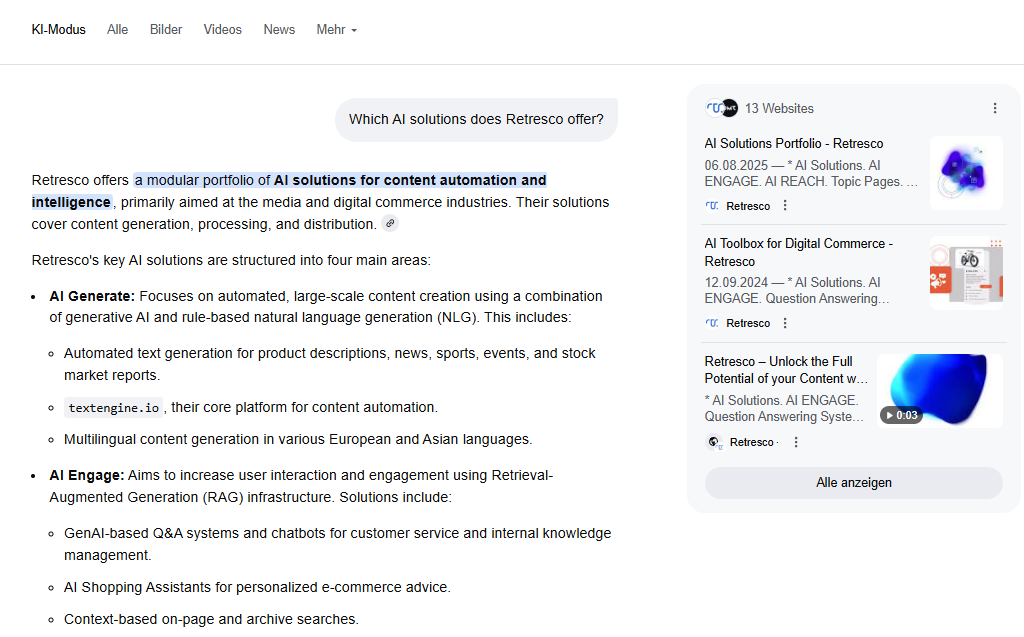
AI Mode: AI-based, dynamically generated summaries directly in Google Search
If you would like to delve deeper into these changes in search behaviour and their impact on the market, you will find detailed analyses and assessments in our blog posts from recent months:
- AI Overviews, AI Mode & Personal Context: How Google is changing the rules of the game
- ‘AI Summaries’ in Google Discover: How media companies are now asserting themselves
- Reach with Google Discover: What options do media companies and publishers have?
AI agents: hype or business reality?
Apart from AI searches, hardly any other topic has been as prominent this year as the use of AI agents. But what exactly is behind the hype? Many see them as the next evolutionary step in artificial intelligence. Unlike conventional AI tools, which only perform tasks on command, agents pursue their own goals, make independent decisions and adapt their actions flexibly to the situation. They act autonomously – even in complex, changing environments – and promise to be able to control entire process chains automatically.
Currently, the line between AI agents, automation and traditional workflows is blurred. There are hardly any clear definitions. The main difference is that AI agents solve non-deterministic tasks independently. They do not follow a rigid pattern, but develop solutions dynamically based on data, context and objectives. This brings into focus a scenario in which agents plan, decide and learn – continuously, adaptively and with increasing performance.
In practice, experimentation still dominates. AI agents usually take on smaller, clearly defined tasks. However, the potential is obvious – as are the increasing demands on data quality, organisation and technology. Companies must therefore ask themselves key questions: Which tasks can AI sensibly take on? Is the data reliable, consistent and sufficiently structured?
What will 2026 bring?
2025 was the setup year for resilient AI applications. Many companies laid the groundwork for using AI technologies productively and realigning internal processes. We at Retresco have also been working on this by developing scalable AI architectures, building automation logic and establishing robust use cases for productive deployment.
In 2026, artificial intelligence can become a real value creator. We are likely to see developments that are significantly more precise and targeted, because AI should be able to provide users with individually tailored content across all channels. In the future, communication should be orchestrated in real time – automated, consistent and highly personalised. At the same time, the integration of AI into CMS, delivery and production processes is growing. Artificial intelligence will thus become not just a tool, but a central component of digital value creation.
There is also great potential in new dialogue-based business and advertising models: dynamic, context-sensitive and closely interlinked with products, services and ranges of offerings. In future, users will not only interact with content or product information, but also with intelligent interfaces that bring together answers, recommendations and transactions.
My conclusion: 2025 marks a turning point – AI is evolving from a promise for the future to a concrete growth engine for media companies, publishers and retailers. The opportunities are enormous. With more commitment and intelligent personalisation, companies can deliver their content in a scalable way: more efficiently, more precisely and more relevantly than ever before.
What do you think? Contact us – our AI experts will be happy to get in touch with you!
Recent Blog Posts