Blog
AI agents in the media environment: between hype, automation and reality

Simon Pollock
Senior AI Account Manager & Strategy Advisor, Retresco
Hardly any other topic is currently being discussed as intensively in the media industry as the use of AI agents. But what is behind the hype? Can agentic AI be integrated into editorial processes in a meaningful, targeted and reliable way – or will it remain a mere promise?
Consultants at Deloitte US even predict that the current revenue forecasts for agentic AI will be exceeded by 15 to 30 per cent by 2026. By 2030, the global market could even reach a volume of up to 45 billion US dollars – provided that the relevant agentic solutions can be strategically orchestrated and effectively embedded in their processes.
Growing pressure on editorial teams
Editorial teams face a double challenge: on the one hand, the flood of information is growing, resources are dwindling, publication cycles are becoming shorter and shorter, and the demand for personalised offerings and multimodal content is increasing, all of which are placing greater demands on editorial work. On the other hand, targeted automation using artificial intelligence is essential – but without compromising journalistic quality.
This is where AI agents come into play: they promise greater efficiency and support in the creation and distribution of content. This article provides an assessment based on practical experience and also discusses possible application scenarios in everyday media work.
How AI agents could change the media landscape
AI agents are considered AI 2.0. Compared to conventional AI applications, which implement specific instructions and tasks, agents pursue independent goals and make autonomous decisions – based on multiple process steps and dynamic adaptation. AI agents do not just act reactively, but operate autonomously in complex situations and confusing constellations – with the promise of managing entire process chains automatically.
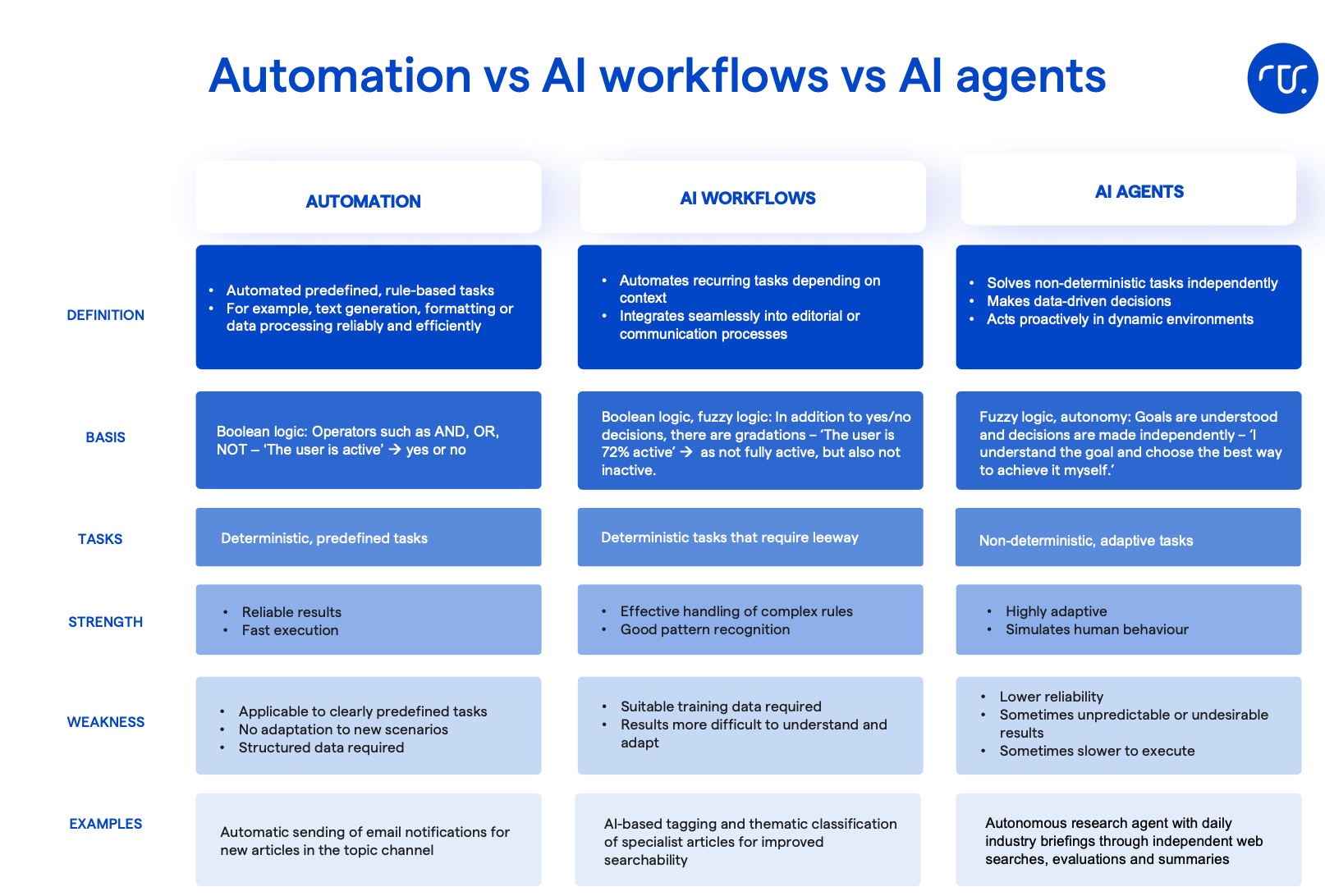
AI agents act non-deterministically – and can therefore be used autonomously and adaptively (own illustration)
What distinguishes AI agents from current tools?
AI agents do not work deterministically and perform specified tasks autonomously: they analyse situations and contexts and then plan their own courses of action, load relevant data and continually adjust their decisions as they work.
These agentic capabilities are based on the interaction of various technologies:
- An understanding of context that stores and processes history, interim results and feedback
- Structured workflows that break down tasks into sequential individual steps
- Large language models (LLMs) such as ChatGPT or Claude as a natural language basis
RAG systems (‘retrieval-augmented generation’) are also fundamentally agentic. They combine generative AI with verified, retrievable knowledge from databases, archives or documents – an important element for use in a media context. This makes it possible to provide readers with content automatically and interactively without the need for editorial intervention.
More than just prompting
However, AI agents are not ‘advanced prompt responders’. While simple LLM applications depend heavily on the quality of individual prompts, agents act iteratively. They interact with their environment, use external tools and data sources, analyse feedback and improve their ‘modus vivendi’ over several cycles.
Exemplary AI agent: Self-learning topic radar
Below is an example of how a self-learning topic radar can operate as an AI agent in the media environment. The agent continuously analyses a wide variety of external data sources, identifies relevant topics and sentiments in real time – and independently performs the following steps:
- Data collection & aggregation
The AI agent collects large amounts of content from a variety of sources such as news portals, social media, RSS feeds, blogs, forums and databases. The aim is to create as broad and up-to-date a database as possible. - Pre-processing & normalisation
The raw data is cleaned, classified and converted into a uniform format: duplicate data is removed, language and entities are standardised, key elements are identified (named entity recognition (NER)) and media types are determined. - Topic & cluster recognition
Using NLP algorithms, the agentic AI identifies thematic clusters and bundles comparable content into topic clusters. - Trend & relevance analyses
The system evaluates how strongly topic clusters are developing, which content is receiving increased attention (e.g. shares, publication frequency or tonality) and to what extent they are new or recurring topics. - Sentiment & context analysis
The agentic algorithm recognises the tonality (positive, neutral, negative) and captures the thematic context (e.g. events, actors, opinions, occurrences or interdependencies) - Feedback integration & learning
Feedback from the editorial team (e.g. which topics are accepted or rejected) and regular user interactions enable the AI agent to optimise topic weighting, clustering and relevance. - Information provision & use
The results are regularly provided to the editorial team via alerts, dashboards or API – and can thus be used journalistically for topic plans, content strategies and derivations.
Where AI agents can already be used effectively in journalism
A lot of experimentation is currently underway, and the first areas of application with real added value are emerging – beyond the hype and buzzwords.
AI agents cannot replace editorial staff – and will not be able to do so in the future. But they can meaningfully enhance editorial processes by acting as adaptive, autonomous assistance systems. The media company Ippen Digital is one of the pioneers in the German-speaking world when it comes to the use of AI agents in an editorial environment.
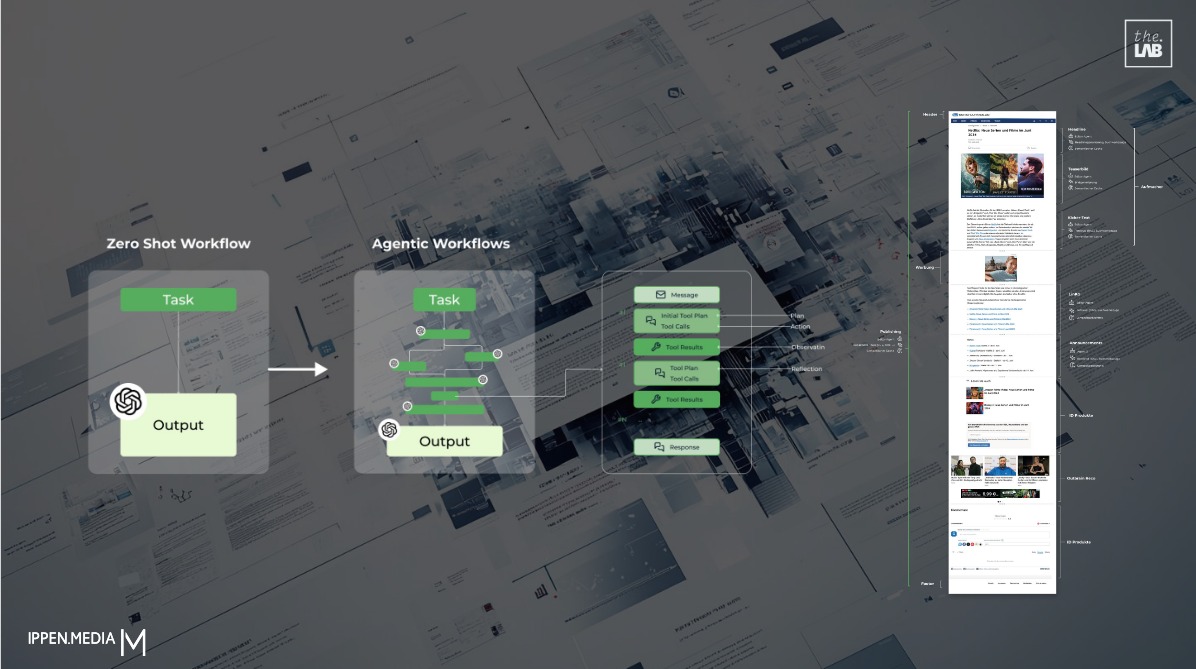
Advanced editorial processes using AI agents at Ippen Digital (INMA)
How Ippen Digital improves editorial processes with AI agents
Ippen Digital has been experimenting with agent-based workflows for some time now in order to organise editorial processes more efficiently, flexibly and scalably. At the heart of this is the idea of an ‘external second brain’ – an intelligent, AI-supported assistance system that supports editorial teams in their research, topic development and content production. This system is based on the concept of a so-called exocortex: this acts like a digital co-worker who thinks through tasks, accompanies processes and takes on subtasks independently. The technological basis is formed by language models from OpenAI, Anthropic and data from the company’s own publishing infrastructure.
Editorial tasks are broken down into smaller subtasks (i.e. prompts). These prompts are linked together in a targeted manner (‘prompt chaining’) so that the output in individual steps produces a coherent, usable result. An example: when researching topics, the AI agent first creates several individual evaluations – for example, on the source situation, expert opinions or historical context. The responses are then condensed into a reliable overview. This not only enables agent-based research processes that deliver faster results, but also work in a structured manner in terms of content – while maintaining editorial control over the content (human-in-the-loop).
The agent-based workflows at Ippen Digital are software-based, modular in design and continuously expandable. The aim is to create high-quality content in a short time – without compromising editorial standards.
Which AI agents are useful in the media environment?
My assessment: Over the next one to two years, AI agents will have to prove their concrete added value. Below are four areas of application in which this can be achieved:
- Content planning & editorial automation
Finding topics is one of the most time-consuming tasks in everyday editorial work. AI agents can provide data-driven support for such processes:
– Topic analysis: AI agents evaluate traffic data, trend analyses, high-performance content clusters, social media data and target group interests to generate relevant topic suggestions.
– Prioritisation: Topics are automatically evaluated and weighted according to criteria such as reader interest, seasonality or reach potential.
– Editorial calendar: Based on performance analyses, editorial plans can be created automatically – including suggestions for publication dates, target channels and suitable formats based on historical data. - Multimodal distribution & content repurposing
AI agents come into play when it comes to moulding individual posts into a networked content asset across channels for greater reach:
– Extracting key messages: AI agents independently identify central messages, concise quotes and suitable headlines from long-form content.
– Generating formats: Key messages are transformed into tailor-made content of varying lengths for social media, app messages, newsletter teasers or metadata.
– Tone & variation: AI agents ensure consistent tone across all touchpoints, but vary the target audience and focus. - Supportive fact-checking & source verification
AI agents take on the role of intelligent assistance systems here – without replacing editorial responsibility:
– Source verification: AI agents analyse linked content, checking the origin, credibility and topicality of sources.
– Conflict detection: Contradictory statements between text and source are detected and marked as potential points of conflict for editorial review.
– Consistency & validation: The agentic AI supports longer texts by ensuring consistent source naming, checking citation logic and comparing implicit claims with fact-based data. - Personalised content production
Agentic systems can tailor content to specific target groups:
– Reading level & living environments: Agents vary reading complexity and example worlds – for example, for younger or older target groups, professionally or privately oriented readers, or even regional and dialect-influenced reader segments.
– Linguistic fine-tuning: Tonalities such as formal vs. informal or emotionalised vs. factual can be continuously differentiated.
– Versioning without additional effort: A basic text is used to create target group-specific text variants that are particularly well-suited to their audience.
Obstacles, limitations and ethical issues: what to consider when using AI agents in the media environment
The debate surrounding AI agents in journalism is not only technological in nature – it also raises ethical and legal questions. Regardless of the potential of such AI systems, it is essential to realistically assess their limitations and risks. The responsible use of agentic AI requires a high degree of care – not least because it concerns editorial credibility, transparency and standards.
Why journalistic expertise remains indispensable
Generative AI in general, and AI agents in particular, struggle with hallucinations. The systems generate linguistically plausible, statistically based outputs. With agentic AI, which performs complex and multi-layered tasks autonomously and in multiple stages, the risk increases: errors in one processing phase can affect subsequent process steps without being noticed. That is why editorial monitoring remains essential. In short: there is no way around human-in-the-loop for AI agents either.
Where can autopilot take over – and where can it not?
Journalistic responsibility cannot be delegated. Especially in times of information overload, fake news and growing scepticism towards media offerings, independent AI agents must not be allowed to undermine editorial principles.
Instead, every media company needs to clarify the following questions:
- Where is the line between technical assistance and editorial authority?
- Which parts of the editorial process can be automated by AI agents without major risks?
- How can editorial teams ensure that agent-based output is not used without reflection?
Outlook: The role of AI agents in future journalism
Even though AI agents are currently being tested mainly in pilot projects or test environments and are facing legal and ethical hurdles, their transformative potential for journalism is fundamentally undeniable. This is not just about automating individual work steps, but about the potential transformation of editorial production logic: away from linearly structured, manually initiated processes – towards dynamic, data-driven systems in which AI agents participate as active, operational partners in the editorial process.
It is conceivable that agentic content ecosystems will establish themselves in the medium term: autonomous systems that not only provide AI-based output, but also interact with each other, exchange information and assign tasks to each other – embedded in a human-in-the-loop concept that ensures editorial control at all times.
In practice, however, many media companies are only at the beginning of this development. The real challenge lies not in the technology, but in the editorial realities. Without high-quality, accessible data, clearly defined processes and a deep understanding of its own editorial workflows, AI cannot operate effectively. Questions need to be clarified, such as: Which data and content pools are available on an ongoing basis in a structured and high-quality format? What special features need to be taken into account in the respective editorial office? Which tasks does the editorial team want to and is allowed to hand over to the agentic AI?
It is not a matter of ‘just’ building an AI agent – it is about designing processes and workflows in such a way that agentic assistance can be used at all. Many media companies are not yet sufficiently prepared for this in terms of process maturity. Even in advanced organisations, the possible applications are often limited to clearly defined use cases or individual teams.
Therefore, my recommendation is this: instead of rushing into investing in complex agent architectures, media companies should first optimise their existing structures – particularly with regard to data storage, content management and editorial processes. The greatest leverage currently lies not in the development of new systems, but in the consistent further development of existing workflows and AI applications. Only when this foundation is in place can agentic AI have a broad impact – and prove to be economically viable.
One thing is clear: AI agents will not replace journalism either. However, when used correctly, they can help to organise editorial work more efficiently. Resilient agents create space for research, classification and creativity by taking on standard tasks and speeding up workflows.
Do you have any questions, suggestions or are you interested? Get in touch with us – we look forward to hearing from you. Our experts will be happy to get back to you!