Blog
Sample Questions for AI Chatbots: How Media Companies Introduce Users to Interactive Information Services

Nadine Jakob
Marketing Manager, Retresco
AI chatbots are changing the way users interact with digital information services. Instead of navigating menus, search boxes, article lists or topic pages, users can now ask individual questions, explore content in context and engage in a step-by-step dialogue.
For media companies, publishers and specialist media providers, this creates a new form of user relationship: more direct, more conversational and more closely aligned with specific information needs.
However, these interaction patterns do not emerge automatically. Many users first need to learn how to make effective use of conversational services. This is where providing sample questions makes a difference. They lower initial barriers, make use cases visible and demonstrate the range of topics an AI chatbot can cover.
What Are Sample Questions?
Sample questions – sometimes referred to as conversation starters, opening questions or quick replies – are predefined questions or response options within an AI chatbot (or comparable interactive service). They act as an icebreaker and remove the barrier of the “empty input field”. When used effectively, sample questions are far more than a simple UX element.
They are a strategic tool for sustainably increasing acceptance, depth of use and interaction with AI-based information services. Organisations that use example questions strategically not only improve the user experience, but also strengthen their own platforms and services as central destinations for reliable information.
Why Are Sample Questions Useful?
Sample questions are predefined questions or prompts displayed directly within the chat interface. They can be fairly general, such as “What are the most important news stories today?”, or tailored to a specific topic, section, dossier or service. In a regional or local media environment, examples might include “Which decisions affect my region?” or “What’s new regarding traffic and roadworks in my city?”. For specialised publishers, typical starter questions might be “Which new regulations are relevant to my company?” or “Summarise the most important developments on this topic.”
The real value of sample questions lies in the orientation they provide. An empty chatbot interface can quickly feel overwhelming. Users who do not know what they can ask may decide not to ask anything at all. Example questions, by contrast, immediately demonstrate what an interactive service is designed to do. They show concrete use cases, inspire interaction and provide an initial sense of the topics an AI chatbot can address. Sample questions are particularly useful in mobile-first contexts, where tapping is easier than typing, helping to simplify use and encourage deeper engagement.
Conversation Starters Boost Direct User Relationships for Media Companies
This effect is particularly important for new interactive information services. Although users are becoming increasingly familiar with AI systems, not every audience automatically transfers this experience to journalistic or specialised information services. A chatbot on a media portal, within a specialised information system or on a service platform therefore needs a simple, intuitive entry point. These conversation starters help to make this first step as accessible as possible.
The increasing shift of search and information access into the closed ecosystems of Google and other platforms presents a strategic challenge, particularly for media companies and publishers. When users increasingly obtain information directly from external platforms, the direct relationship between a media brand and its users comes under pressure. At the same time, the visibility of publishers’ own content declines. Proprietary AI chatbots and interactive services can help counteract this development in a targeted way.
Interactive information services enable media companies and publishers to make their content available conversationally on their own platforms. Users no longer have to begin their information search via search engines, external AI search services or social media, but can interact directly with the media company’s own offering. Example questions are an important lever here. They guide users towards proprietary content, make editorial expertise visible and make it easier to establish regular interaction with suggested follow-up questions.
How to Use Interactive Services
Retresco’s customer analysis shows that user behaviour in relation to AI chatbots and interactive information services changes significantly over time. Initially, many users rely primarily on the example questions provided. They use them as a safe entry point to familiarise themselves with the service and gain their first experience of conversational search or interactive information retrieval.
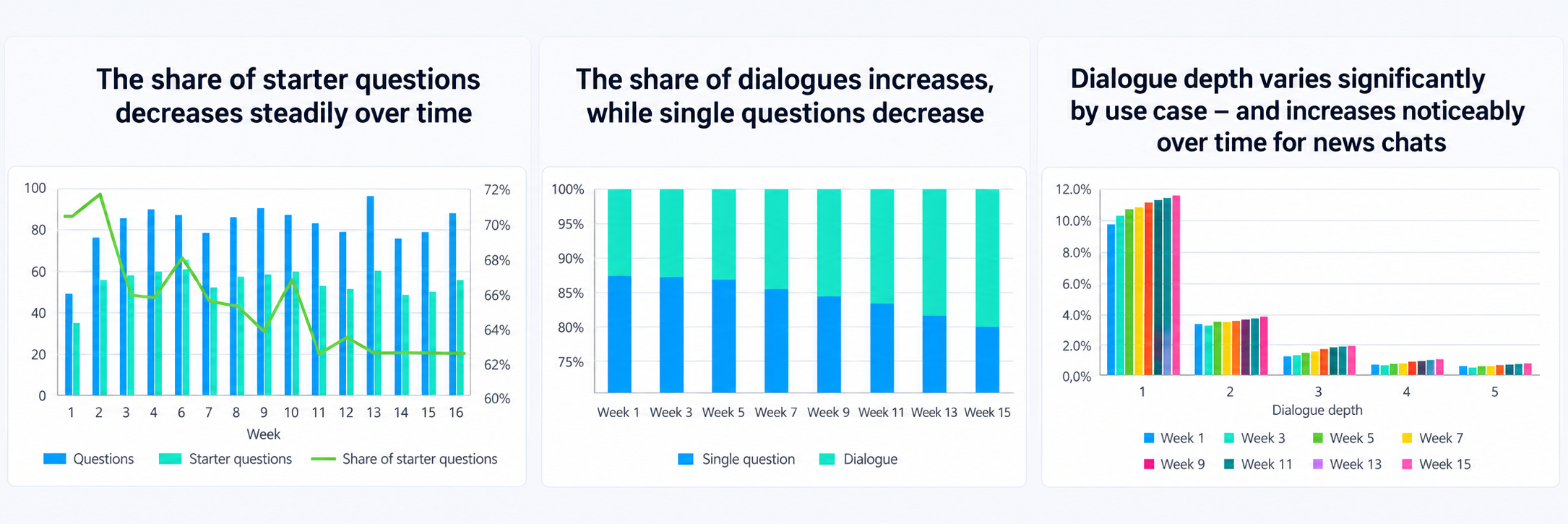
Sample questions increase acceptance of interactive information services over time (Retresco customer analysis)
As familiarity grows, the proportion of self-formulated questions increases significantly. Users begin to express their own information needs more precisely, ask (suggested) follow-up questions and actively integrate interactive services into their research and decision-making processes. What begins as the use of predefined prompts gradually develops into a more independent way of interacting with the service.
This is an important finding for media companies and publishers. It shows that example questions do not replace free-form interaction; instead, they help to initiate it. Starter questions are not a rigid framework, but a training ground for conversational use. Through concrete examples, users learn which types of questions are useful, what constitutes a reliable answer and how follow-up questions can add greater depth.
From Individual Questions to Multi-Stage Dialogue
Another important effect can be seen in the development of conversational depth. The longer a chat service is embedded within a media portal or digital platform, the more the number of questions per interaction tends to increase. Users no longer ask only isolated, one-off questions, but gradually enter into a multi-stage exchange.
This is strategically important for media companies. A single search or isolated question only generates limited interaction. Multi-stage conversations, by contrast, increase depth of use. Users remain within the service for longer, refine their queries and explore content in context. A simple information request becomes an interactive user journey.
This is particularly important for complex topics. Anyone looking for information about political decisions, local developments, economic trends, health topics, legal questions or specialised information rarely has just one question. More detailed or entirely new information needs often emerge during the interactive exchange itself. One answer leads to the next question. A summary leads to a request for detail. An explanation leads to a request for examples, sources or possible courses of action.
Regularly Updating Sample Questions for Recurring User Engagement
Sample questions are particularly effective when they do not remain static indefinitely. Regularly updated or dynamically generated sample questions can sustainably increase chatbot usage by continually creating new reasons to interact. They can reflect current topics, direct users towards relevant content and signal that the service is active, editorially maintained and closely aligned with users’ information needs. This is especially relevant when media companies or publishers continuously attract new users to their interactive services through targeted marketing activities.
For media companies and publishers, this means that example questions should not be defined once and then left unchanged in the chat interface. Instead, they should form part of ongoing editorial and product strategy processes.
Orientation Within Complex Information Environments
Sample questions are particularly valuable in media environments where users need guidance through complex information spaces: regional news services, large article archives, thematic dossiers or interactive answer systems based on proprietary content. A regional media company can use starter questions to make local relevance immediately visible. Relevant opening questions translate editorial content into concrete everyday situations and simplify access to useful information.
Making Specialised Information Usable in the Workplace
Specialised media can also benefit from dynamically maintained sample questions. New legal requirements, industry trends, market analyses, commentary, specialist articles, standards or database content can be transformed into targeted question prompts. B2B users do not first need to formulate an abstract search query, but can immediately begin with practical, work-related questions. Specialised information therefore becomes not only easier to find, but directly usable within a specific professional context.
Seasonal Occasions and Recurring Advisory Needs
Current news developments, seasonal topics, regional events, new dossiers, thematic priorities or frequently asked user questions can regularly be translated into new starter prompts. Special-interest services can also adapt example questions to seasonal interests, purchasing decisions or recurring advisory needs. This creates additional entry points that reactivate existing content and regularly guide users towards relevant topic areas.
Verified Content for Sensitive Subject Areas
The benefits are particularly clear in sensitive and knowledge-intensive areas such as medicine, pharmaceuticals, law, taxation or compliance. Here, sample questions can help make verified content accessible in a controlled, comprehensible and context-sensitive manner.
The crucial factor is that AI chatbots are based on reliable sources, clear references and professionally verified content – ideally drawing on publishers’ own content as well as agentically provided information from trustworthy external data sources.
Sample Questions Connect UX, Editorial and Strategy Better Guidance
The success of suggested questions depends on more than their wording. What matters is that they are developed at the intersection of user guidance, editorial expertise and strategic objectives. Effective example questions do not merely answer the question: “What can the chatbot do?” Above all, they answer: “What information needs do our users have – and how can we guide them meaningfully into our service?”
Sample questions should therefore fulfil several functions:
- They should be clear, concrete and easy to understand.
- They should show which topics the service covers.
- They should lead users towards relevant content and encourage follow-up interactions.
- They must fit the media brand, its editorial profile and the relevant usage context.
For media companies and publishers, this is crucial. Their strength lies not only in the technology itself, but above all in reliable content, editorial interpretation and specialised expertise. AI chatbots deliver their real value when they make verified and relevant content accessible through dialogue.
What Sample Questions Can Teach Companies
Analyses of sample questions and chat histories provide valuable insights for product development, editorial teams and audience development. They reveal which starter questions are used most frequently, which topics generate multi-stage conversations, which content leads to large numbers of follow-up questions and in which topic areas users quickly begin to formulate their own questions.
These insights highlight users’ actual information needs. They help organisations identify thematic priorities, structure content more effectively, plan new thematic dossiers and continuously develop services in a more user-centric way.
From Experimentation to Productive Use
What matters most is how chatbot usage develops over time. If the proportion of self-formulated questions rises while the number of questions per interaction also increases, this suggests growing familiarity and greater confidence in using the service. Users learn not merely to experiment with the interactive service, but to integrate it productively into their regular information routines.
Continuously Developing Follow-up and Sample Questions
As explained above, to realise this potential fully, starter questions need to be editorially maintained and continuously optimised. They should reflect the current news agenda, the target audience and the specific service. The key is to review them regularly, replace them selectively and develop them on the basis of usage data.
Collaboration Between Editorial, Product and Technology Teams
Close collaboration between editorial, product, audience development and technology teams is essential. Editorial teams understand topics, relevance and tone of voice. Product teams understand user guidance and interface logic. Data analyses show which questions actually work. Technology partners can help integrate sample questions effectively into chatbot services, knowledge databases and retrieval processes.
Examples of Sample Questions in Current Media Services
Sample questions are already established across global media companies and renowned news publishers. The following three examples illustrate how effective example questions are being used in practice.
1. Sample Questions as an Entry Point Into Journalistic AI Services
A prominent example of starter questions in a journalistic environment is Ask The Post AI by The Washington Post. Its focus is to reimagine the traditional search experience for news consumers. The tool was built via Together AI and is designed as an enhanced, modern search engine for deep daily news reporting dating back to 2016.
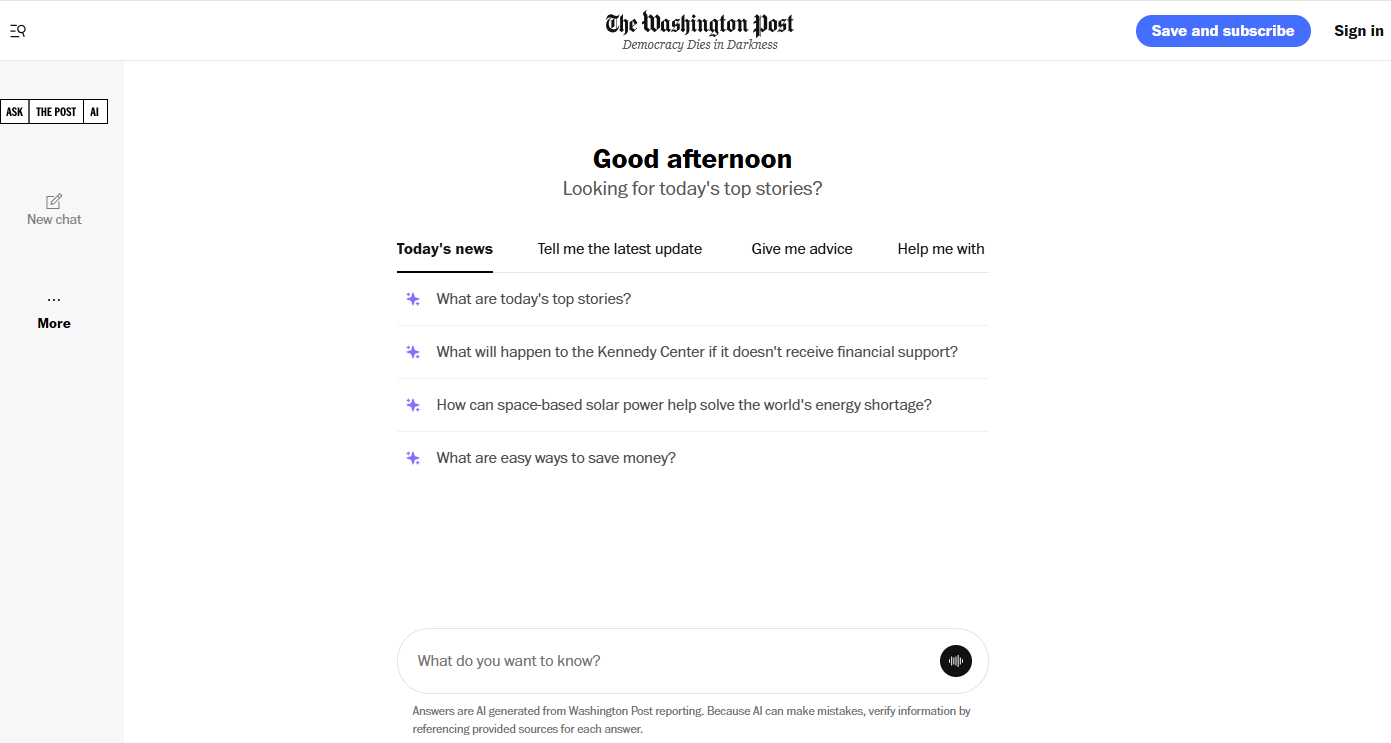
Sample questions on Ask The Post AI, focusing on product search and current news.
The strategic benefit: Premade questions position a new AI service not as abstract technology, but as a concrete information assistant based on proprietary journalistic content.
2. Article-Related Search for Long-Term Historical and Cultural Trends
The AI-powered interactive platform TIME AI built by TIME Magazine offers its subscribers, registered users, and page visitors varying access to the service’s functionalities. It was built in a partnership with Scale AI and focuses on long-term historical trends, cultural evolution, and global accessibility.
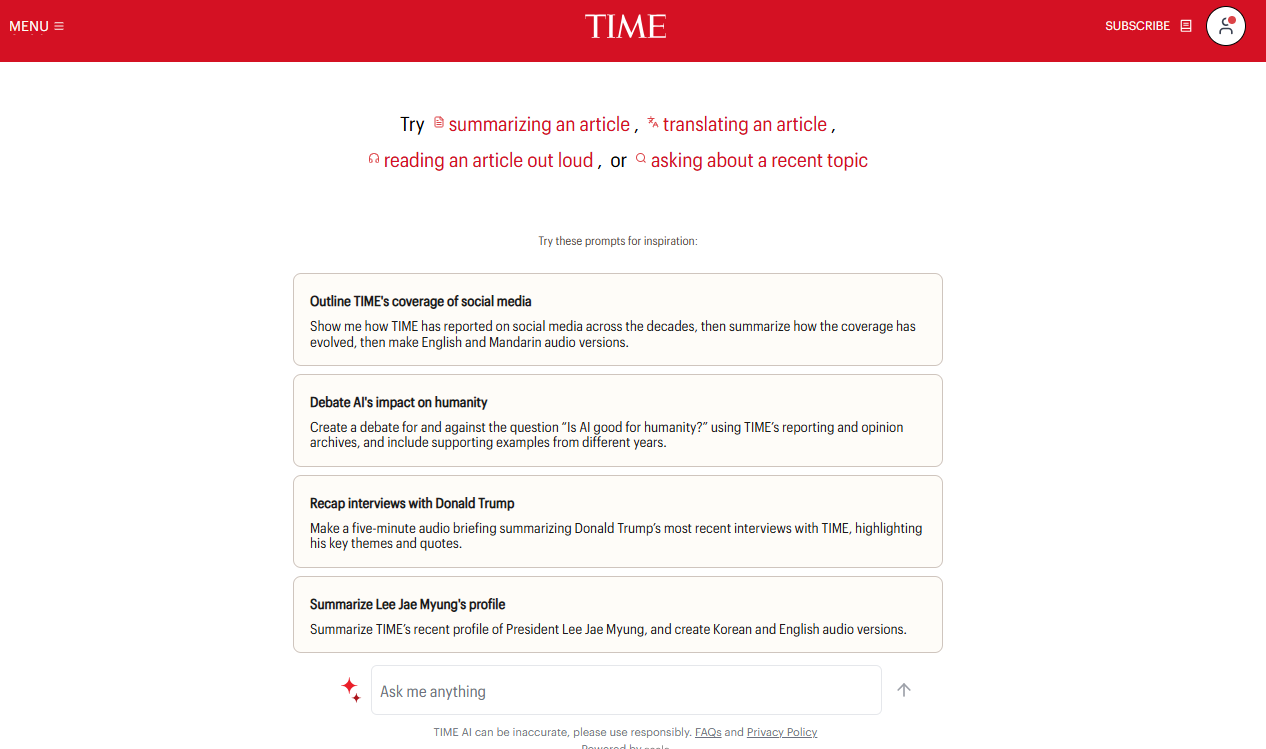
Starter questions guide users directly towards relevant topics on TIME AI.
Sample questions perform an important bridging function: they show which topics the chatbot covers, reduce barriers to entry and guide users directly towards relevant information.
3. Example Questions for Better Access to Massive Libraries via Search
Forbes takes a different approach from the publisher-walled AI tools of The Washington Post and TIME Magazine. The global media brand positions its massive library of business data, executive insights, and product reviews as a valuable resource feeding into external AI search platforms like Google AI Overviews and Perplexity.
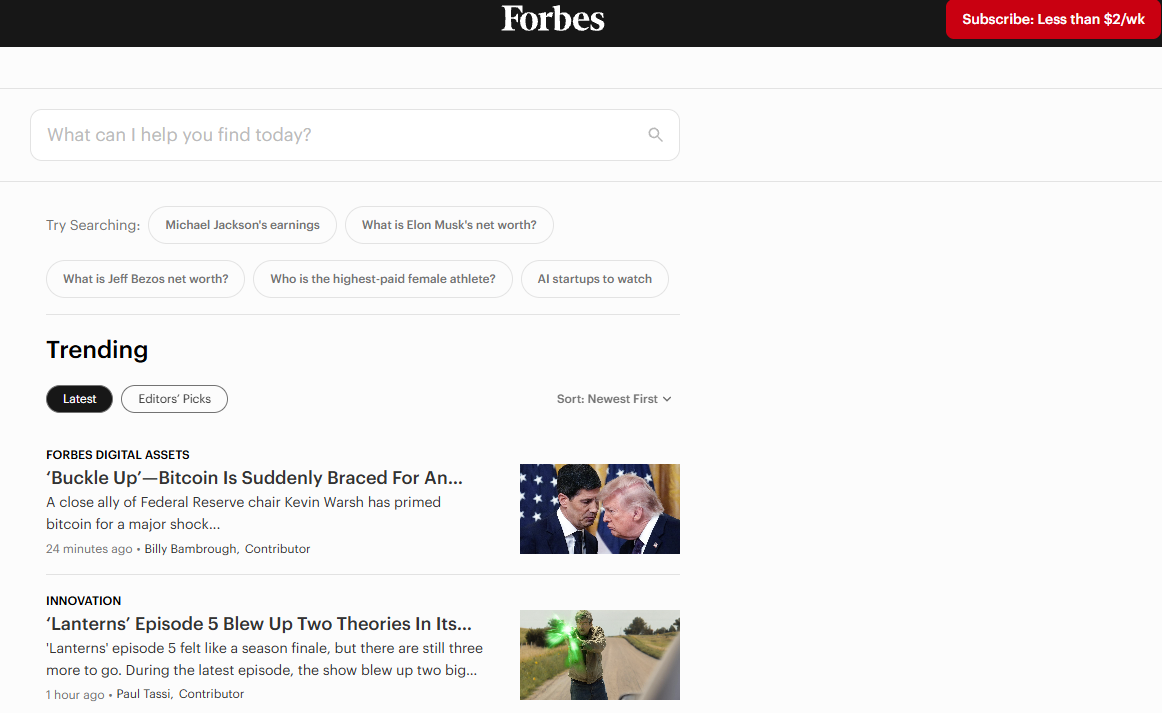
Entry questions and suggestions make it easier to navigate Forbes.
Users can explore content in greater depth, ask comprehension questions and request explanations of wider contexts from a variety of data points. This lowers barriers in usage and increases time spent within the service.
Do you have feedback, comments or questions? Get in touch – our AI experts will be happy to hear from you!
Recent Blog Posts