Blog
How to Monetise Chatbots: Strategies for AI, Advertising and Editorial Balance

Johannes Sommer
CEO, Retresco
The debate around advertising in AI-powered search and chatbots is no longer theoretical – AI search has entered the market. OpenAI is expanding its subscription and API offerings to include an ad-funded business model. Initial tests with ad placements in ChatGPT apps are already underway in the US. Competitor Perplexity, by contrast, is moving away from traditional display formats in user chats after early experiments last year, instead focusing on publisher partnerships and revenue-sharing models.
The Financial Times reports that Perplexity aims to maintain user trust by appealing to those who prefer chatbots without commercial intent, or who might otherwise question the credibility of the information provided. The major OpenAI rival, Anthropic, has responded to the introduction of advertising in ChatGPT by announcing that it intends to forgo ads altogether – a stance it underscored with a widely discussed Super Bowl campaign.
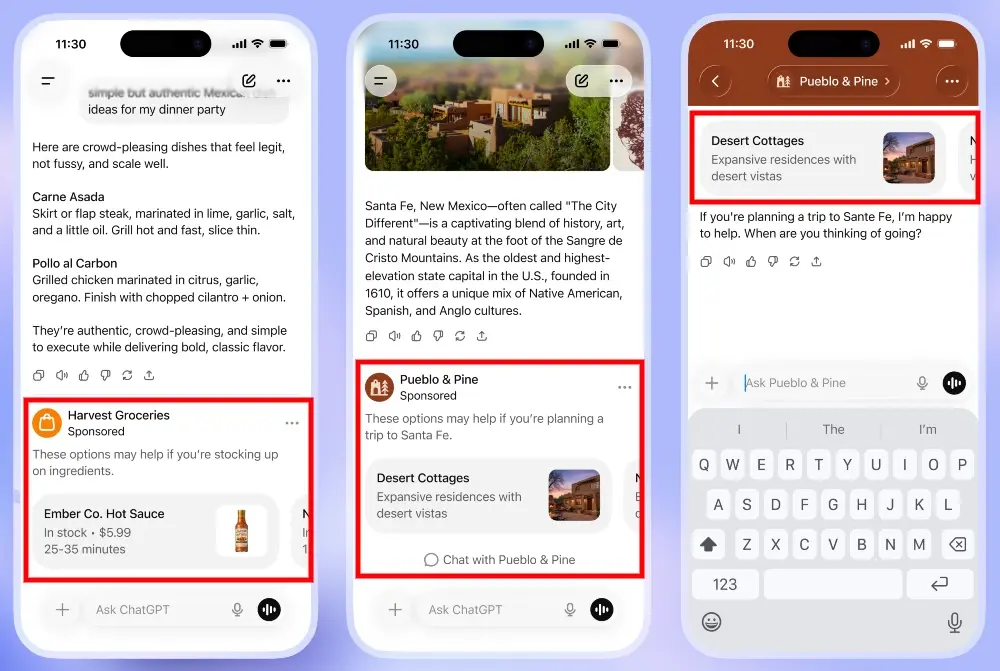
ChatGPT ads in apps: product recommendations embedded within conversations (OMR mock-ups)
This closely watched debate is of great relevance to media organisations and publishing houses. In recent months, many publishers have launched their own chatbots on websites and within news apps. These chatbot responses are generated using editorially vetted, in-house sources. The aim is to offer users a new, conversational way to access content and services, thereby enhancing interaction, increasing engagement, and strengthening audience loyalty.
Beyond this, chatbots provide a highly valuable asset: user insights. Conversations naturally centre on user intent and analysing queries reveals what people are actively searching for, what captures their interest in the moment, and what they expect when visiting a news platform. This creates a rich and dynamic source of intelligence – one that can inform content production and curation and significantly strengthen personalisation strategies.
Within the media ecosystem, the next question arises almost immediately: how can these new formats be commercialised and directly monetised – especially in such an innovative environment with seemingly new, potentially personalised advertising contexts?
At the same time, there is the question of whether, and to what extent, advertising elements can be integrated without compromising journalistic integrity. Particularly in contrast to general-purpose AI search and chats from providers such as ChatGPT or Gemini, this integrity remains the central currency for media organisations.
Managing the Tension Between Limited Reach, Strategic Objectives and Trust Risks
Platforms such as ChatGPT benefit from enormous reach when it comes to monetisation. Chat offerings from media organisations typically lack this advantage. As a result, they are less a tool for achieving maximum reach and more an innovative instrument of editorial brand-building. They can help to demonstrate and strengthen credibility, trust, topical authority, relevance and proximity to the audience.
Against this backdrop, it is insufficient to fill chat interactions with conventional banner formats, native ads or programmatic advertising. Instead, native, dialogue-based advertising formats that directly relate to user queries and their context appear more appropriate.
However, this creates a tension: the more differentiated and context-specific the targeting, the smaller the reach of individual advertising messages. At the same time, the closer advertising gets to the individual usage context, the greater the potential mistrust among users regarding how their data is being used. This also increases the risk of blurring the essential boundary between journalistic integrity and commercial imperatives.
Suitable Advertising Formats for AI Chatbots
To begin monetising chatbots, it makes sense to use formats that can be integrated as naturally as possible into the conversation flow. These include clearly labelled recommendation boxes in the form of native cards – standalone advertising units placed directly beneath dynamically generated responses. These are marked as “Ad” or “Sponsored” and may appear as text-image formats with a short description and a call to action.
More complex formats include sponsored intros or follow-up questions. Such placements must also be clearly labelled as advertising. They can be displayed alongside thematically relevant example questions within the chat interface – either above or below the input field.
Both formats can be delivered either statically or contextually, based on user queries. Their key advantage lies in addressing user intent without influencing the core responses.
In essence, these are distinct, clearly labelled elements within the conversation. They integrate visually and functionally into the dialogue without interrupting it. This allows them to remain connected to the context of user queries and to provide direct value within the interaction – for example, as recommendations, product suggestions or additional services.
Contextual vs Profile-Based Targeting in AI Chatbot Advertising
A distinction must be made between contextual delivery and personalised targeting. In chat environments, advertising should not be based on individual user profiles, but rather on the specific query and its semantic context. In practice, this means that ads need not be delivered in a static manner but can be dynamically aligned with the topic and intent of a user’s query.
Intent categories, topic clusters and sensitivity filters can be used for ad delivery. By contrast, targeting based on individual user profiles should be avoided. Particular caution is required in sensitive areas such as politics, health, legal matters, issues concerning children and young people, and disaster coverage. OpenAI also currently excludes or significantly restricts advertising in such areas.
The Market Is Experimenting with AI – Future Revenue Models Remain Unclear
The editorial use of chatbots, as well as their monetisation, is still in its early stages. The fundamental question mirrors that of previous innovation cycles: what primary objective should a chatbot offering serve? Should chats focus on retaining existing users, acquiring new subscribers, or primarily generating advertising revenue? They could also aim to increase online revenues or support transactional services.
Only once this strategic objective is clearly defined decisions be made regarding whether and how advertising should be integrated into chat offerings. When this strategic objective has been clearly defined can decisions be made about whether and how advertising should be integrated into chat offerings.
4 Scenarios for Monetization of AI Chatbots That Currently Appear Plausible
Scenario 1: “Safe Bet” – AI Chatbots as the New Search
In this scenario, media organisations and publisher establish AI chats as comprehensive search solutions. Chatbots draw on a central pool of searchable content – such as CMS article archives, structured databases from information services and public authorities, and other trusted third-party sources.
Monetisation takes place through contextual native ads or ad boxes delivered based on semantics and user intent. These formats are clearly separated from editorial responses and appear, for example, in transactional queries.
The advantage is that chat becomes a central component of a news platform or app, effectively functioning as a new form of search. From a commercial perspective, the focus is less on reach and more on monetising individual user intent. Standard formats such as display ads or affiliate links can also be integrated relatively easily, although they only partially exploit the potential of conversational environments.
One risk is that users may leave the publisher ecosystem, limiting value creation to click-based revenue models.
Scenario 2: “Premium Funnel” – AI Chatbots as a Proprietary Funnel
In this scenario, chatbots act as an entry point into a controlled publisher funnel. Responses remain editorial in nature, while accompanying native advertisements guide users towards publishers’ landing pages and commercial offerings.
Users remain within the publisher’s ecosystem, where value creation takes place: guides, comparison tools and service hubs can be monetised through marketplaces, regional listings, partner directories or proprietary services. At the same time, publishers retain control over user data and conversion funnel.
The advantage lies in a significantly higher value per interaction. The challenge, however, is operational complexity: a functioning publisher funnel requires substantial internal resources, technical expertise, and clear governance structures.
Scenario 3: “Conversion Broker” – AI Chatbots as a Bridge to Commercial Offers
In this scenario, monetisation mechanisms are more deeply integrated into the interaction. Alongside native ads, conversational follow-ups may appear, such as: “Would you like to find suitable providers in your area?”
Here, the chatbot acts as an intermediary between user intent and relevant external commercial offers.
Such models can achieve high conversion rates, particularly when clearly positioned as a service within the appropriate usage context. However, they are sensitive from a journalistic perspective: if users perceive responses as being driven primarily by commercial interests, trust in the editorial brand may suffer.
Scenario 4: “Trust Builder” – AI Chatbots as an Ad-Free Space
In this scenario, media organisations deliberately keep chats largely free of advertising. The focus is on increasing engagement and strengthening user loyalty. Revenue is generated primarily through loyal, long-term digital subscribers. However, it remains unclear whether fully ad-free chatbot models can be economically sustainable in the long term.
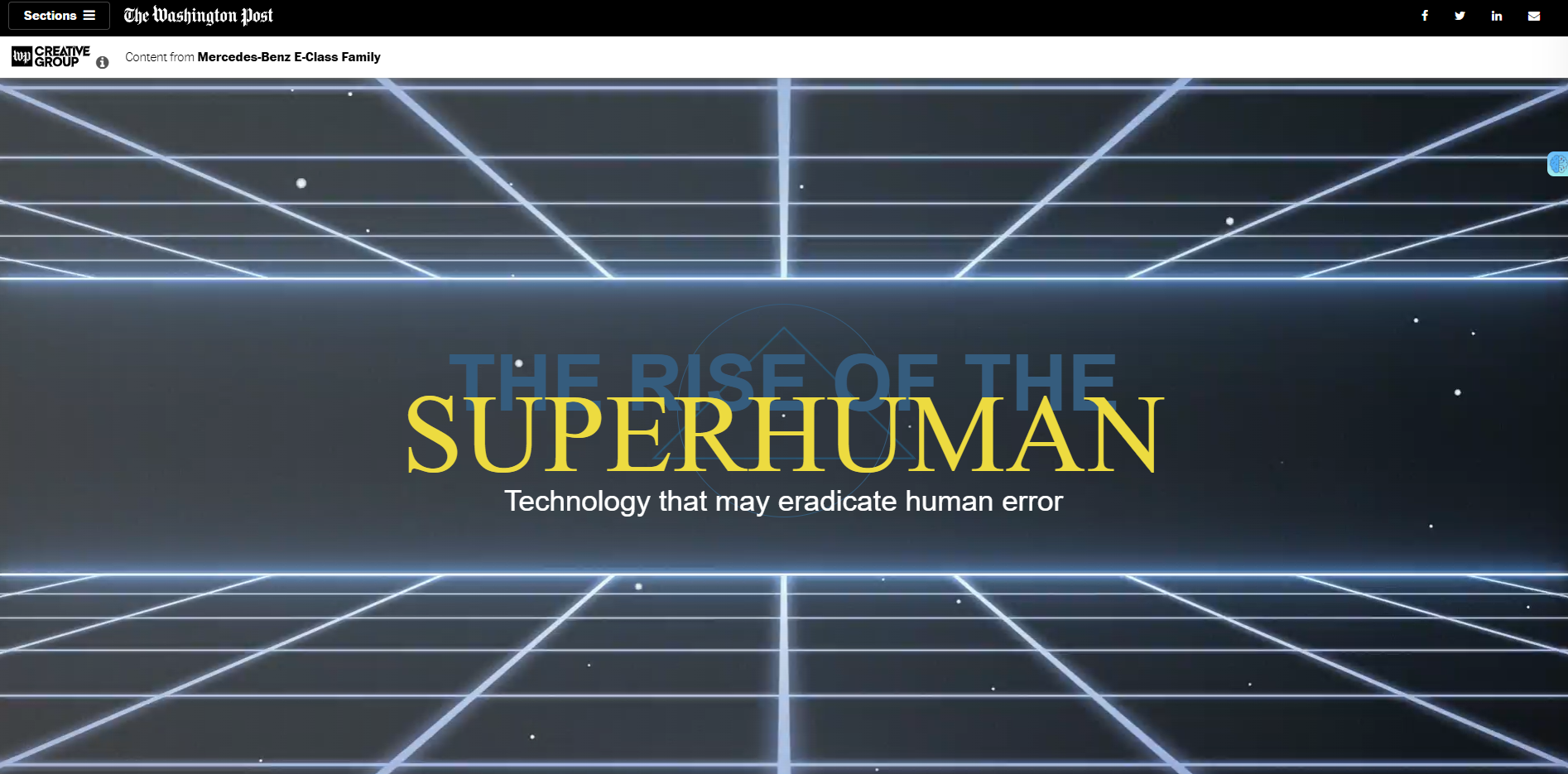
Editorially curated, interactive native advertising feature by Mercedes-Benz in The Washington Post
Rethinking the Monetisation of AI Chatbots but Preserving Credibility
The guiding principle for current monetisation experiments should not be to maximise the volume of advertising within chatbot conversations. Rather, as in the past, success depends on a clear strategy that maintains a strict separation between editorial content and commercial activity.
AI should generate responses solely on the basis of editorial content. In parallel, a separate monetisation layer can match context and user intent with existing campaigns. Both layers are brought together only in the user interface – within clear guardrails: transparent labelling, exclusion categories, frequency capping, and binding governance rules between editorial, product and commercial teams.
Especially in interactive environments, not every additional euro is worth earning. If commercial chatbot elements become too dominant or too frequent, users may quickly perceive the offering as primarily monetisation-driven. For premium journalistic brands, this poses a significant risk.
Conclusion: Not Every Chatbot Response Is an Advertising Opportunity
The future does not lie in simply transferring established advertising logic to new, interactive chat formats. Media organisations and publisher that succeed will be those that treat AI chats as a distinct form of user interaction – and deploy monetisation only where it provides genuine added value and aligns with the user’s intent at a given moment.
The strategic question is therefore not: How insert advertising into chats?
But rather: What business model fits these new interaction formats; where relevance, intent and trust are more closely intertwined than ever before? Those who can answer this convincingly will be able to develop sustainable, robust business models from conversational services.
Do you have feedback, comments or questions? Get in touch – we look forward to the exchange!