Blog
AI in journalism: My 5 insights from the Reuters Report 2026 for media companies

Simon Pollock
A third less traffic, the growing importance of artificial intelligence and increasing pressure to innovate in newsrooms:
The new report ‘Journalism, Media, and Technology Trends and Predictions 2026’ from the Reuters Institute for the Study of Journalism provides exciting insights into the current reality of media companies and publishers worldwide.
First things first: for decision-makers and practitioners, AI in journalism is no longer a topic for the future – it already determines reach, efficiency and competitiveness today. The study is based on surveys of 280 executives from 51 countries, conducted at the end of last year. Those surveyed included CEOs, editors-in-chief and digital managers. The majority of participants came from the UK, the US and European countries such as Germany, Spain, France, Austria, the Benelux countries and the Netherlands.
Below, I present my five most important findings from the Reuters report. At the same time, I give my assessment of what they mean in concrete terms for media companies and publishers.
1. Google is Losing Its Role as a Traffic Provider
What has been looming in the media market for some time is now a reality: Google has increasingly relinquished its role as the central traffic provider for publishers. Media companies worldwide are seeing an average decline of around a third of their search traffic, and in the US this figure is as high as 38%. The main reason for this is Google’s AI Overviews, which answer user questions directly on the search results page. Google Discover is also contributing to this development, with a year-on-year decline of around 21%. For editorial teams, this means a profound structural change that goes far beyond short-term losses in reach.
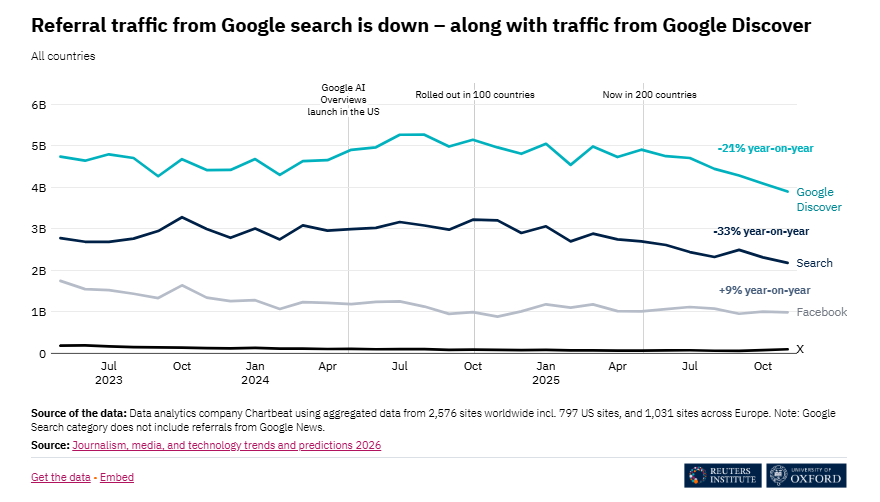
Google traffic plummets: -33% for searches and -21% for Discover
The forecasts are even more drastic: over the next three years, media companies expect further losses of 43% on average in search traffic, with one in five companies even anticipating a slump of more than 75%. Lifestyle and service content such as weather reports, TV programmes, horoscopes and evergreen formats are particularly hard hit. Investigative research, well-founded classifications, analyses and exclusive content are proving to be more resilient – in other words, precisely those journalistic services that cannot easily be replaced by AI or a chatbot.
The consequence of this is clear: in addition to direct customer relationships and ‘owned media,’ media companies must further develop their strategies and invest specifically in Generative Engine Optimisation (GEO). The goal should be to remain visible in the source references of chatbots such as ChatGPT, Gemini, or Perplexity and to be perceived as a reliable reference. Even if the volume of traffic generated there is still manageable at present, presence in AI searches is likely to become a more important factor for reach, brand strength and relevance in the future.
2. AI Chatbots Are Catching up With YouTube and TikTok
AI chatbots will come close to platforms such as YouTube and TikTok in the media ecosystem by 2026, marking a profound change for AI in journalism. The industry’s response to declining reach via Google is clear: media companies are increasingly focusing on diversifying their distribution channels.
This is particularly evident in the investment priorities for 2026. YouTube remains the most important growth driver with an increase of 74%, but AI platforms and chatbots follow closely behind as new access points to journalistic content with 61%. TikTok also continues to grow with 56%.
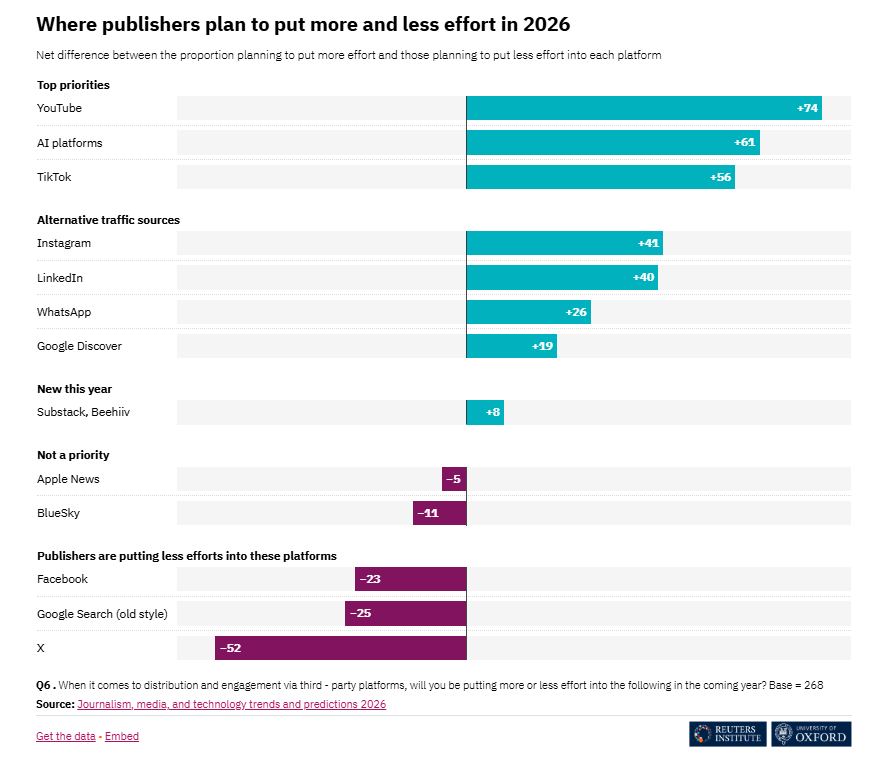
Media companies and publishers will rely on AI chatbots in 2026 – alongside YouTube and TikTok
At the same time, a new model is coming into focus: editors are evolving into creators, building personal brands, cultivating communities and strengthening direct ties with their users. In parallel, chatbots are fundamentally changing the rules of journalism. Journalists need to understand how their content is used in chatbots and AI searches. Content is no longer just read, but summarised in interactive offerings, quoted and used to answer questions.
3. AI in Journalism: From Experiment to Infrastructure
In recent years, AI in journalism has evolved from an experimental field of application to a central infrastructure in the newsroom. More and more media companies are specifically relying on artificial intelligence to organise editorial processes more efficiently, quickly and scalably. Ninety-seven per cent of those responsible consider end-to-end automation to be essential, while 82 per cent already use AI for news gathering. AI also plays an important role in product and software development in journalism: 81% of respondents use it to shorten development cycles and implement innovations more quickly.
The most important areas of application include transcription, copy editing and the automated creation of metadata, which are used by 64% of respondents. In addition, AI is increasingly being used in journalism for programming (44%), commercial applications (33%) and research and topic identification (29%). Basically, it can be said that AI is strategically relevant in journalism – but has not yet been widely adopted at the operational level.
4. The Biggest Hurdle Is Not AI, but Implementation
The biggest hurdle for AI in journalism is not the technology itself, but its consistent implementation. External disruption from AI searches and closed ecosystems are a major challenge, but this is not enough. There are also barriers to innovation within organisations: according to the report, 62% of media companies are held back by a lack of resources, 48% struggle with a lack of coordination between different teams, and 33% do not have the necessary skills to implement robust AI solutions.
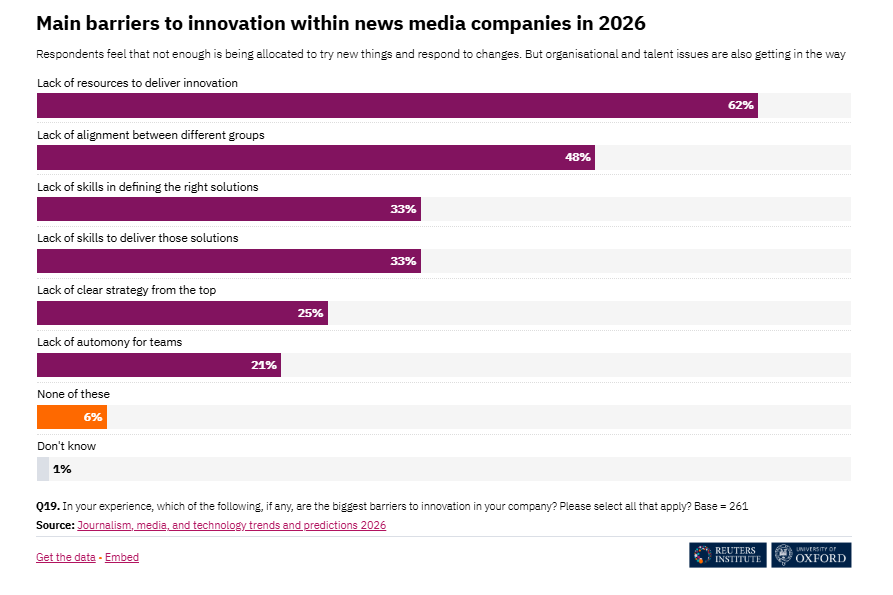
The biggest innovation challenges for media companies and publishers in 2026
This makes it clear that it is not visions or strategic declarations of intent that determine the success of AI in journalism, but rather the ability to consistently translate AI projects into robust processes, functioning workflows and a suitable organisational culture.
5. Confidence in One’s Own Company, Doubts About the Media Industry
The Reuters report also reveals an interesting contradiction that says a lot about the state of AI in journalism: while 53% of respondents are optimistic about the future of their own media company, only 38% share this optimism when it comes to journalism as a whole. This divergence between confidence in one’s own company and doubts about the industry as a whole is not a short-term effect, but part of a longer-term development. Since 2022, optimism for journalism has fallen by a full 22 percentage points.
The respondents cite uncertainty about the long-term impact of AI on journalism, increasing competition from external creator ecosystems, and politically motivated attacks on the media as the main reasons. AI is perceived as both an opportunity and a risk: on the one hand, it promises efficiency gains and new journalistic formats, but on the other hand, it fuels concerns about quality, credibility and economic stability.
My Conclusion: Now or Never
The report leaves little room for interpretation: artificial intelligence is changing journalism not gradually, but structurally. Anyone who continues to view it as a mere tool is misjudging its significance. Visibility and reach no longer arise automatically through Google, but increasingly through AI applications that process content and deliver it in a targeted manner.
Without an AI strategy, media companies are losing control over their reach. Chatbots and generative engine optimisation are not gimmicks, but a relevant journalistic and economic skill for the future. At the same time, the value of what AI cannot do is increasing: original research, classification, attitude and journalistic quality. For media organisations, this means one thing: AI must not remain an isolated experiment. It must be mastered editorially, technologically and strategically.
Do you have any questions, comments or feedback? Get in touch – I’ll be happy to hear from you!