
Rely on topic pages for successful content management
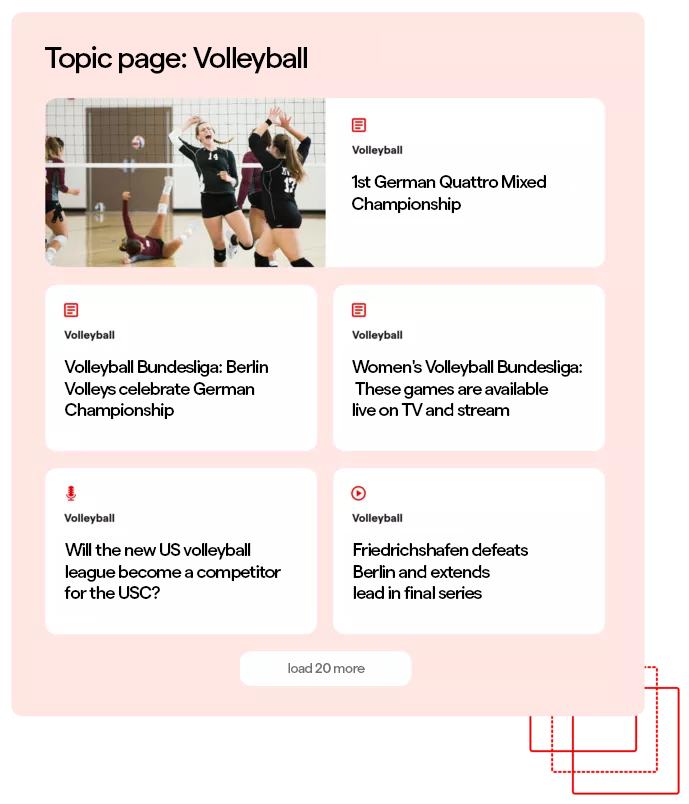
Benefit from topic pages as a powerful tool to enhance the visibility and reach of your media content on Google and other platforms. With the help of semantic analysis and intelligent automation, your editorial teams can efficiently and purposefully create thematically grouped pages to engage readers across multiple formats based on their interests.
New articles, videos, and other relevant contributions can be continuously added to your existing topic pages, increasing the attractiveness of your media offering for search engines. At the same time, you offer your audience an improved user experience by allowing them to easily and quickly access the content most relevant to them.

Identify trending topics
Identify emerging, fast-growing topics early by creating topic pages based on the search queries of predefined reader groups. This enables your editorial teams to proactively respond to audience interests and gain traction through relevance.

Automate the creation of thematically consistent pages
Whether it’s sports, crafts, entertainment, or politics – with our automated topic pages, you can compile all articles from a specific subject area on one page in real time, boosting your visibility and the time visitors spend on your site.
The following technologies are used in this tool
Frequently asked questions about topic pages
What are topic pages?
Topic pages are SEO-optimised, user-oriented pages that bundle and clearly present content on a specific topic. They increase the visibility and reach of content in search engines like Google. By grouping topics and organising content, media outlets, publishers, and publishing houses can improve the discoverability of their content and reach new target audiences.
What are the benefits of topic pages?
Topic pages are designed to precisely provide target audiences with relevant content, thereby increasing reader engagement. Through the intelligent creation of user-oriented and search engine optimised topic pages, not only can the visibility of content in search engines be enhanced, but the overall SEO relevance of your media offerings can also be expanded. At the same time, time-consuming and repetitive workflows are automated, allowing editorial teams more time for their core journalistic tasks. Last but not least, topic pages make an important contribution to monetisation in the media sector by driving more traffic to your own websites and increasing reach.
How are topic pages created to be search engine optimised?
The creation of topic pages is based on semantic analyses of the available content to identify and group relevant topics. Using natural language processing (NLP) and machine learning algorithms, entities and keywords such as company names, people, products, events, and industries are recognised and linked with relevance indicators. Based on this, automated curation and bundling of content on topic pages can be initiated. To achieve top rankings on Google and other search engines, the topic pages are also automatically optimised by implementing the latest search trends and creating in-text links to thematically related content.
How does the integration into existing editorial systems work?
The integration of topic pages into existing editorial systems and content management systems is usually seamless and requires minimal effort. Editorial teams can quickly and easily create and publish relevant topic pages using the Retresco solution to bundle current news topics, trends, or evergreen content. New articles are automatically added to existing topic pages, further increasing their visibility on Google and other search engines. Additionally, automated cross-linking between contents improves the discoverability of your media offerings even more.
What results can be expected from Retresco’s topic pages?
Topic pages have been proven to deliver significant performance uplifts. For example, approximately 25% of the SEO visibility of faz.net is based on automatically generated and bundled topic pages. Overall, SEO relevance was increased by as much as 33% compared to the news portal. Thus, topic pages make an important contribution to greater reach and better monetisation of media content.
Expand your toolbox flexibly
You don’t just need support with automated topic pages? Create your toolbox exactly as you wish.